
Who would have guessed six years ago, when I started my garden writing journey, that I would one day be quoting Joe Paterno. And Ice Cube. In the same article. And. Truth be told. Not I. Yet here I am.
“We play garden with enthusiasm and recklessness. We aren’t afraid to lose. If we win, great; but win or lose, it is the competition that gives us pleasure.” ~ Joe Paterno
Gardening in Texas in August is much like a high-stakes football game. Are we up for the challenge? Have we prepared well in advance for this moment? Are we focused on the fundamentals? Are we able to quickly adjust our strategies? Can we throw a Hail Mary? And. Yes. “You win some, you lose some. You live, you live to fight another day.” ~ Ice Cube
Life, football and gardening all have metaphors and analogies galore. You win some, you lose some – perhaps the most overused phrase in the English language – easily applies to life and any sporting endeavor. In gardening, it is often overlooked as it can take weeks, months and sometimes even a few years to make sense of a win or a loss. Why is one year better for tomatoes and not for cucumbers? Is the pomegranate you nursed through two freakishly hot summers really a mislabeled ornamental variety? To paraphrase Ice Cube, “If you garden, you garden to fight another day.” Or perhaps it is, “If you live, you live to garden another day.” Either way, you roll with the punches, you take what life gives you and make lemonade from life’s lemons. And. Yes. That means gardening when the thermometer tops out at 106 degrees for days weeks on end.
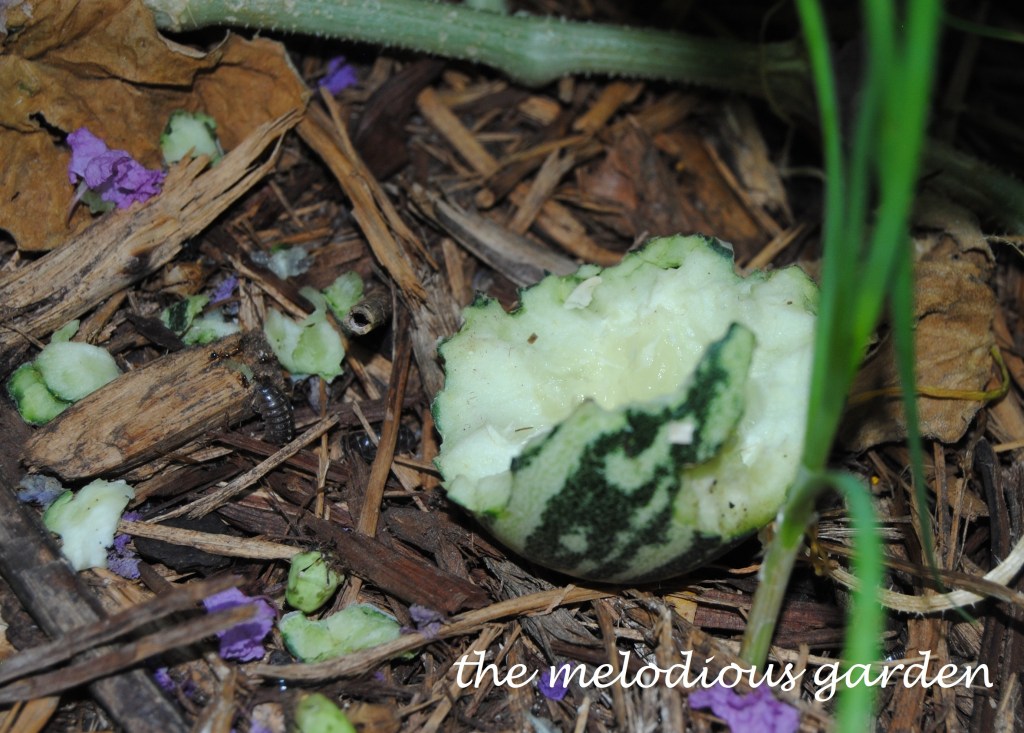
You win some, you lose some. And sometimes something eats your watermelon. (Shown below.) I am not sure whether it was squirrel, rat or rabbit that initially got the watermelon, but the pillbugs are finishing off the job.
Are we up to this challenge, gardening in a Texas summer? More importantly, Are our gardens up to this challenge? Better yet, how can we get our gardens up to the challenge? By feeding the soil, not the plants. A healthy soil is first and foremost the most important part of gardening. Healthy soil should be teeming with life, visible to the naked eye (earthworms) and invisible to the naked eye (bacteria). Watering long and deep and infrequent promotes healthy, extensive root development, over the shallow roots which form when plants are watered often for short periods of time. Mulch, mulch, mulch, but please. No mulch up against the trunks of trees or shrubs. The plant needs space to breath. We mulch the ground, not the plant.
Have we prepared well in advance for this moment? Some people are fair weather gardeners, enjoying the cooler temperatures and ample rainfalls that spring and fall supplies. Still others may flip the seasons – If northern climate gardeners can take off the cold of winter, then southern gardeners can take off the heat of summer! There is nothing wrong with being a two or a three season gardener. Four season gardeners – such as myself – those of us that garden with enthusiasm and recklessness the entire year – prepare well in advance for today’s high temperatures, yet somehow try to balance preparing for the upcoming seasons. We are nursing tomatoes through the summer, in anticipation of a nice fall harvest, while starting our winter collard greens and cabbages. There is a learning curve to figuring out what to start when and how to know when to pull the plug on something to make room for another crop. Thankfully, two of my favorite local garden centers have extensive vegetable planting guides on their websites (links below) and I keep multiple copies printed off – on my gardening clipboard and in my gardening binder and folded up with my seed inventory. Seed packets will say how many days to harvest and knowing how to calculate that off the average first or last freeze dates is a critical skill for all vegetable gardeners.
You win some, you lose some. Astia zucchini (shown below) has been a fabulous producer all season long, with both the plant and the harvest being of manageable size.

Are we focused on the fundamentals? Yes, gardeners are easily seduced by the pretty pictures in a seed catalog or by the racks of seeds on display at the nursery. It is always fun to push the envelope, to try to grow something others in our region aren’t growing. But at the end of the day, what we can harvest – and eat – is what nourishes our soul and our body. Leave room in the garden to play with new varieties, but focus on the fundamentals, the tried and true varieties. Yellow pear tomatoes are one I have grown for more than twenty years because I know they will always produce well, even in higher temperatures. That is my nod toward the fundamentals. The tropical papayas and guavas, which spend their winters nicely tucked away inside our home, are my enthusiasm and recklessness.
Are we able to quickly adjust our strategies? That may mean pulling a plant that just isn’t producing. Or – in my case this past week – pulling a plant that was overly vigorous and overly productive. I mean: Just how many zucchinis is too many?! It was time to break up and move on, for fall gardening is just around the corner. Adjusting our strategies may mean putting up shade cloth to protect tender young plants or moving a container plant to a shadier location. It may also mean getting up and out in to the garden with the sunrise, to get a few hours of gardening in before the sun is too high, or watering in the evening so the water can seep in slowly and not evaporate.
You win some, you lose some. Black Beauty zucchini proved a bit too aggressive in my garden, having swallowed up one pathway and one twenty pound dog, while tossing out meme worthy harvests. I was away from the garden for two days last week and needed the wheelbarrow to move its harvest. Just one Black Beauty produced two batches of zucchini bread and one vegetarian enchilada casserole. It was time to go.

Ah. The Hail Mary. Gardeners are great at this analogy, and fall tomatoes may be the perfect example of the Hail Mary. We plant them in the hottest, driest days of summer and nurse them along for weeks on end, in desperation for just a few more homegrown tomatoes before the frost is on the pumpkin. Growing peas in North Texas may be a close second to the fall tomato. How late is too late to start? When is it too early? For such a durable seed, they are a fickle little thing and one must consult Mother Nature for the inside scoop. If anyone has this figured out already, please let this gardener know. Which brings me nicely back to Joe, for it is the competition that give gardeners pleasure, knowing that we did it. We outsmarted the squash vine borers! We had homegrown tomatoes at Christmas! We survived the summer of 2023! Okay, it may be a bit too early to celebrate that one… But chins up. February is just around the corner.
“We play garden with enthusiasm and recklessness. We aren’t afraid to lose. If we win, great; but win or lose, it is the competition that gives us pleasure.” ~ Joe Paterno
Two vegetable planting guides for North Texas:

 the melodious garden
Very Informative Blog. really loved the style of your writing. Keep sharing such kind of useful information through your blog.
LikeLike