We spend a lot of time looking for happiness when the world right around us is full of wonder. To be alive and walk on the earth is a miracle, and yet most of us are running as if there were some better place to be. ~ Thich Nhat Hanh
Perhaps the best part of gardening is that it forces us to slow down, to stop and smell the roses, to admire the intricate details of a flower, to observe a bee gathering pollen, to watch a butterfly drift and flutter about.
Plains Coreopsis (Coreopsis tinctoria), shown below, has such amazing details. Seeds were purchased from Wildseed Farms and direct sown out in the garden.
Have fun even if it’s not the same kind of fun everyone else is having. ~ C. S. Lewis
My former rose garden was straight out the Steel Magnolias. You know the scene… Where Shelby says her wedding colors are blush and bashful and her mother interjects to say the colors are pink and pink. Yes. My rose garden was pink and pink and the many shades of pink. I knew my garden’s reincarnation would not be. I wanted bold. I wanted big. I wanted bright. I wanted fun. Colorful Fun. I wanted anything but delicate soft pink. Enter: The big and bold daylily.
I’m going to make everything around me beautiful – that will be my life. ~ Elsie de Wolfe
Miss Rumphius by Barbara Cooney was one of our family’s favorite books when our son was just a wee thing. Though he towers over me now, I still pull out the book from time to time and tear up reading its story. Miss Rumphius’ grandfather tells the young child to do something to make the world more beautiful. I think of this story again and again as I wander about my garden. As I sit on my patio and gaze out on the garden while writing this post, I listen to the birds chirping and can say that – in my own humble way – I have done something to make the world more beautiful.
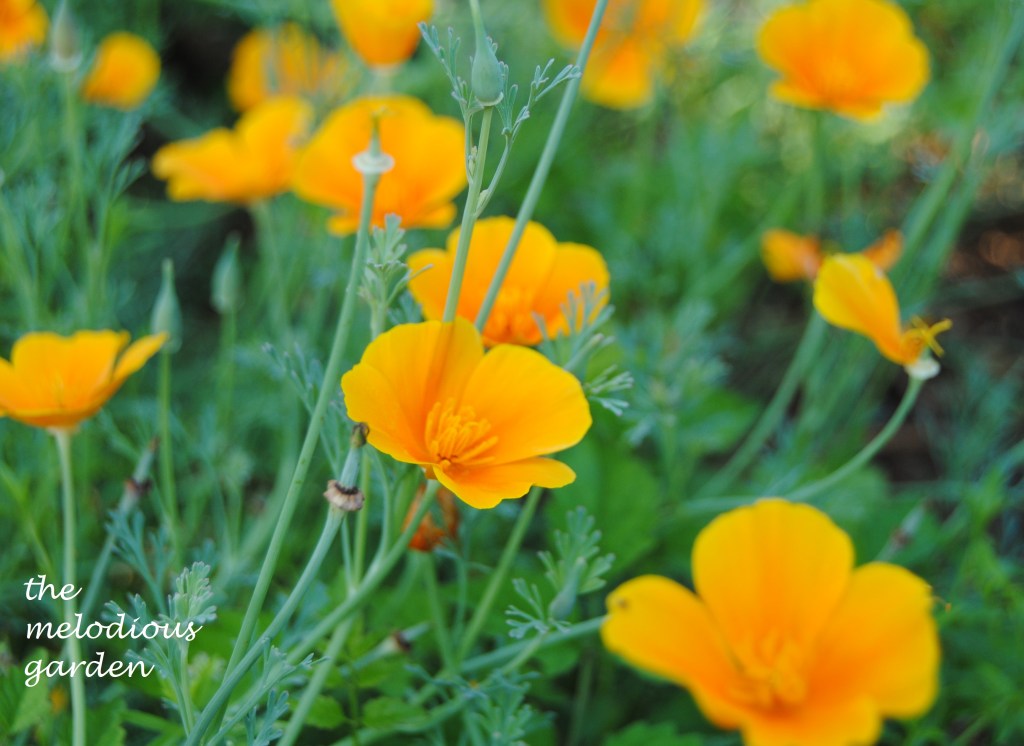
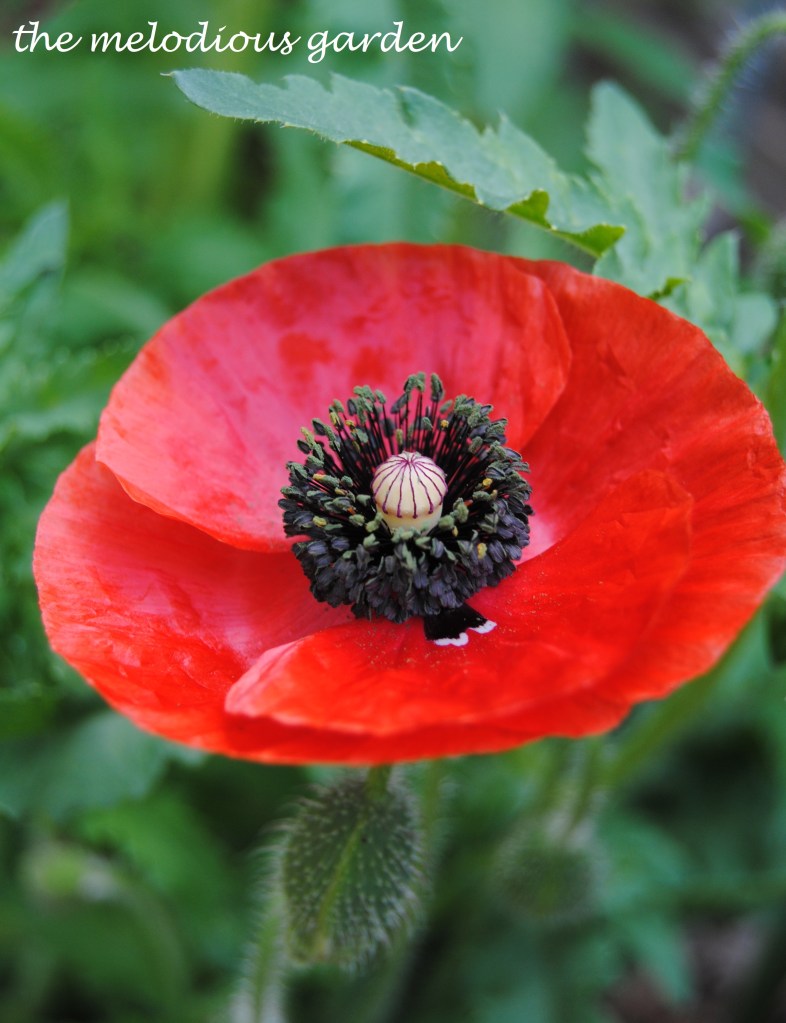
This is my first year growing California poppies (shown below), but hopefully it won’t be my last. They have bloomed steadily for well over a month now, such a cheerful, bright color. Poppy seeds need winter’s cold to break down the hard outer coat, so the seeds were direct sown in the garden in late fall.
meraki (verb) to do something with soul, creativity or love; to leave a piece and essence of yourself in your work.
Gold-wave Coreopsis, shown below, is also from Wildseed Farms. Another winner, one that has won a place in my heart and in my garden.
When you do things from your soul, you feel a river moving in you, a joy. ~ Rumi
In my garden there is a large place for sentiment. My garden of flowers is also my garden of thoughts and dreams. The thoughts grow as freely as the flowers and the dreams are as beautiful. ~ Abram L. Urban
Oh, the thoughts and dreams that go in to the garden, not to mention the sweat and work, always a joy. There are a thousand ways to garden, no one correct right or wrong way. Each gardener charts their own journey, sets out to see their visions come alive. Keep calm, my fellow gardeners, and garden on, growing your thoughts and dreams into botanical poetry.
I had the privilege recently of reading a garden review that a retired landscape designer had written about a private garden we had both visited just hours prior. The garden was jaw-dropping amazing, as was the review. Seriously. The review was just as lovely as the garden.
I love horticulture vocabulary. Physical layout. Site analysis. Colorful perennial entrance bed. Now that being said… As much as I can appreciate those features in another gardener’s garden, it just isn’t going to happen in my own. I garden for my personal pleasure, not to please the neighbors or to grace the cover of any formal garden magazine. You know the quote… Be yourself; everyone else is taken. That very much applies to me and my garden. I am myself. Quirks and all. Garden rules and design principles just bring out my inner rebel.
In all art forms, gardening included, there are standard design principles which can either be followed, challenged or completely and unapologetically tossed out the window. Horticulturalist Felder Rushing wrote the book on the latter two types of gardeners. Maverick Gardeners. What a great name for those of us who think – garden – outside the box. (A book review will be forthcoming. Spoiler alert: It’s a great book!) Indeed, one of Mr. Rushing’s radio program listeners came up with an apt name for just us gardeners: Determined Independent Gardeners. Determined and Independent I am. I am myself; everyone else is taken.
The only Unity – one of several horticulture design principles – found in my garden is that anything goes. My garden style could perhaps best be described as a mix of There Appears To Have Been A Struggle and Diary Of A Madman, with a touch of She Wanted It All. And I am good with that. It is me. And my gardens are a reflection of that.
Sequence, Simplicity and Rhythm – more horticulture design principles – may be goals of other gardeners. Drifts of three? I am more a “drift of one” gardener. Now a well-placed solo shrub or a lone large perennial can be considered an accent plant, but in my garden most every plant could then be considered “an accent.” Buying plants as “one of this and one of that” allows for more diversity and experiments, as well as more whimsy. (…I say…trying to justify my plant buying strategy…) I can often be found walking around the garden, plant in one hand, trowel in the other, searching for just a few bare inches of ground to squeeze yet another plant in. Some might say that I garden much the way a child would toss confetti at a birthday party. Reckless abandon. They wouldn’t be too far wrong.
I rarely photograph large areas of my garden, in part because it comes across as “busy,” too much to take in at once. Mine is a strolling garden, one to meander through, pausing to take in the details, reflecting on the story behind a certain plant or garden accruement. I also seem to always have some project going on, a wheelbarrow left out, junk trees popping up somewhere or garden hoses stretched across the property. (We don’t have a sprinkler system, which I am perfectly fine with. But more on that at a later date.) It also feels much too personal to show the garden as a whole, so revealing. It would be akin to me walking down a fashion runway in a bikini. Which isn’t going to happen anytime soon. (You are welcome.) But this year, I am challenging myself to stop and look at the larger picture and embrace it. Garden hoses, drifts of one and all!
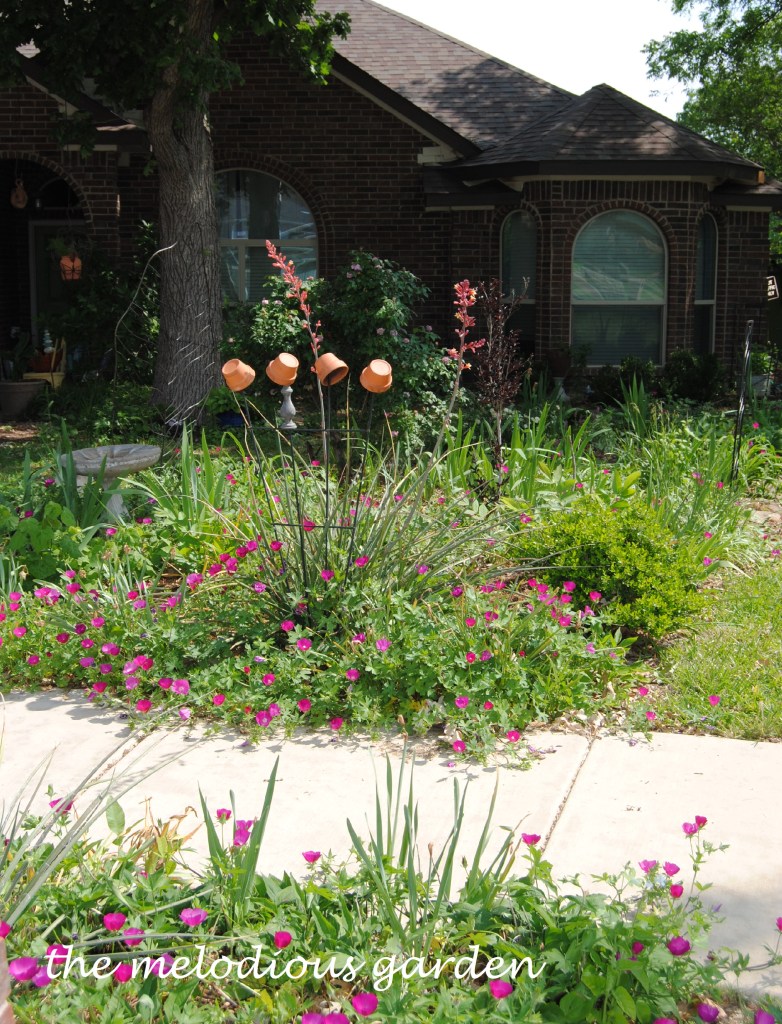
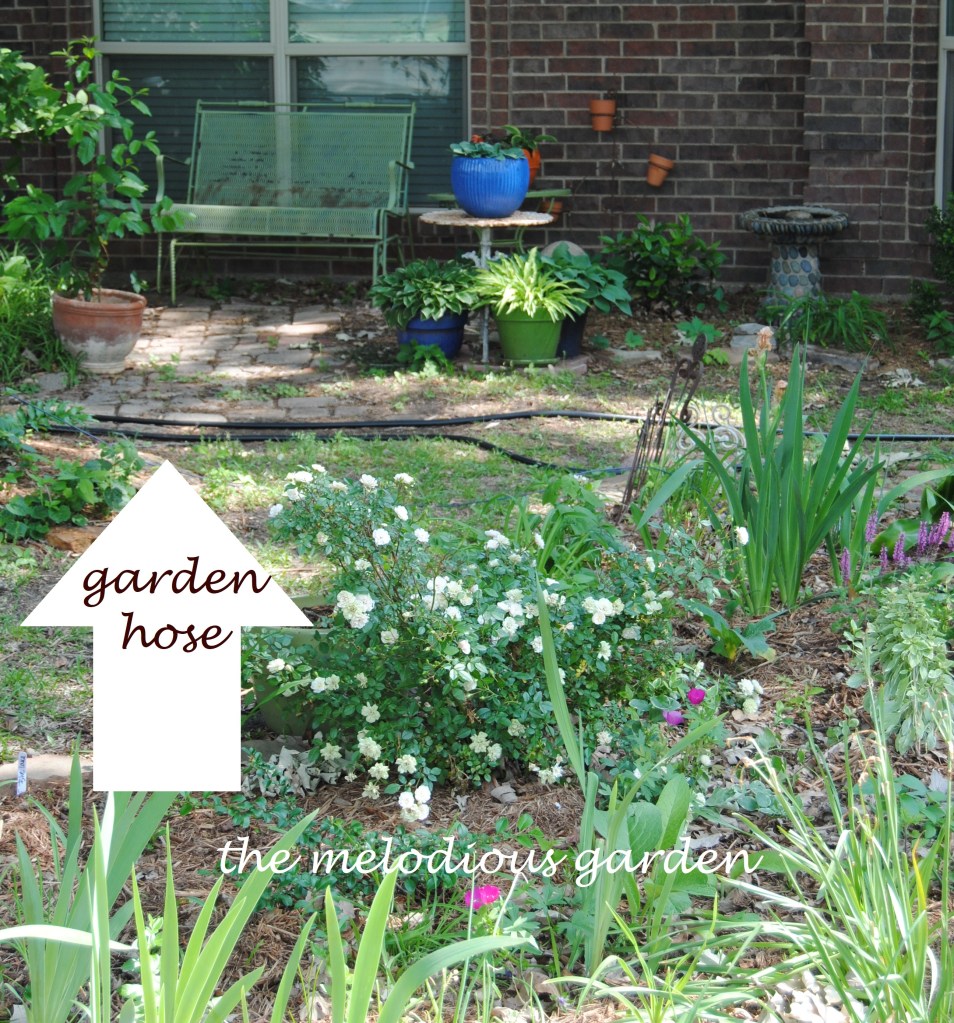
The photograph below shows the front flower beds, much as one would see while out for a neighborhood stroll. The winecups (Callirhoe involucrata) and red yucca (Hesperaloe parviflor) are blooming quite nicely this week. But… If you look closely…
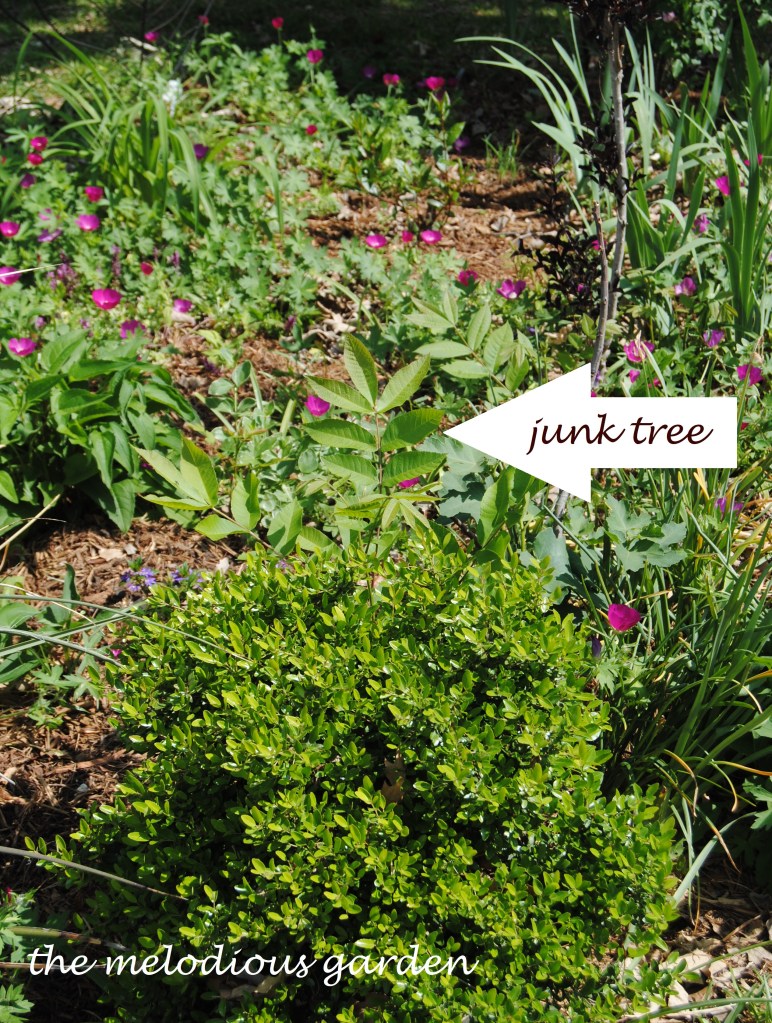
… You will see… A junk tree. (Photograph below.) To me, a junk tree is any tree that I did not plant, one that arrived in my garden via bird, squirrel or wind. The one shown below happens to be a pecan tree, compliments of our neighbor’s tree, planted by a squirrel who was sure they would have time to come back and retrieve the stored nut before it decided to set down roots in my garden. In addition to junk pecan trees, I constantly battle junk bur oak trees, planted by squirrels or gravity, and junk elm trees, which arrive via the wind.
Keeping the garden free of weeds is, as every gardener knows, an endless struggle. Keeping the garden free of junk trees is that times ten. I can walk the garden and dig out or cut down every junk tree, then turn around to find one that has grown knee high in the blink of an eye. At some point, all gardeners know this: The garden will never be free of weeds. Nature simply moves faster than any gardener ever could.
“Ignore the weeds,” I always tell garden visitors. “Oh, and ignore that hose.”
The garden hose is often stretched from faucet to whatever area I am working on that day, then most often lapped back around because there is no sense in only tripping over the hose once if you can trip over it two or three times. I am sure there is an app that removes garden hoses from photographs and, if not, there should be. Until then, my choices are to either coil up the garden hose prior to taking photographs, closely cropping photographs to remove any evidence of said garden hose or to make peace with the hose. I generally opt for the close cropping of photographs. Oddly enough, I wouldn’t think twice about a pair of pruners or a pitchfork being in a garden photograph, for all gardeners know and appreciate what a working garden looks like. But a garden hose left out? Not so much.
I am not sure where garden hoses and junk trees fit in horticulture design principles – perhaps Focalization? – but every gardener knows that… to every good garden weeds grow and garden hoses must be dealt with.
Perhaps the most poetic – and floriferous – of months.
(Yarrow, above)
“May! Queen of blossoms and fulfilling flowers,” penned Lord Edward Thurlow. Not to be outdone, Heinrich Heine wrote, “In the marvelous month of May when all the buds were bursting…” Two centuries and an ocean away, my melodious garden basks in the glory of their poetry, with buds bursting open and fulfilling flowers, capturing the early May sunshine.
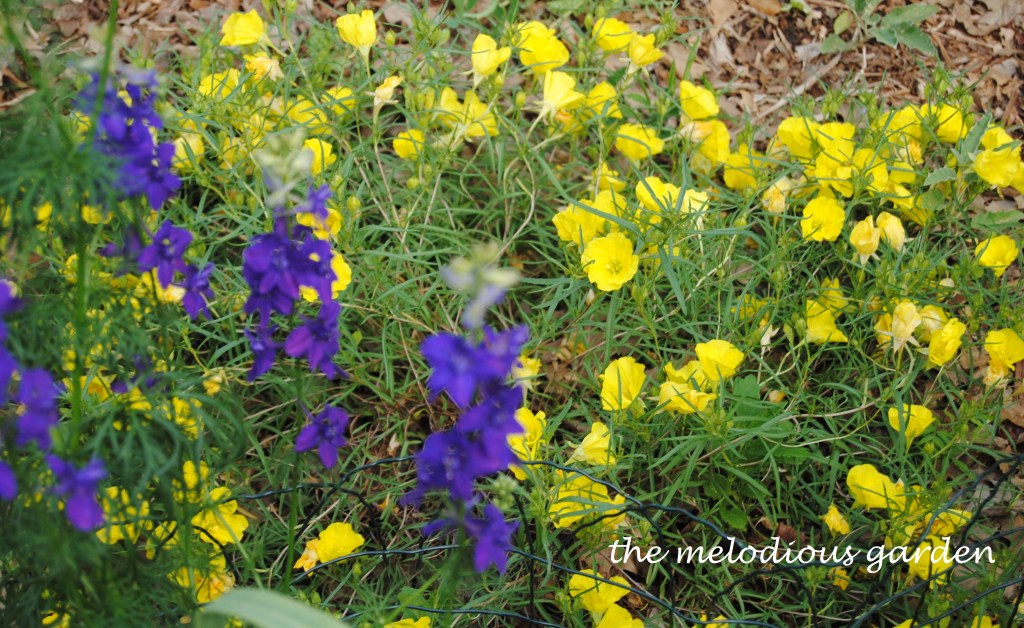
(Larkspur and evening primrose, above)
Yes, May is here once again. And with it, perhaps, a new chapter of my life. My melodious garden was a vision 28 years ago. A suburban garden overflowing with flowers and alive with wildlife. Life has taken a lot of twists and turns since I first put down roots in this Texas soil. But the garden has been my constant. My ever present companion. My journey. My mission. The garden and the gardener have evolved and changed with the years and with the seasons. But now, for the first time, I think I can possibly say, The garden is perfect. Perhaps not perfect for everyone. Perhaps not perfect as in complete, finished, done, for is there ever such a thing? But for the first time in 28 years, it is perfect in my eyes. My garden is complete. I am fulfilled. Edits and adjustments will continue, for don’t they always? Yes, there are still weeds. Yes, there are still plants that need planted and paths that need swept and trees that need pruned. But. My vision. It is perfect. This morning, the first day of May, I walked about the garden, camera in hand, knowing that it had all come together. Perhaps I have been here before. My memory fails me at times. Perhaps my younger self knew this same sense of accomplishment. The garden has been in a state of upheaval for so long now, as losing 100plus antique roses – some the size of a VW bug – has a way upheaving the garden. And the gardener. The past eight years have been filled with challenges. Removing well established roses, diseased from rose rosette virus. Extreme temperatures – record setting lows and record setting highs – and drought. Neurological issues and chronic health challenges. But here we are! We pulled through, didn’t we? “The only constant in life is change,” Heraclitus said. I am quite sure he had the garden in mind at the time, for gardens – and gardeners – are constantly changing. Gone are my beloved roses. Vibrant, healing foods, medicine for this gardener’s body, have taken their place. Ah. Sweet May. “All things seem possible in May,” said Edwin Way Teale. Even healing. For as I walk barefoot about the garden, I know that this garden gives me life. It gives me purpose. It gives me happiness. It gives me food, literal food for my body and figurative food for my soul. No garden is complete without flowers to attract the pollinating insects needed for good food production. Photographs are just a few of the buds bursting forth today, this first day of May.
(Candytuft, above)
“May and June. Soft syllables, gentle names for the two best months in the garden year: cool, misty mornings gently burned away with a warming spring sun, followed by breezy afternoons and chilly nights.” Peter Loewer
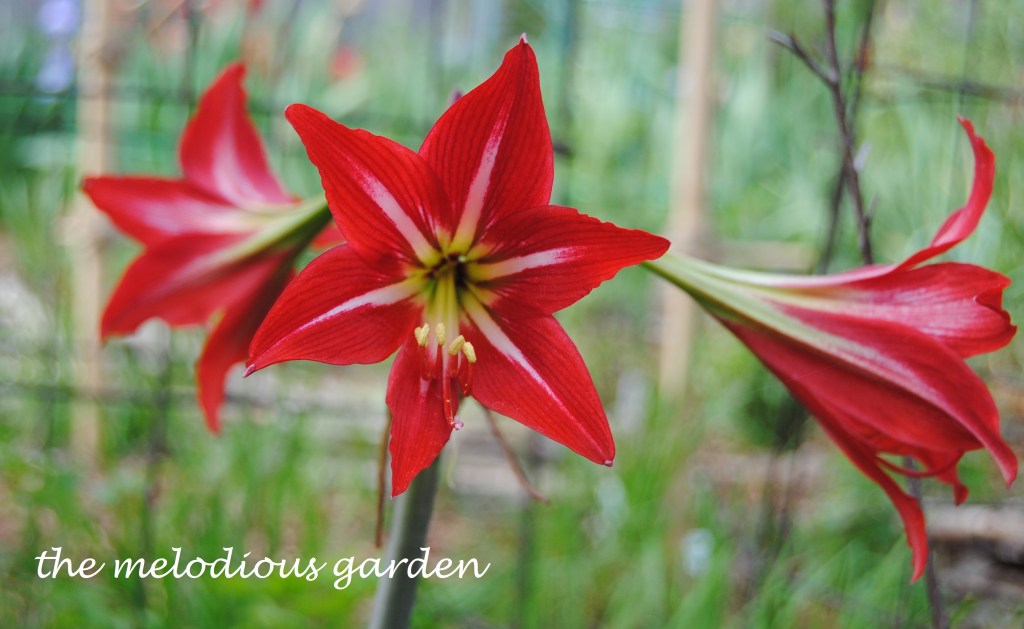
(Hardy amaryllis, above)
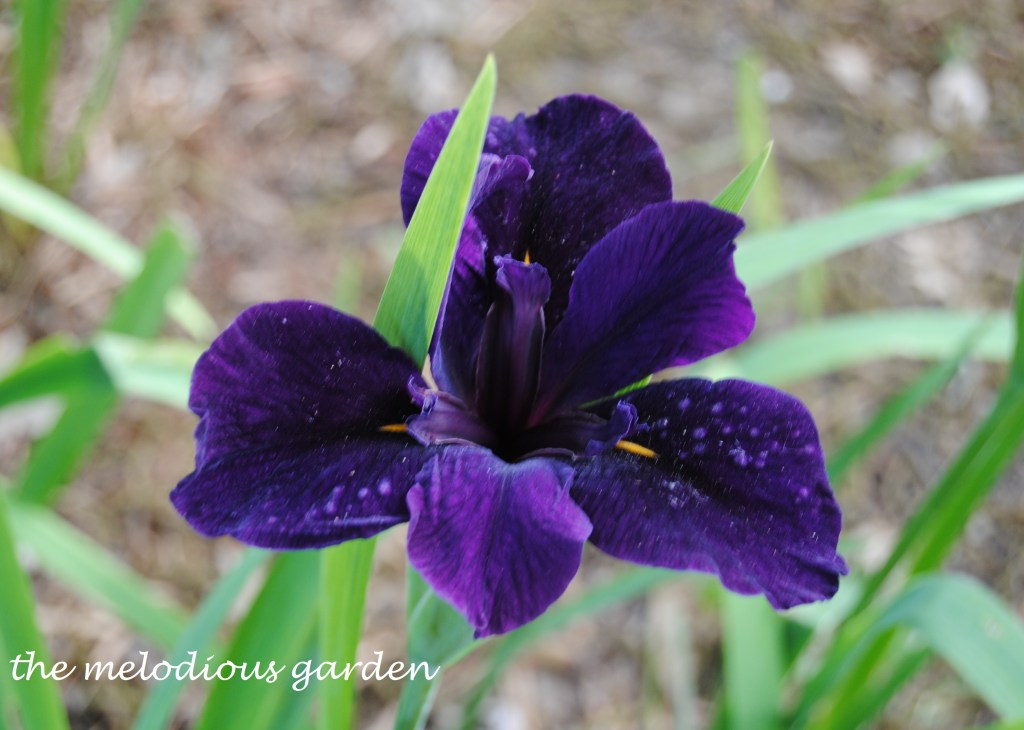
(Louisiana iris, above)
(Poppy, above)
“When April steps aside for May, like diamonds all the rain-drops glisten; Fresh violets open every day: To some new bird each hour we listen.” Lucy Larcom
“Where flowers bloom, so does hope.” Lady Bird Johnson
Texas is well known, and rightly so, for their springtime display of wildflowers. From the highways to the back roads, the state seems to be awash in blue this time of year. But look a bit closer and one is apt to pick out other, lesser known, wildflowers. Pale pink primrose. Bright orange Indian paintbrush. Hot pink winecups. With more than 5,000 different varieties of wildflowers throughout the state, it would be hard for anyone to list their favorites or for any gardener to grow even a fraction of them. Still one wildflower is often overlooked, which is a shame because it certainly deserves a spot in any top ten or top twenty Texas wildflower list.
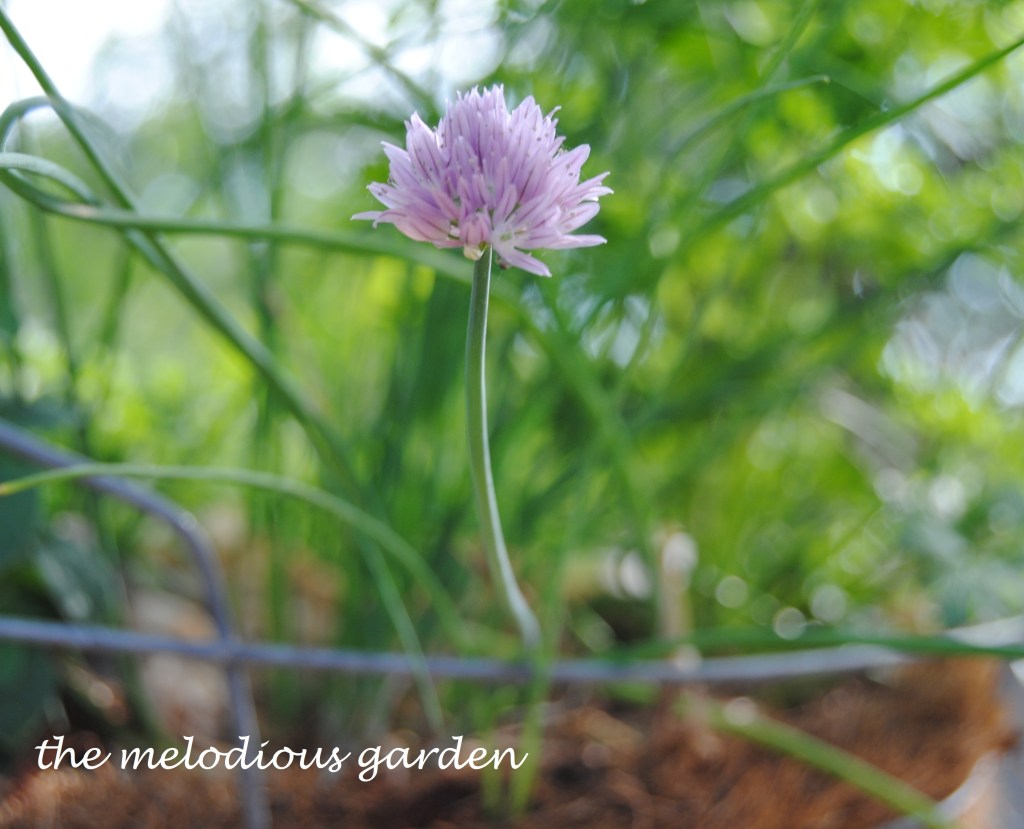
Penstemon tenuis, shown above, sports dainty lavender blossoms that dance in the spring breeze. It is highly adaptable to the cultivated garden, which is not the case with all wildflowers. It is equally at home in a cottage style garden as it is in a meadow. Isn’t it gorgeous with the apricot colored bearded irises in the background? I would love to take credit for that color combination, but I can’t. You see, after Penstemon tenuis is done blooming, I let the seedheads form and dry, then take the seeds and scatter them about. I never know where they might pop up the following year and I love it that way! (Photograph below: Dried seedheads of Penstemon tenuis in late summer, with garlic chive blossom.)
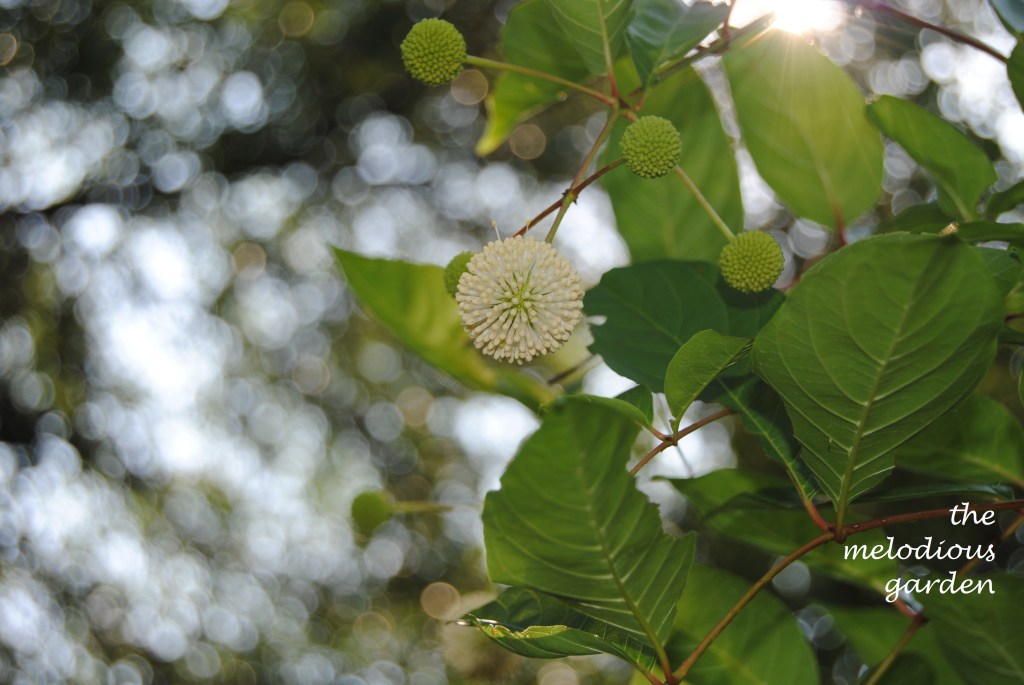
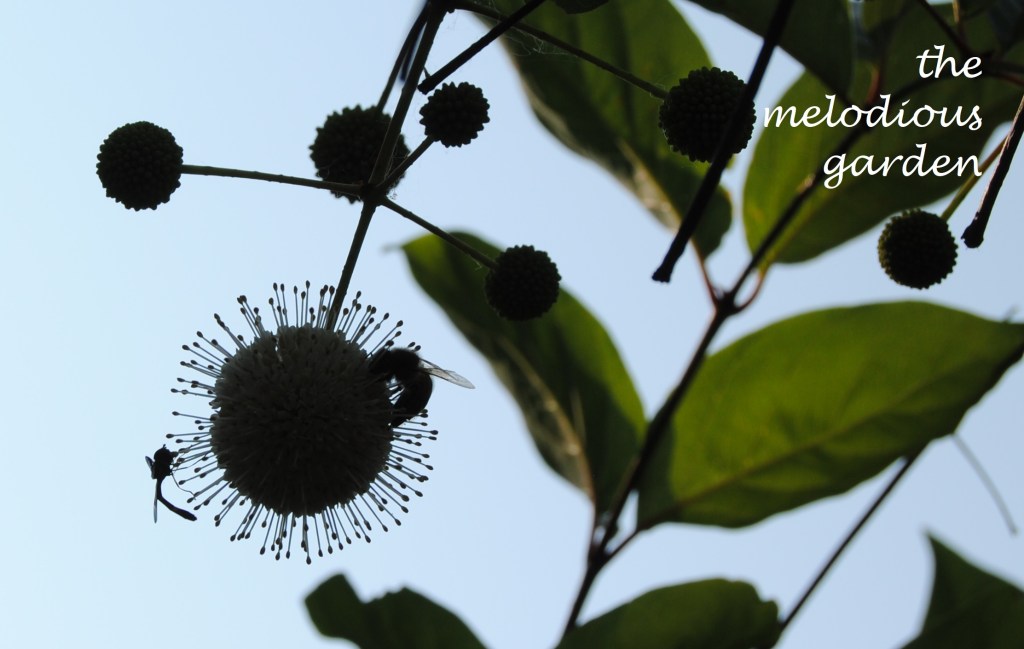
Yes. Sometimes the flower will sprout up in an odd place, such as directly under my native buttonbush, shown below. Thankfully they are great companions and neither one bothers the other. Penstemon tenuis grows best in partial to full sun, so will bloom and flourish just fine in this area of my melodious garden.
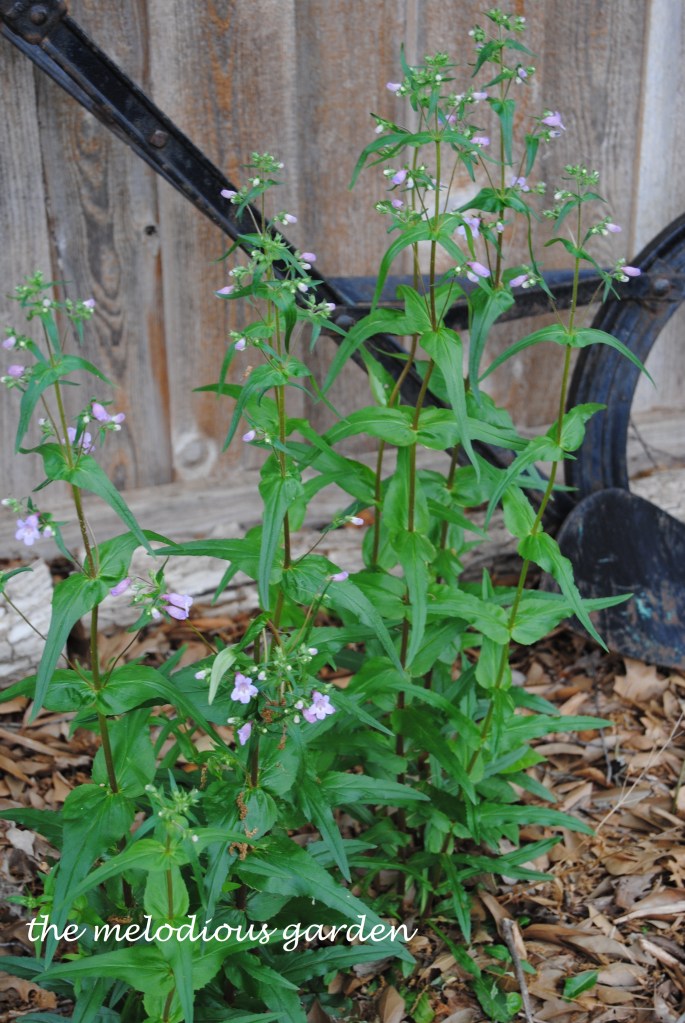
Other times, Penstemon tenuis pops up in just the perfect spot, such as in front of an antique plow, shown below. This gardener loves that whimsical side of Mother Nature.
Penstemon tenuis grows to about 2 1/2 feet tall and is airy enough that it can be grown along pathways or the front of formal garden beds. Typical bloom time is from April to June in North Texas. It is a good nectar source for bees and butterflies. Its native range is the Gulf Coast prairies and marshes from Texas to Mississippi and up to Arkansas. Penstemon tenuis is said to be a great cut flower, though I have not personally use it in arrangements.
While not widely available in the nursery trade, it can be found at garden centers that specialize in native plants and seeds can be acquired from fellow gardeners.
“April! April! is it you? See how fair the flowers are springing! Sun is warm and brooks are clear, Oh, how glad the birds are singing! April! April! is it you?” Poem by Dora Read Goodale
“Spring translates earth’s happiness into colorful flowers.” Terri Guillemets
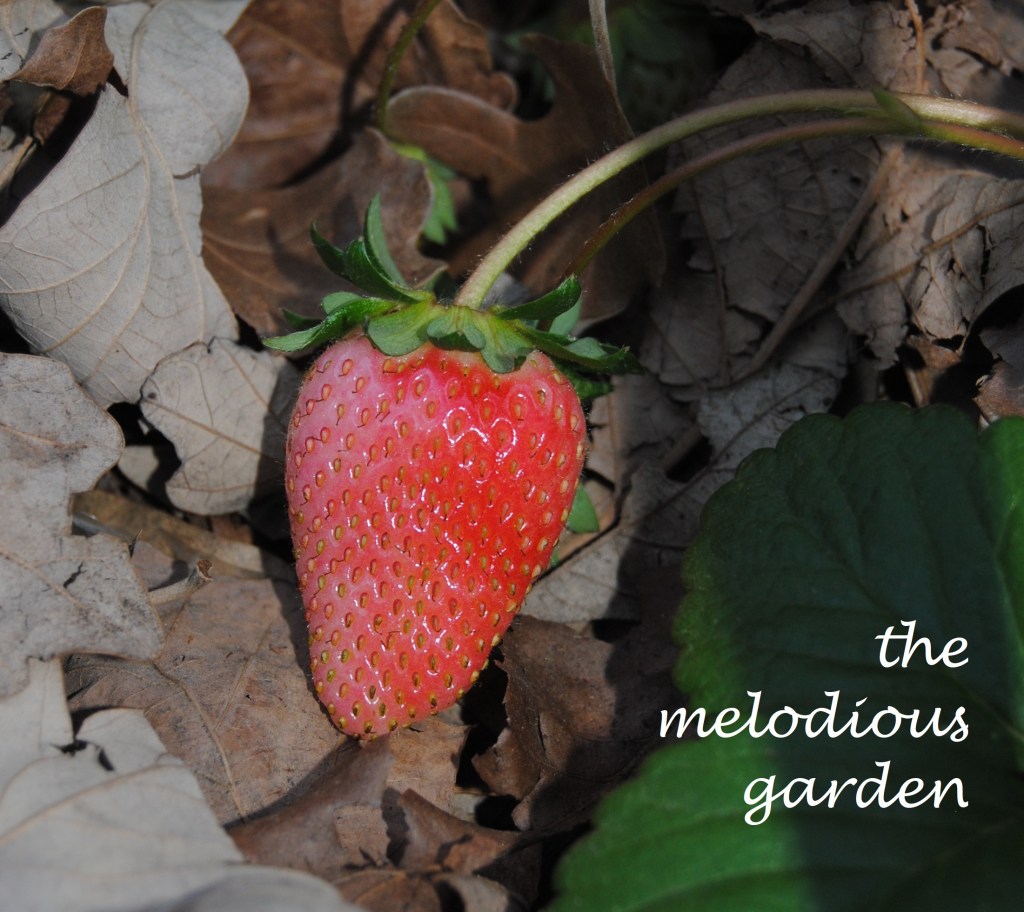
The pale pink roses, shown above, are reminders of my garden past, beautiful blossoms this first day of April. The strawberry, shown below, embodies the hope and possibilities of the season ahead.
“It was such a pleasure to sink one’s hands into the warm earth – to feel at one’s fingertips the possibilities of the new season.” Kate Morton
One question that has been asked dozens of times the past few weeks has been, “Is it safe to plant now?” That translates to: Have we seen our last freeze of the year? Old-timers will tell you that we aren’t out of the woods for a late freeze until Easter. True enough, this gardener remembers an Easter snow many years ago. Mid-March is Dallas-Fort Worth’s average last freeze date. Average meaning: Our last freeze may come in February. Or it may come at Easter. This year the last freeze came early. Or so it appears.
Is it safe to plant now? This gardener will generally answer that question with another question. Is it ever truly safe to plant? One never knows what Mother Nature may throw at us. Late freezes. Hail. Intense heat. Record breaking cold. Prolonged drought. Relentless rain. This week’s weather brought us intense winds, leaving many of the tall bearded irises listing wayward. (Below photograph.) In 28 years of gardening this plot of earth, I have seen the extremes. It is never really safe to plant. To garden is to take chances. One learns quickly to roll with the punches and to always have a backup plan.
This suburban food forest is coming together, nourishing the gardener’s body and soul. To wander about, barefoot, harvesting herbs for a lunchtime salad. The onions and potatoes, planted in January and February, are coming along nicely. Tomatoes and peppers have been planted. Succession plantings of beans has begun. The possibilities truly seem limitless in the springtime garden.
“The glory of gardening: hands in the dirt, head in the sun, heart with nature. To nurture a garden is to feed not just the body, but the soul.” Alfred Austin
Despite the winds, the tall bearded irises, shown below, have been especially delightful this week, nurturing my soul.
“Flowers always make people better, happier and more helpful; they are sunshine, food and medicine for the soul.” Luther Burbank
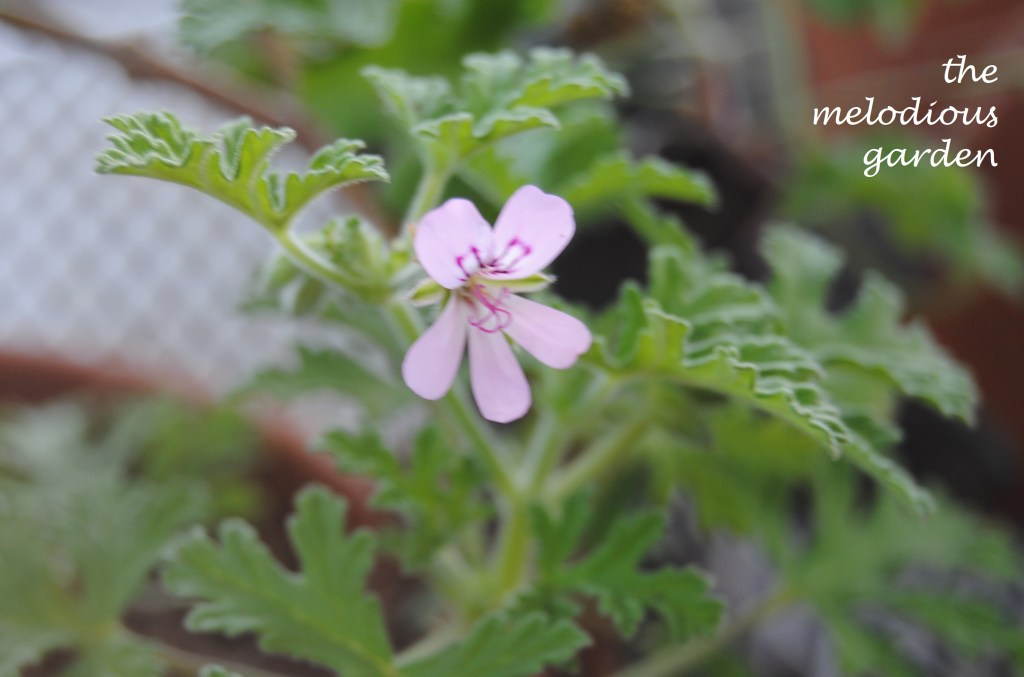
Scented geraniums are best known for their intoxicating scents, though this gardener finds the flowers equally charming. (Shown below.)
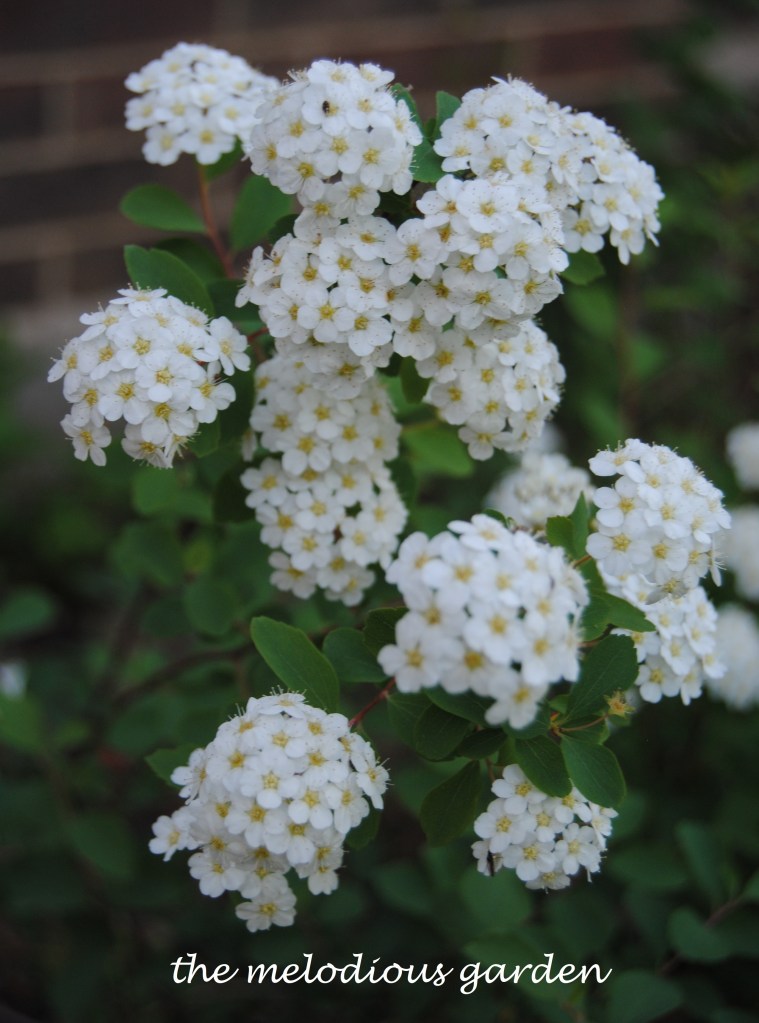
Bridal’s wreath spirea, shown below, is aptly named. Ah, spring! See how fair the flowers are springing!
“If I could be a fairy now, I’d learn a lot of things, what flowers find to talk about and what the birdie sings. I’d fly around the garden with the butterflies for hours, I’d find out if the honey-bee says “thank you” to the flowers.” Source unknown
“Come fairies, take me out of this dull world. For I would ride with you upon the wind and dance upon the mountains like a flame.” W.B. Yeats in The Land of Heart’s Desire
“She was always doing funny things – for a grown-up. Like running through woodland trails or climbing and jumping out of trees. Perhaps, it was because she had just a drop of fairy in her blood, that kept her wild and free.” Source unknown
“Few humans see fairies or hear their music, but many find fairy rings of dark grass, scattered with toadstools, left by their dancing feet.” Judy Allen, Fantasy Encyclopedia
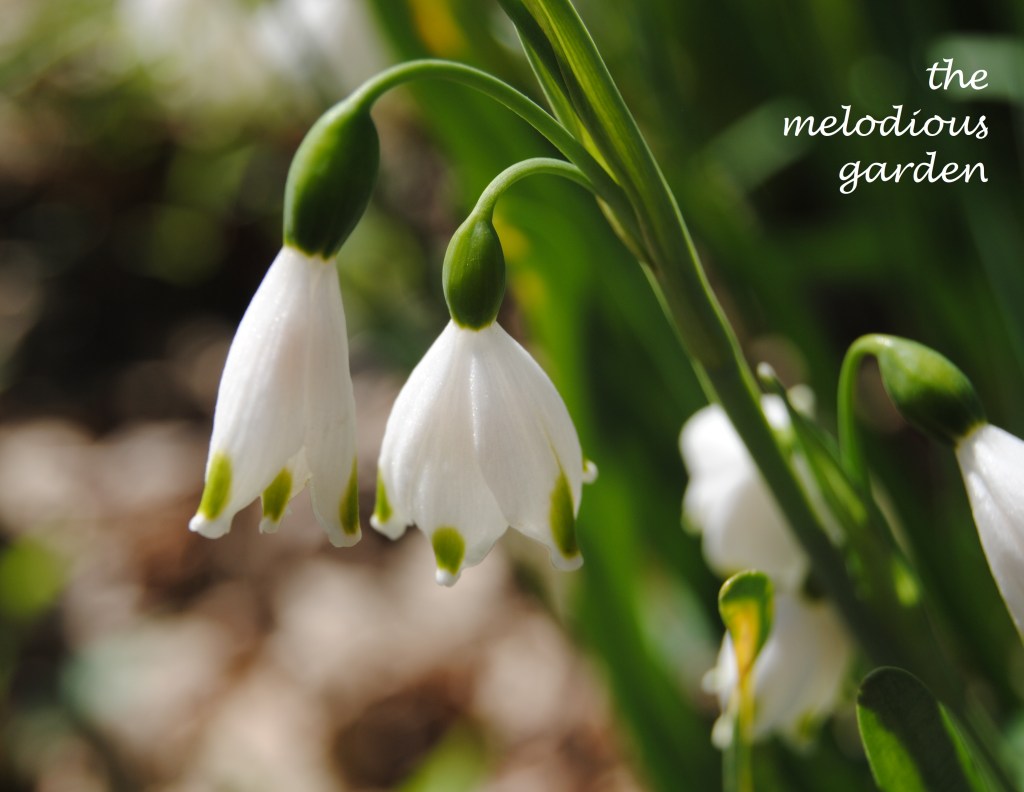
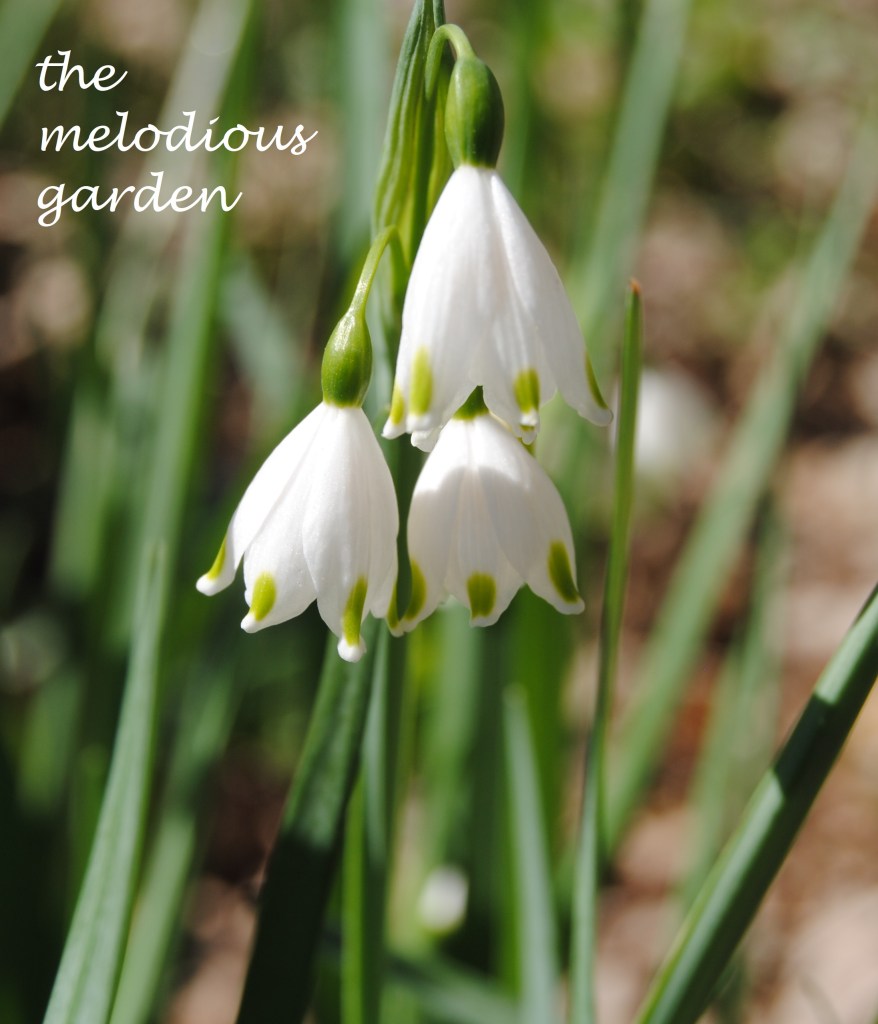
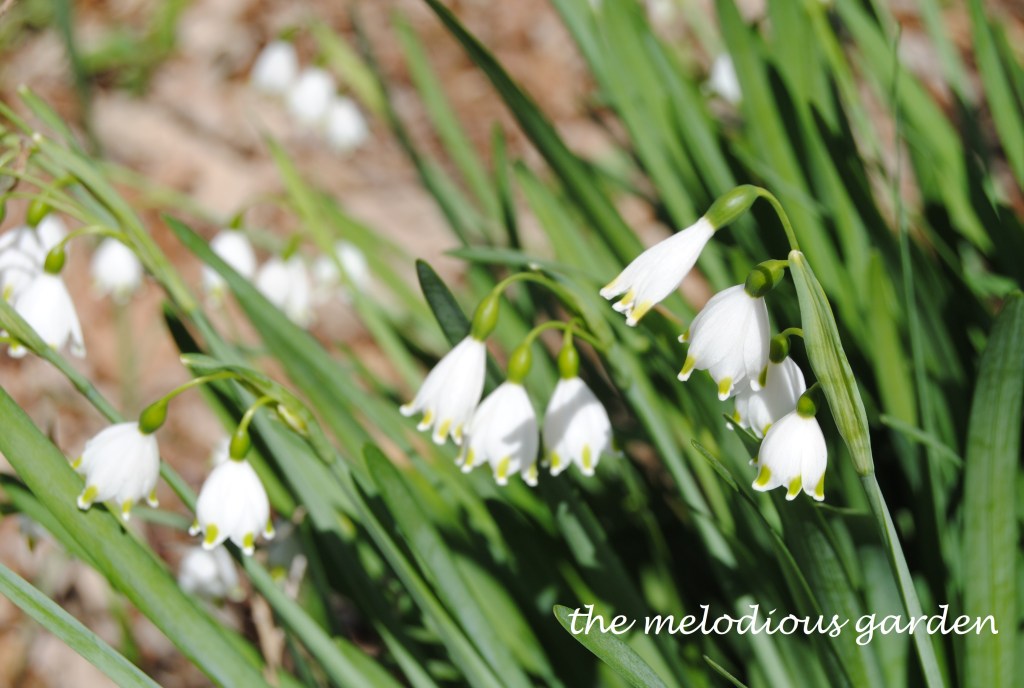
If one needs proof of fairies dancing about the garden, they only need to kneel down and gaze upon the Leucojum blossoms, for the fairies have left little dots of green on every dainty flower.
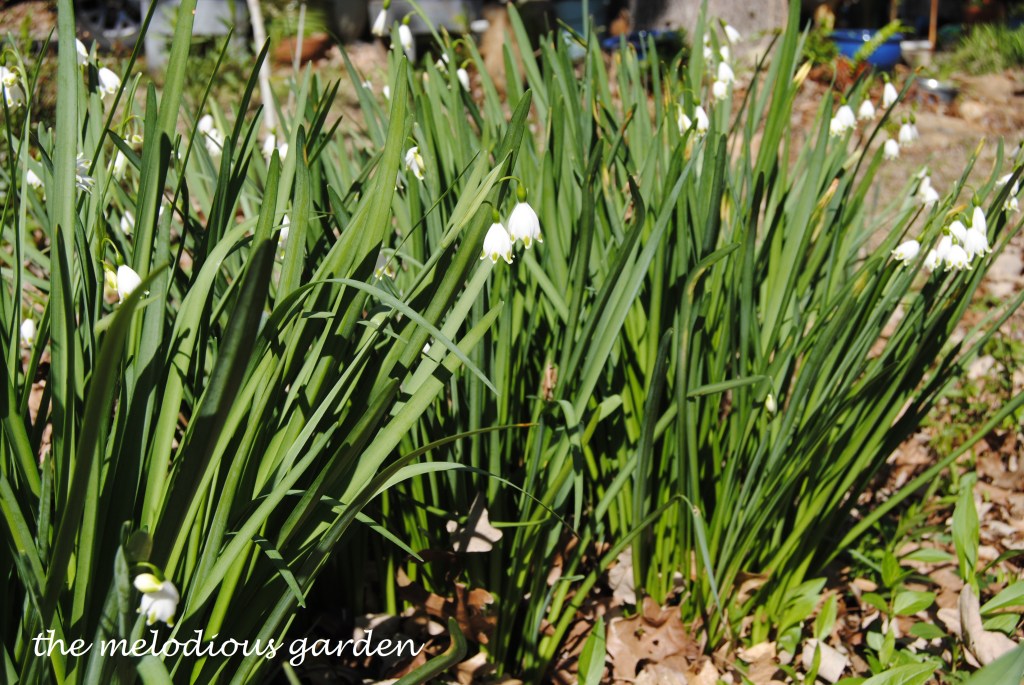
Leucojum, like daffodils and tulips, are planted in the fall for spring time blooms. They naturalize quite nicely in zone 8a, North Texas, returning year after year with ease. Botanically speaking, they are in the amaryllis family with just two species, both commonly referred to as “snowflakes.” Leucojum vernum is the spring blooming bulb and the variety I have growing in my melodious garden. These bulbs were initially planted 20-plus years ago and have received no additional care, sans trimming off the leaves after they have dried and dividing and thinning out every few years. As you can see in the photograph below, this patch is due for dividing, which I will do as soon as they are done flowering.
Leucojum add a bit of whimsy and charm to the spring garden, as they are proof that fairies are indeed real and dance about the garden.
“And spring arose on the garden fair, like the spirit of love felt everywhere; and each flower and herb on Earth’s dark breast rose from the dreams of it’s wintery rest.” Percy Bysshe Shelley, The Sensitive Plant
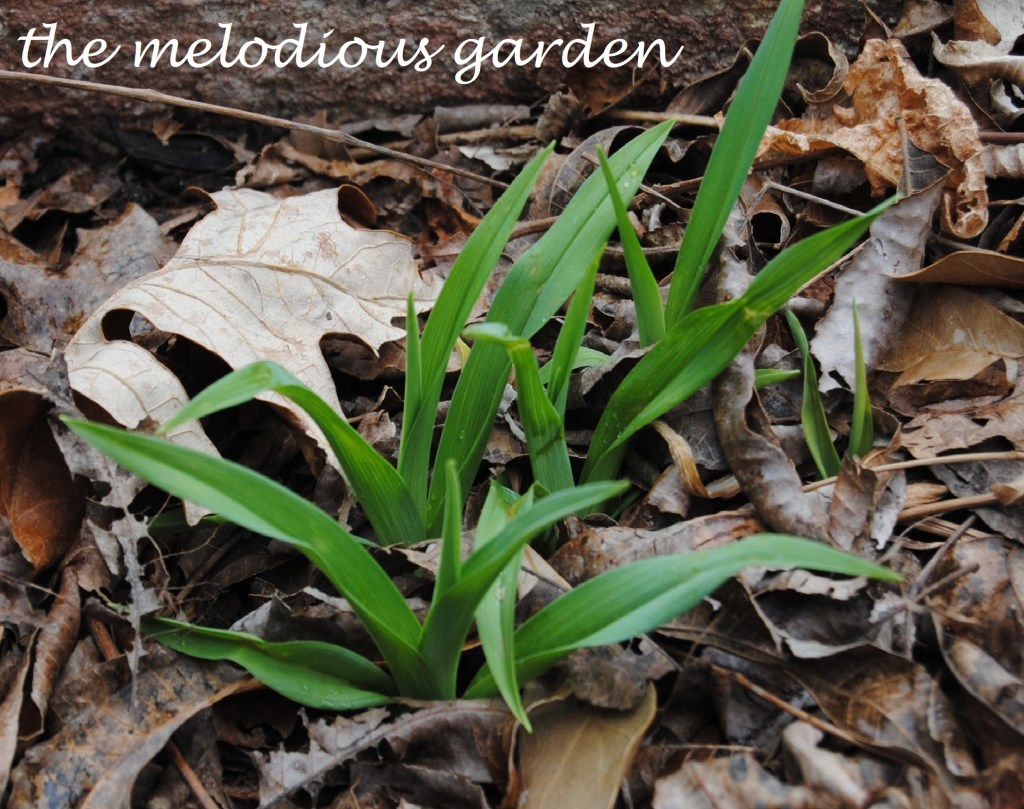
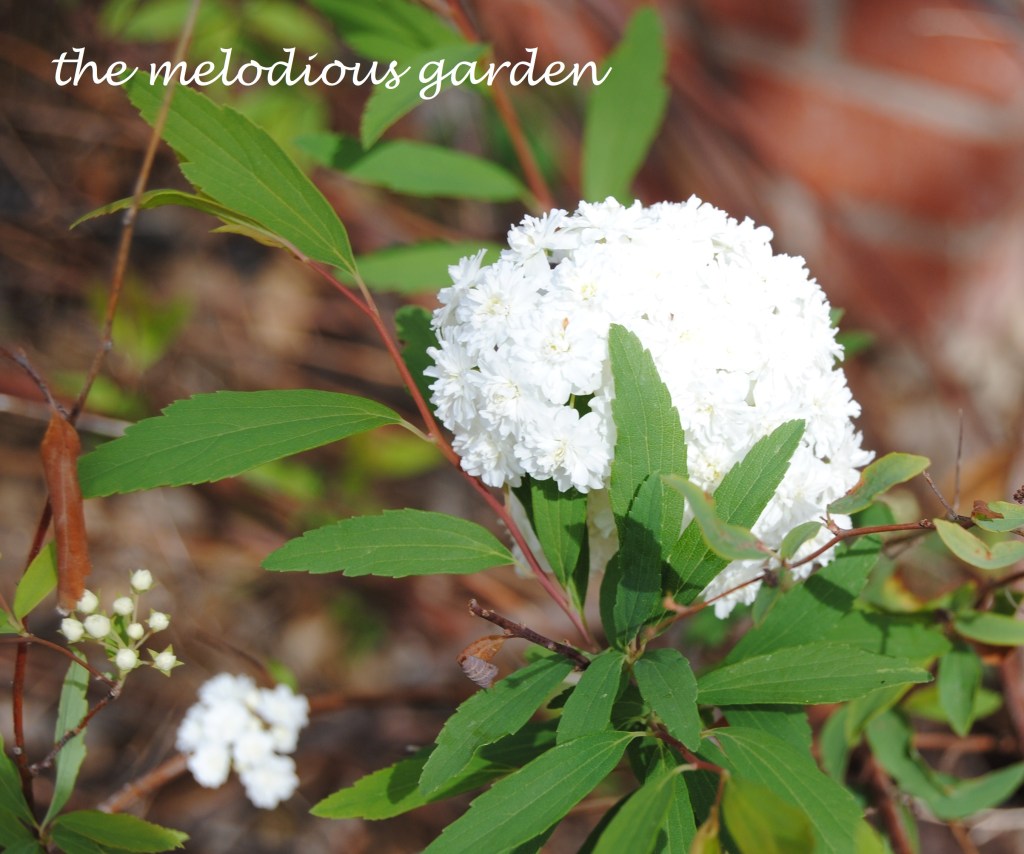
Spring has been popping up for several weeks now in my melodious garden. Daylilies that go dormant in winter have been emerging through the leaves I let blanket the garden. (Shown above.) Spring blooming shrubs are having their moment of glory, as are the bulbs – daffodils and leucojum. (Bridal’s wreath spirea, shown below.)
“She turned to the sunlight and shook her yellow head, and whispered to her neighbor: Winter is dead.” A.A. Milne, When We Were Very Young
Winter is dead. Or so we can hope. The Dallas-Fort Worth area saw overnight low temperatures down to freezing over the weekend but the ten day forecast shows that winter weather may be gone now and spring weather here to stay. Happy Vernal Equinox, indeed. The sun is shining bright this morning and the garden and the gardener are basking in its rays. The gardener is, as usual on days like this, full of garden dreams.
The garden last year was plotted and planned out on the pages of an old school notebook. Late in the season, a downloadable, printable garden journal was purchased through Etsy, fully customizable, where I could add or subtract sections as needed. One section that was subtracted – The Garden Budget. Who has time for things like gardening within the constraints of a budget? Alas. Sometimes a garden budget may be necessary as one large purchase that kept getting tossed aside in favor of more plants was the acquisition of a new wheelbarrow.
Having not shopped for a wheelbarrow in 28 years, I was rather shocked that the entry level price for a decent one is around $150, which equals roughly three to four fruit trees or 37.5 four inch herb plants. Give or take a few. This gardener, you see, is always on team More Plants instead of New Wheelbarrow.
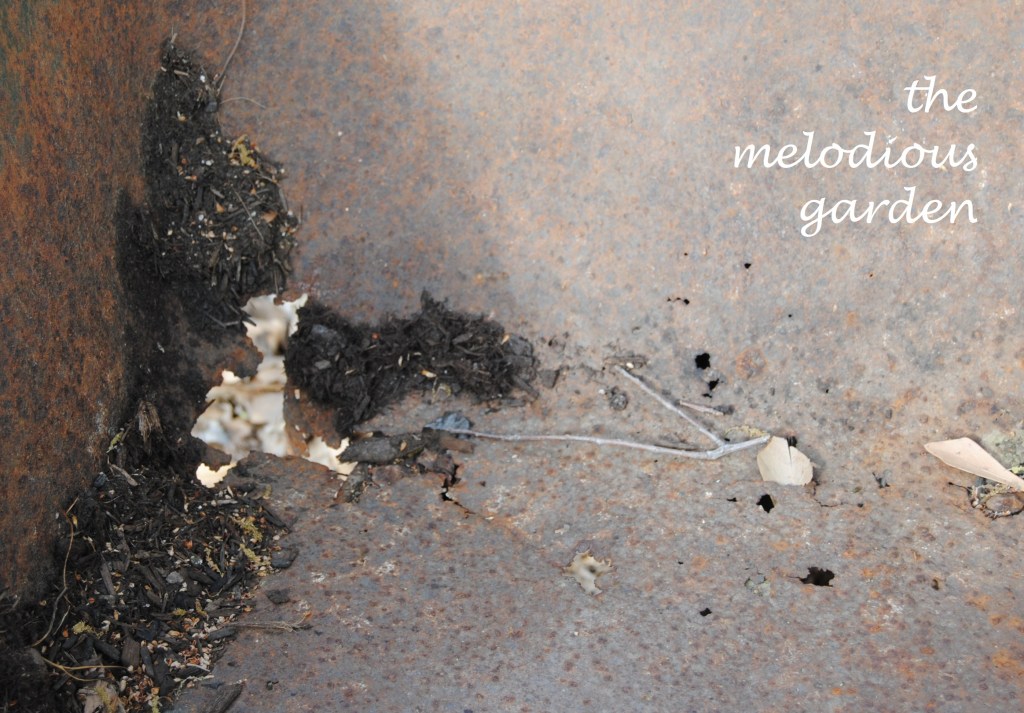
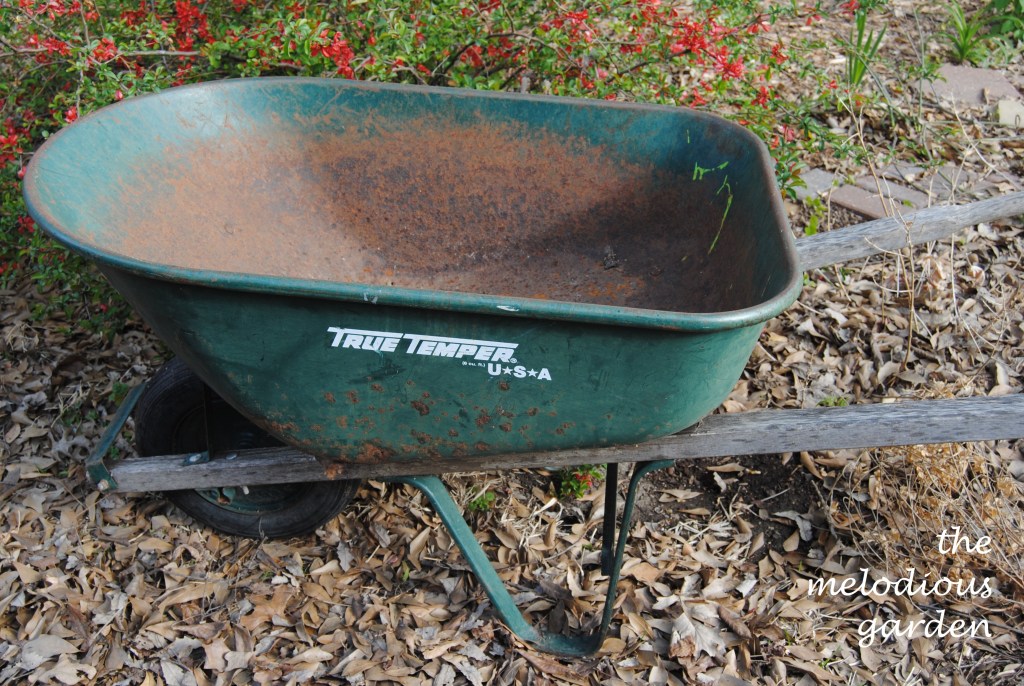
A good wheelbarrow is often one of the first major purchases a gardener will make, as it is handy for moving soil, mulch, rocks, plants and dreams. I don’t remember when or where I bought my first wheelbarrow – or how much it cost! – but I know it has been by my side in the garden for 28 years now. It has hauled a great many cubic yards of compost and mulch. It has hauled tons of rocks and bricks. It has hauled countless plants and garden tools and bags of fertilizer. But years of digging in with a shovel to scoop out its load and years of rocks and bricks jostling about have worn away at its metal. A few small holes here and there over the years gradually grew until – by last fall – the bottom was rusted through in large spots and talk of purchasing a new wheelbarrow ensued. (Just one of the large holes in the old wheelbarrow, shown in photograph above.)
“Talk of purchasing a new wheelbarrow…” generally went like this…
The non-gardener: What do you want for our anniversary? The gardener: A new wheelbarrow.
Which was followed a few weeks later by… The non-gardener: What do you want for Christmas? The gardener: A new wheelbarrow.
Which was immediately followed by… The non-gardener: What do you want for your birthday? The gardener: A new wheelbarrow.
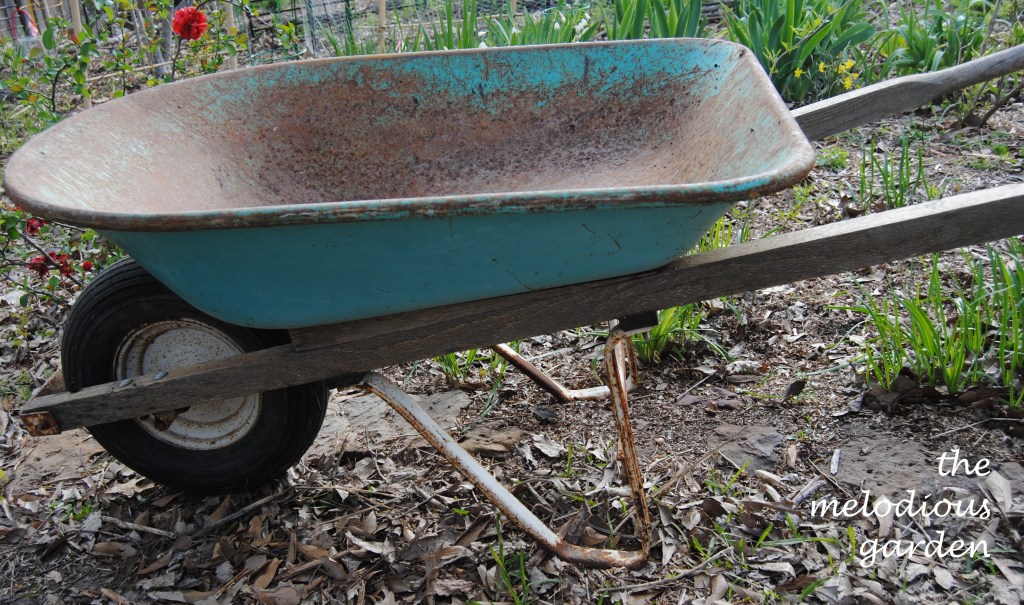
Last month, the talks turned serious. Real serious. The gardener, to the non-gardener: Hey, I bought myself a new wheelbarrow today. Well. It is new to me. Technically, it is probably older than I am. But it doesn’t have any holes in it. Oh. And it is teal.
You see, sometimes the older things are the best things. Wheelbarrows being no exception. Especially when they happen to be teal.
“I love the first tingling of spring when sunlight lingers just a little bit longer and you can almost feel the whole world soften as birds chirp nearby, puddles take slowly to the sky and you gently wake up to what’s growing inside.” M.L. Cole
And so it is. The first tingling days of spring, when the sunlight lingers just a little bit longer, that my trusty old wheelbarrow will be carted off to the great wheelbarrow heaven in the sky. It lived a great, though laborious, life here at the melodious garden. I am forever in its gratitude for the burdens it carried to make my garden chores just a little bit lighter.
Oh. And did I mention the new-to-me wheelbarrow is teal?
I may well someday lead up a Gardeners Anonymous group with, “Hi. My name is Suzie Linn and I own a teal wheelbarrow.” Oh. And she only cost me 5.5 four inch herb plants. Give or take a few. Perhaps most importantly, I didn’t have to figure out a budget to buy myself a new wheelbarrow.
“All through the long winter, I dream of my garden. On the first day of spring, I dig my fingers deep into the soft earth. I can feel its energy, and my spirits soar.” Helen Hayes
I am again at a crossroads in my life. I feel the energy of another spring, though don’t yet know which path to take from here. I long to spend my days puttering about my garden, blocking out the news of the world and the demands to make money. I long to dig my fingers deep into the soft earth and know that this is santosha, my contentment, right here in the garden. I am not yet sure where to go from here, but in the meantime I have bulbs to plant and seeds to sow, new garden gloves to wear out and dreams to dream and miles to go before I sleep.
We are often advised to live in the present moment, which is all well and good, as we only live this moment once and we need to enjoy it for all its worth, but gardeners know we also have to live – and think and plan – a season or two ahead of this moment. That is the way of the garden. Appreciating the beauty of today, but also thinking ahead to our future gardens. Daffodils are the perfect example of this.
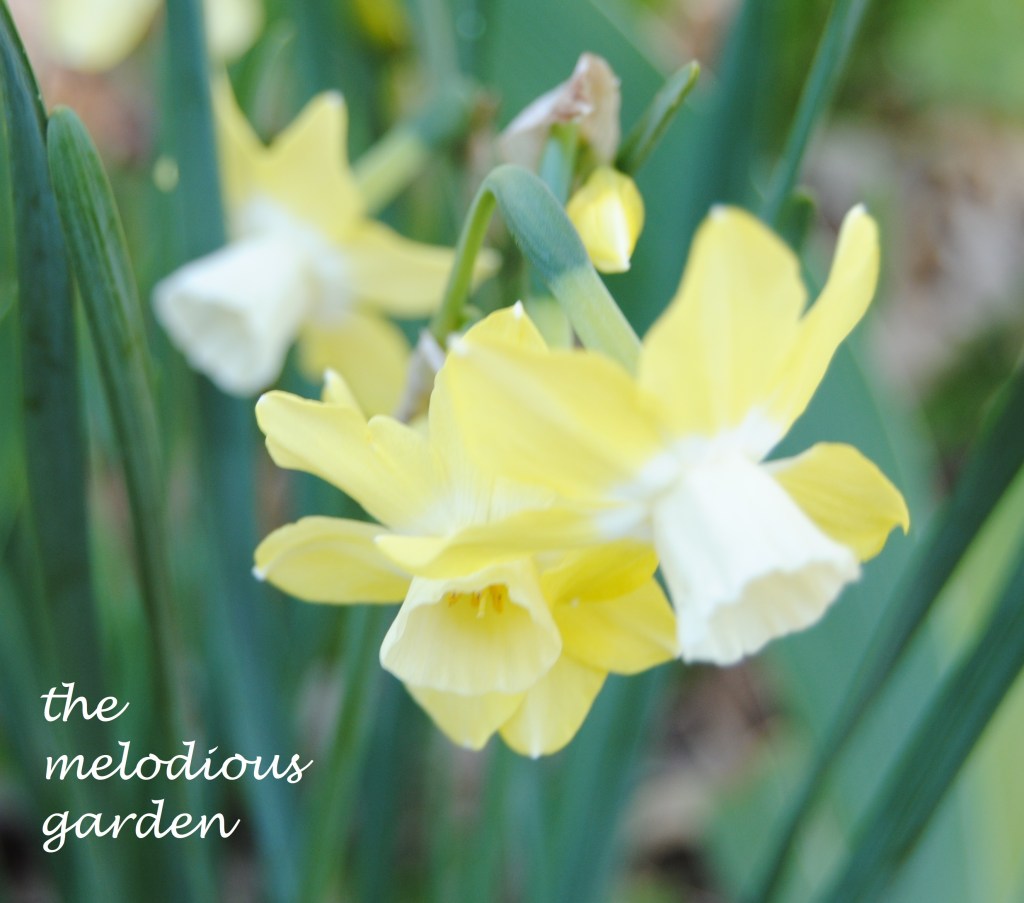
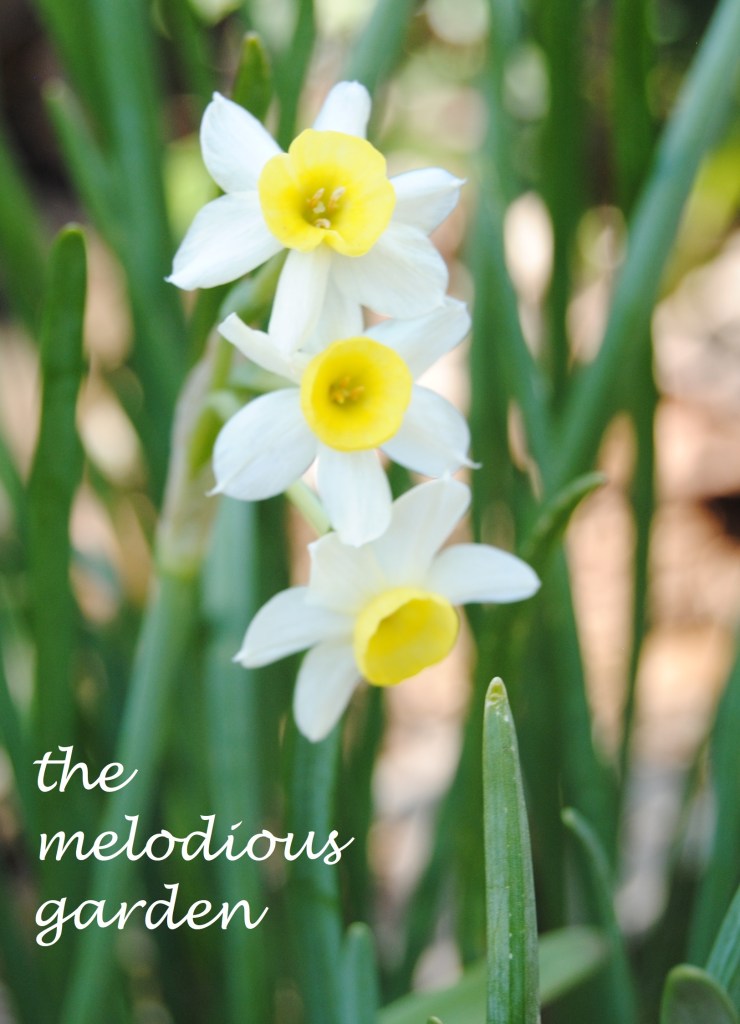
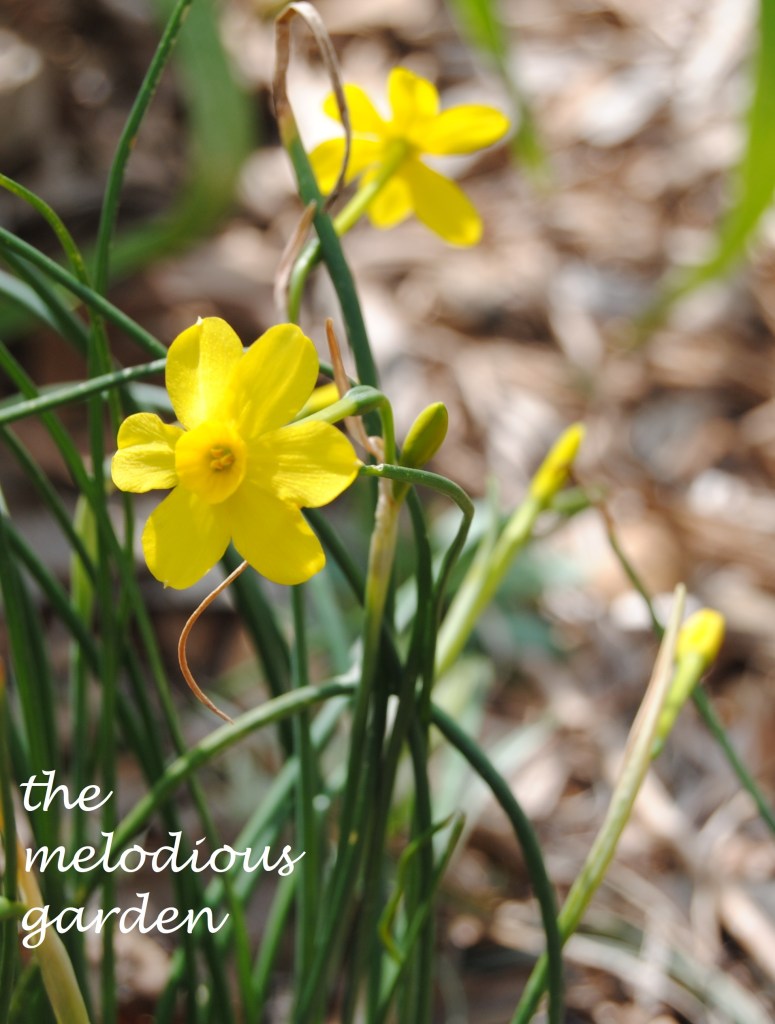
The daffodils shown above are blooming in my melodious garden today, a sunny though chilly mid-March day. We hopefully had our last freeze of the season overnight here in zone 8a, North Texas. Now is the time to take stock of our own gardens and jot down notes. If we already have daffodils, which clumps need divided? What areas of the garden would benefit from a cluster of daffodils, fluttering and dancing in the breeze? We can stroll our neighborhoods to see what other gardeners have blooming now. Or visit a botanical garden or arboretum. Always be sure to take photographs of daffodils you like and would love to have in your own garden next year.
There are several different types of daffodils, so it is best to research and see which ones you are drawn to. (This is where visiting a botanical garden pays off! You can see first hand what different varieties look like and how they perform in your area.) Daffodil colors range from white to yellow to some with peach and orange-ish accents. Colors are always a personal preference. As you can probably tell from the photographs from my own garden, I am drawn to the white and yellow varieties.
After the daffodil flowers have faded, the greens will die down, later to be trimmed off and forgotten about through summer and fall. In late summer or early fall, the gardener can pull out their notes and photographs, as that is the time to plan the spring garden and purchase daffodil bulbs for blooms the following year. In this area, spring blooming bulbs, such as daffodils, can be planted between Thanksgiving and the new year. I generally plan to do this chore on a sunny day when the leaves have fallen from the oak trees, when the heat of summer is just a memory, but the cold of winter hasn’t yet touched my soul. Just such days are perfect for digging in some new bulbs and thinking ahead to spring-time blooms.
Daffodils need to be planted in an area that has well draining soil, as the bulbs will rot if planted where water stands during prolonged wet periods. Daffodils are otherwise not fussy about growing conditions or soil pH. It is important to let the foliage die back naturally, as this stores the bulb’s energy for the following year.
Always stop and smell the flowers and enjoy today to its best! But also keep an eye ahead and plan out those gardens of tomorrow. As William Kent said, “Garden as if you will live forever.”
There are so many beautiful quotes and sayings about planting and gardening… “To plant a garden is to believe in tomorrow,” said Audrey Hepburn. “Blessed are you who sow. Every seed you so plant, will grow into bountiful crops for great harvest,” wrote Lailah Gifty Akita. And – perhaps the best – “If you plant junk, don’t expect to harvest jewels,” attributed to Luke Taylor. While many sowing and harvesting references were likely never meant as a direct analogy to the act of placing a tiny seed into the soil, they still spring to mind as I wander about my melodious garden this week. (Bad pun intended.)
Plant something and watch it grow, indeed is true.
My shift from mostly ornamental gardener to grower of nutrient dense fruits and vegetables wasn’t exactly seamless, for there is a learning curve to pulling tomatoes through 108 degree temperatures and protecting the garden against an Arctic cold front that saw us dipping down to nine degrees. But we survived, the garden and the gardener. Wiser now. And as energized as ever to plant something and watch it grow.
Last year was a time of reconstruction and renewal around my garden. I started in mid winter, one small area at a time. New garden beds were marked off, using the branches and trunks of shrubs and trees that were removed to make room for Garden 2.0.
(Little did I know how much enjoyment I would get at watching the various fungi move in to the garden, photograph below.)
A dump truck load of organic compost and cedar mulch was delivered this time last year, one last workout for my 27 year old wheelbarrow, now too rusted out to haul much of anything. Fruit trees galore were purchased and planted. Seeds were sown. By bits and pieces, a new garden emerged, my suburban food forest. A garden I can wander and harvest and consume healing foods straight off the plant. “Organized chaos” might be an apt name for my garden in 2022. “A goal without a plan is just a wish,” wrote Antoine de Saint-Exupery. Yes, there were plans. Penciled out in an old notebook, drug out to the garden daily, often times soaked in mud and sweat.
Some plans worked out, some didn’t. At a certain point, everything simply came down to just getting the ground covered, as nature – and this gardener – doesn’t like bare soil. Years of organic gardening and soil regeneration were in my favor when a heatwave and extended drought baked North Texas over the summer. When we first moved to this garden, we were cursed with heavy clay dirt, typical of this region. But slowly, over the years, the dirt gave way to a loamy soil that now teems with beneficial life. Last summer I learned to appreciate that okra loves 100+ degree days, as do the bees that visit its blooms. I also realized that I love raw okra, straight off the plant. As a bonus, okra leaves are edible and make a decent salad at a time when it is too hot to grow lettuce or kale. Summer – not soon enough – gave way to fall and winter greens were planted. But now. Now! “Hope springs eternal,” wrote Alexander Pope. And so it does. Entering year two, I am filled with hope. And dreams and plans and wishes. (Too bad my bank account is not filled with money!) Hopes and dreams, after all, are what keep us gardeners perusing seed catalogs.
“Anyone who thinks gardening begins in the spring and ends in the fall is missing the best part of the whole year; for gardening begins in January with a dream,” wrote Josephine Nuese. Seeds were started indoors shortly after the Christmas tree came down and those January dreams are now outside, getting acclimated to the elements, soon to be planted out in the garden.
Biquinho chile peppers, started from seeds from Botanical Interests. (Photograph above.)
Earlier this week, I walked through the garden, camera in one hand and a notebook and pencil in the other. What to plant where? Which trellises to move to make them more efficient? What to grow more of? (Dragon Tongue beans were a favorite last summer, so double the amount will be planted this year.) What to grow less of? (I’m looking at you, turnips!) More plans were penciled out and seeds were sorted by what would be planted where.
Today was unseasonably warm, 87 degrees in mid March, just shy of a record. The day was spent in the garden, putting some of those plans in place, moving tomato cages, expanding the size of the asparagus patch. Yes, this is a time to dream!
Ornamental quince was one of the first shrubs I planted 28 years ago as a new gardener. Later, I would read in a Texas gardening book that it is best planted to the back of the border, where you notice it when in bloom but can ignore it the rest of the year. I am so glad I didn’t read that until long after I had planted mine front and center, as I might have been tempted to believe them. Or I might have taken that as a challenge and still planted it front and center. Most likely, the latter because I have always been a rebel gardener.
Last year was devoted to garden reconstruction and renewal. Each and every plant was given the critical eye. Does it still deserve space in my new garden vision? Gone are my roses, lost several years ago to rose rosette virus. Gone now are the variegated privet that I planted as a cheap and easy hedge, long before I knew or understood how invasive they can be. Gone is the vitex, also now recognized as an invasive weed. Gone are the two redbuds that framed my back gardens. Oh, how I do miss thee, dear redbuds. Alas. “Short lived” lived up to that description when they both died right at their 25 year mark. But that original quince? It is still lovely. It is still going strong. And, most importantly, it survived my garden reconstruction assessment, as did the four ornamental quince I planted after losing my beloved antique roses. Yes, quince does indeed still warrant space in my garden. In fact, I will soon plant another two quince, even though I am shifting from ornamental gardener to primarily fruit, vegetable and herb gardener.
Some may question why I would grow seven non-fruit bearing shrubs at a time when I am attempting to grow as much of my food as possible on a standard suburban lot. (Read: Space is at a premium.) First, though, a bit of horticulture dissection. There are multiple plants referred to as quince – ornamental quince (Chaenomeles) and Cydonia oblonga, which produces an edible fruit commonly known as quince. For this discussion, I am referring to the first, Chaenomeles. (These may or may not produce bitter, largely inedible, fruit, depending on variety.)
Ornamental quince is a deciduous shrub without any remarkable fall foliage. One day it is your basic green shrub, a few days later its branches are bare. In my zone 8a garden, it will start to set flower buds shortly after losing its leaves. Mine have been blooming now since shortly after Christmas, even through our February ice storm. Yes, the flowers were beat down for a few days, but they quickly perked back up and resumed glowing in the winter sun. If you look closely and critically, there is notable browning from the ice, though it is easily overlooked.
We are now one week in to March, which means that this shrub has been blooming for a full two months. If it were blooming in the middle of summer, one might scoff at the idea of a shrub blooming for only two months. But that is where quince really shines. It blooms in mid to late winter in North Texas, at a time when very little else is blooming. It has virtually no competition for our attention, aside from our winter pansies.
Ornamental quince is Mother Nature’s way of saying, “You got this. If I can shine through some storms, so can you.” It is for this reason that 1.) I am glad I didn’t know I should have relegated quince to the back of the border and 2.) I will soon have seven ornamental quince in my melodious garden.
Quince is as carefree as shrubs come. I have never pruned mine, nor deadheaded them or shaped them up in any way. The branches are rather gangly and arching while bare, though this gives them a soft rounded appearance when fully leafed out. I may or may not hit them with some organic fertilizer as I am applying fertilizer to the lawn or flower beds.
In full disclosure, I planted my original quince so long ago that I have long since lost any record of which quince variety it is. I have not been able to find any reference to one that exactly matches it. This one sports a single row of petals in a deep coral color, does not have thorns and has never set fruit. It has also stayed at at tidy three feet tall and three to four feet wide. (If you happen to know, please drop a comment.)
Double Take Scarlet quince is a newer cultivar and one I planted in my early post-rose days. This is the first year that it has put on a real show in my garden. I have found that if one purchases a smaller, one gallon size shrub, they will take a few years to get settled before blooming well, though that may also be due to my laissez faire approach to fertilizing.
Once spring is in full swing, the quince is finished blooming and fully leafed out. It could easily fade off now, overshadowed by nearby spring and summer blooms. However, that is when quince goes to work, in my opinion. You see, once its branches are fully covered with greenery, it makes a fabulous shelter for insects, lizards and small birds, all an essential part of a vibrant ecosystem. Too many times, we overlook the importance of natural shelter, protection from both the elements and from species further up the food chain. To smaller species, the quince’s tangle of arching branches offers just the perfect habitat for them to weather out a storm or seek protection from a hawk flying overhead.
Wildlife need shelter, food and water to survive, and gardeners need wildlife. Wildlife brings life and vibrancy in to the garden. And wildlife helps with pest management and control, for the ladybettles come in to feed on the aphids, which draws in the lizards and, suddenly, before your eyes, you have an entire ecosystem seeking to balance itself out.
In a forest, there are multiple layers, from the canopy far overhead, to the vines that climb up those trees to the life below ground. The understory or shrub layer of a forest or backyard garden is an important layer for wildlife, as this is their shelter. The lizards or small birds that come in seeking shelter may stay and eat some insects, therefore the shrub layer may also provide a natural food source. Water collecting on the leaves or petals of a bloom may also provide essential water. Quince provides all this – and it blooms in the dead of winter, too!
So Keep Calm and Garden On and Plant Some Shrubs. You won’t regret it. Trust me.