gardening, nature

Does your garden bug you?

Does your garden bug you? It should.

Indulge me a moment on why bugs are good for your garden and, by extension, good for you.

Last summer, our doorbell rang, which set off my rescued mutt Princess Leia. Don’t let her name fool you. She is no princess. Ferocious guard dog, yes. Princess, no. Normally I would ignore the door except my dog smelled a killer on the other side of the door and wasn’t about to back down. Nor was the person on the other side of the door, as knocking soon followed the doorbell. Wrestling Princess Leia into my arms, I opened the door without looking through the peephole to see who might be on the other side. And. Wouldn’t you know it. There was a killer on the other side of the door.

A bug killer.

Nice young man. But a bug killer.

He flashed the identification badge the city requires door to door salespeople to wear, announced what company he was representing, then proceed to tell me I had an incredibly beautiful garden. Now this was after I had renovated the front garden, topped it off with fresh compost and cedar mulch, but before the real heat and drought of summer had set in. It was actually looking quite incredible, if I say so myself. We chatted about the garden for five or ten minutes, while Princess Leia was debating whether she could let her guard down. I mean, Momma is talking gardening with this bug killer, so he must not be too bad, right?

Then the guy drops the conversation down to why he was actually at my door in the first place.

“With a garden like this, you must have a lot of bugs! For only x-amount a month, we can come out and spray your entire foundation, interior and exterior, and you won’t see a single bug!”
I said that I actually wanted to see bugs.

Come again, he asked.

Yes. I want to see bugs.

But bugs are bad! You don’t want bugs!

Oh, but I do want to see bugs. You see, bugs are what pollinate my vegetable garden, bugs are what feed my soul when I see them fluttering from leaf to leaf in search of nectar, bugs are what feed the geckos and lizards and birds that call my garden home. Why would I want to kill them?

His reply? “OMG! You have an entire ecosystem here! That is so amazing!”

Why, yes, that is correct. It is an entire well balanced ecosystem. When you let nature take the reigns, it finds a way to balance things out. You build it and let it be and they will come.

Yes, I do get some bad bugs from time to time. But while I sit back, research options and decide how I want to handle the situation at hand, more times than not something has already moved in and taken care of it. From time to time, we do decide to intervene, though always taking the least harmful options first. Every few years, for example, I apply beneficial nematodes to the gardens, which are fantastic at keeping the dreaded fire ants at bay.

The young man and I ended up chatting about nature and the cycle of life for another ten minutes. I thanked him for his time and he walked off. To the neighbor’s house. To try and sell them on killing all the bugs that were, well, bugging them.

Sometimes it feels like an uphill battle, educating and encouraging others in living a non-pesticide lifestyle.

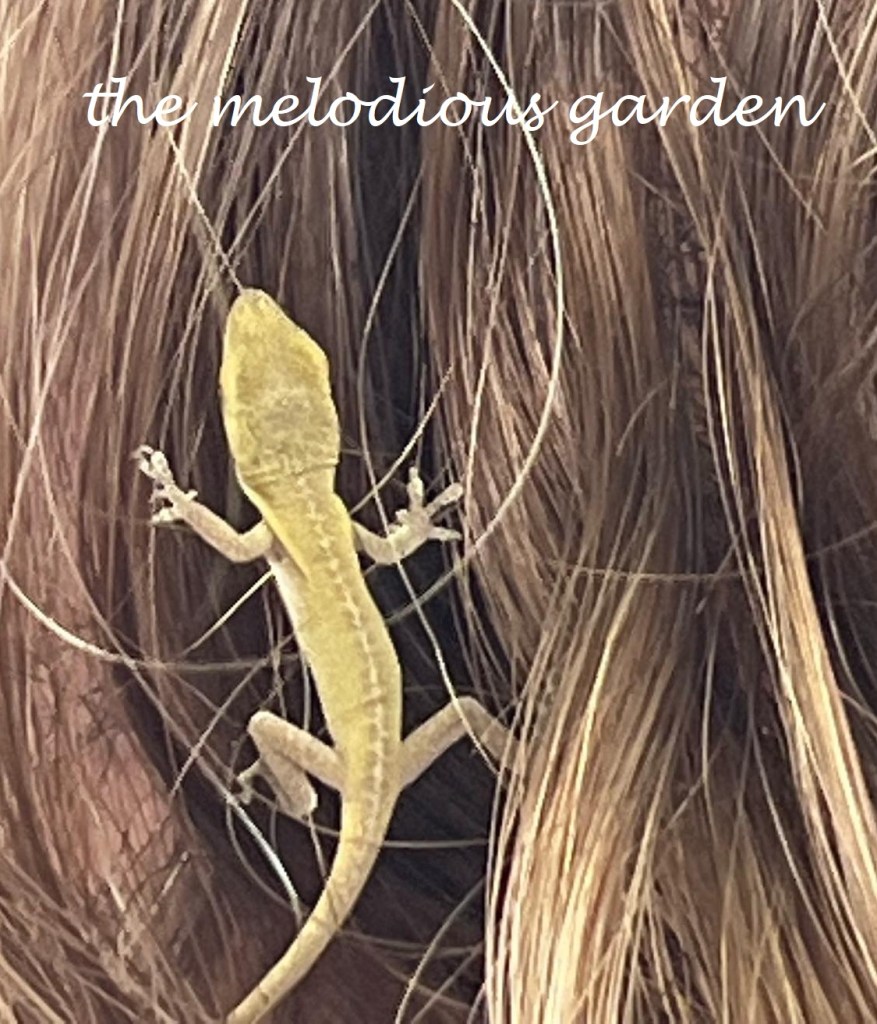
Not thirty minutes later, my husband, son and I were leaving the house for the afternoon. I kid you not, an anole was our vehicle’s windshield, stalking a bug. As we were laughing about Mother Nature’s wicked sense of humor and impeccable timing, and asking “Now where is that bug killer when we need him?” the anole jumped on to our son’s shoulder!

(And. No. I didn’t ask the anole to pose nicely. Happy chance photograph.)

Now my son hasn’t cut his hair since Covid lockdown, which coincided with his first year away at college. He looks a bit like a mashup of John Lennon and Jesus. Seriously. Even people that don’t know him say that when I proudly show off recent photographs of him. So the anole decides he needs to take shelter because six human hands are trying to catch him, which resulted in lots of twisting and turning (us humans) and flipping (the anole) and hiding (still, the anole).

I am pretty sure the bug salesman was across the street this whole time, thinking, Yeah, they do, too, have some bug problems.

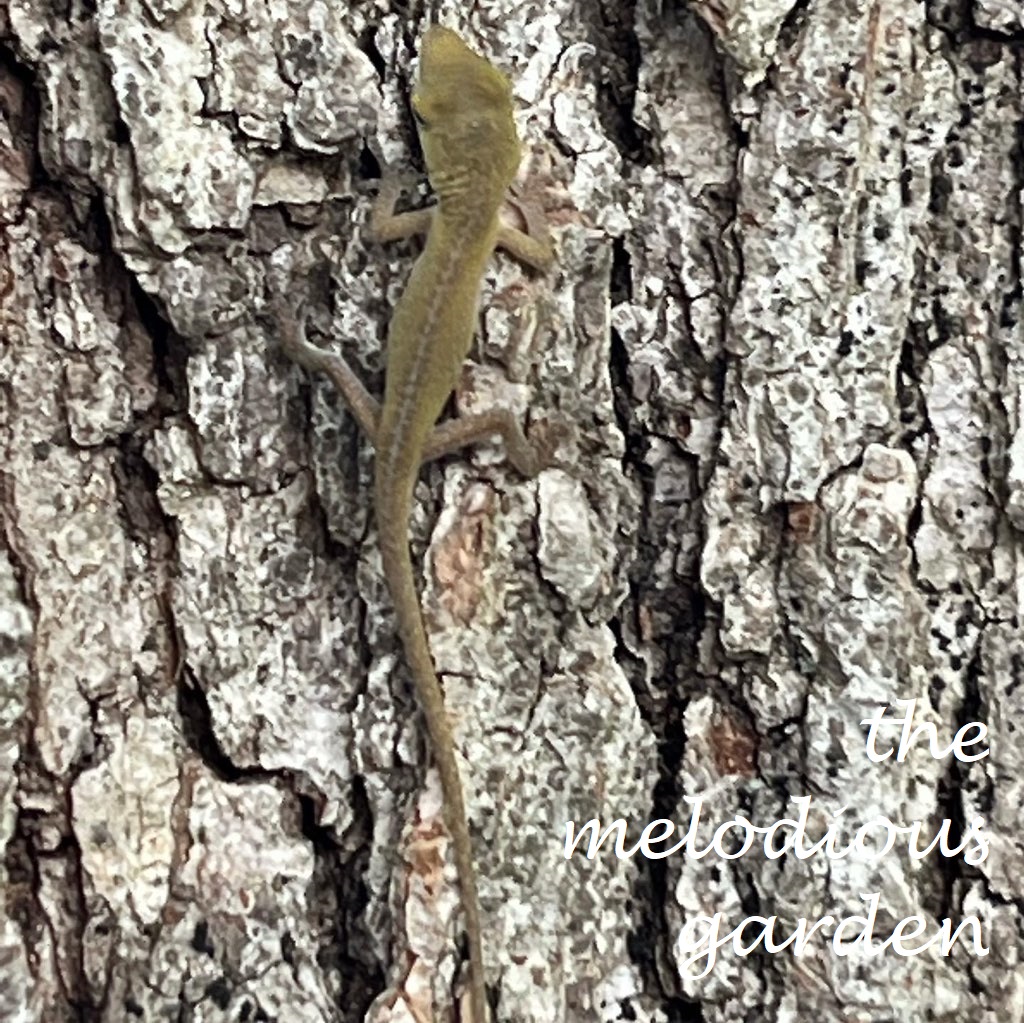
We were finally able to coax the anole to a nearby tree, shown above.

We bought our home 28 years ago, knowing at the time of purchase that I wanted to have an extensive organic garden that welcomed wildlife. We have never used pesticides, nor have we ever been tempted to. As in the movie Field of Dreams, “Build it and they will come.” The good, the bad, the ugly. But they all have a way of balancing off.

There are tons of insects in the world. (More like ten quintillion bugs, if you want to know.) Less than a million of the different species of insects in the world have actually been identified by scientists.

Insects are often classified by gardeners as beneficial (bees), bad (tomato hornworms) or somewhere in between. The majority of insects fall in that middle range. They are neither bad nor beneficial – or they are equally bad and beneficial. The praying mantis is a great example of an insect that falls in that middle area. They are fabulous hunters, taking down both dragonflies (bad!) and grasshoppers (good!) Selective control of bad insects is warranted in some cases and, thankfully, natural options are available. Aphids, for example, can be hosed off a plant with a strong burst of water. Or the gardener can create a habitat that welcomes in natural controls for aphids, such as small hiding places for amphibians and reptiles around the garden. It is also important to be able to recognize insects in their various stages, as the larva stages look nothing like the adult forms more widely recognized. The larva stage of the ladybug is just one example of an insect that is often mistakenly identified as a bad bug. Field guides – either an old school printed book or an online version – are an important resource for creating a pesticide free, wildlife friendly garden.

I have never found a reason to like grasshoppers, though I do know they are an important food source for birds, amphibians and reptiles, so I try to be tolerant of them. But even the much maligned fly serves an important part of our ecosystem, as they pollinate our crops, control other pests, decompose wastes and are an important food source for species further up the food chain. Hoverflies, which are often mistaken for bees or wasps, are quite beautiful and harmless to humans. They also cover a wider territory than bees and will fly in a wider range of weather conditions, making them more effective as a pollinator than bees.

The world is slowly starting to awaken to the reality that indiscriminate killing of insects is harmful to all species on the planet, humans included. What affects one species down the food chain ripples up the food chain. The majority of our food crops are dependent on insects for pollination, whether in own vegetable patch or in a farmer’s field in some far off place. So please, Keep calm and garden on and let your garden bug you.

gardening, nature, vintage

If you don’t like the weather…

Y’all know the saying… If you don’t like the weather in (enter your region), just wait a minute… Though too much a cliche, no truer words have ever been spoken about this week’s weather here in North Texas.

Six days ago, we were battening down the hatches and filling our pantries and readying ourselves for a good old fashioned Texas ice storm. Most of the Dallas-Fort Worth metroplex hung out the “closed” sign as three rounds of sleet and freezing rain made the region one large ice skating rink.

Today? Wearing shorts and a T-shirt and giving thanks for making it through the past week unscathed, thankyouverymuch. But please bear with me as I share a few more photographs from my frozen melodious garden, taken this past week.

I know.

The ice storm is behind us now; let’s move on and look ahead to spring! But it is always a good reminder that even a few days of severe weather impacts our gardens and the wildlife that inhabit our gardens, long after we humans have moved on.

No croquet games played last week.

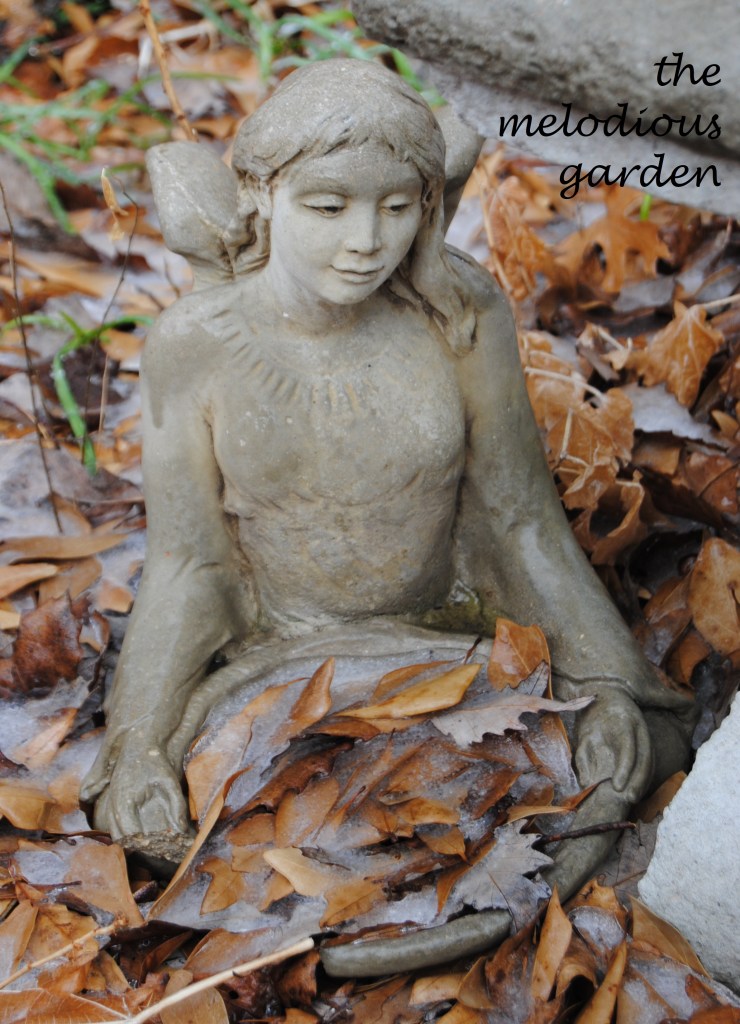
Even my meditating gnome (below) seemed cold.

I have collected Campania statuary since I worked at Redenta’s Garden 20plus years ago. I love picking out pieces that represent who I am, my interests and my hobbies. Each piece is so special to me. The gnome and fairy, shown above and below, are both Campania pieces. (Sadly, I dropped something on the bowl of the fairy a few years ago and broke a chunk off. It just reminds me that while we are all broken in some way, we are still beautiful.)

More vintage around the garden. I love using bed frames as trellises or to mark off different areas of the garden. (Above photograph.)

Bear with me while I prattle on a bit about the messy photograph above…

When my now adult age son was much younger, we read together Frances Hodgson Burnett’s The Secret Garden. My son was enthralled with the idea of having his very own secret garden, though he quickly decided he wanted the area to be his very own observation point for wildlife. Thus began “The Secret Biology Lab.” I happily obliged in helping him set up his own space in my overfilled garden. (Read: as in the book, my own garden was somewhat untended, thanks to motherhood…) We crawled to the back fence line, hidden by years of shrubbery left to grow wild. Among the accessories that went in to the secret biology lab, the basket (above) attached to the fence and for years filled with acorns and dried corn on the cob.

Last year I undertook a massive garden deconstruction and renovation project. That line of shrubbery was slated to be removed, having long outlived their usefulness and not in alignment with my current desires. But first, I had to text my son, away at college, and ask him if he would mind if I dismantled his secret biology lab. His response? “Uh… You still have that?” I think he was a tad embarrassed…

Having cleared that hurdle, I shed a few tears, reflected back on those younger days, removed my son’s discarded Tonka truck and the pink flamingo “Welcome” sign he wanted to mark the entrance to his secret biology lab… then I ordered my trusty garden assistant, the dear husband, to take the chainsaw to the shrubs.

To new beginnings! It is never too late to start over, redo, undo, move on!

I decided to leave the basket on the fence and do find it rather useful to hold assorted garden items. The fencing and landscaping pins landed there “for another day, for another project…” Until then – it is a great juxtaposition. The past – the basket – and the future – what project next? – frozen in time. Or frozen in ice, as it is. Someday I will reflect more on the dismantling of the secret biology lab. Good lessons to be learned. Good reasons to never cement anything in place. Until then… A few more frozen photographs!

I love this little… bird? chicken? Not quite sure what it is, but I love it all the same. (Above photo.)

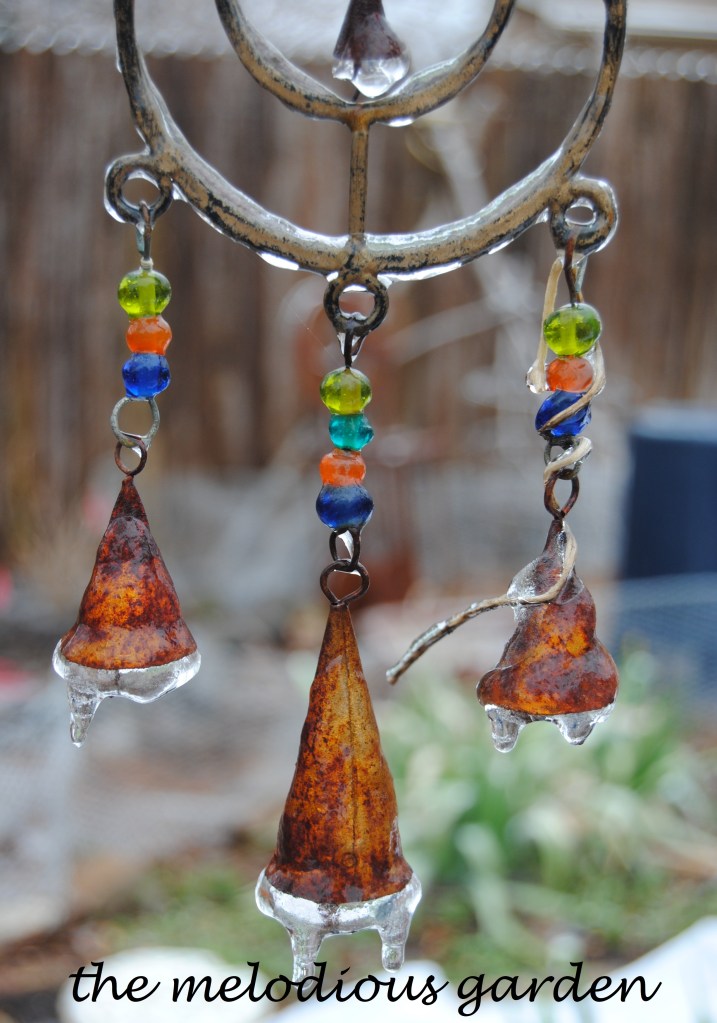
I love to mix different elements and pieces of color around the garden. A very modern, very boho windchime. (Above)

Two frozen cherubs, acquired at an auction. Auctions, estate sales, antique markets and thrift stores are all great sources for unique garden items. A garden, like a home, should be filled with treasures, lovingly collected!

Happy gardening. And remember: It is only February. Yes, we are wearing shorts now, but our average last freeze date isn’t until mid-March. A lot can happen between now and then, so Keep Calm and Garden On! But keep the frost cloth handy and don’t plant those tomatoes outside just yet!

gardening

Keep your faith in beautiful things

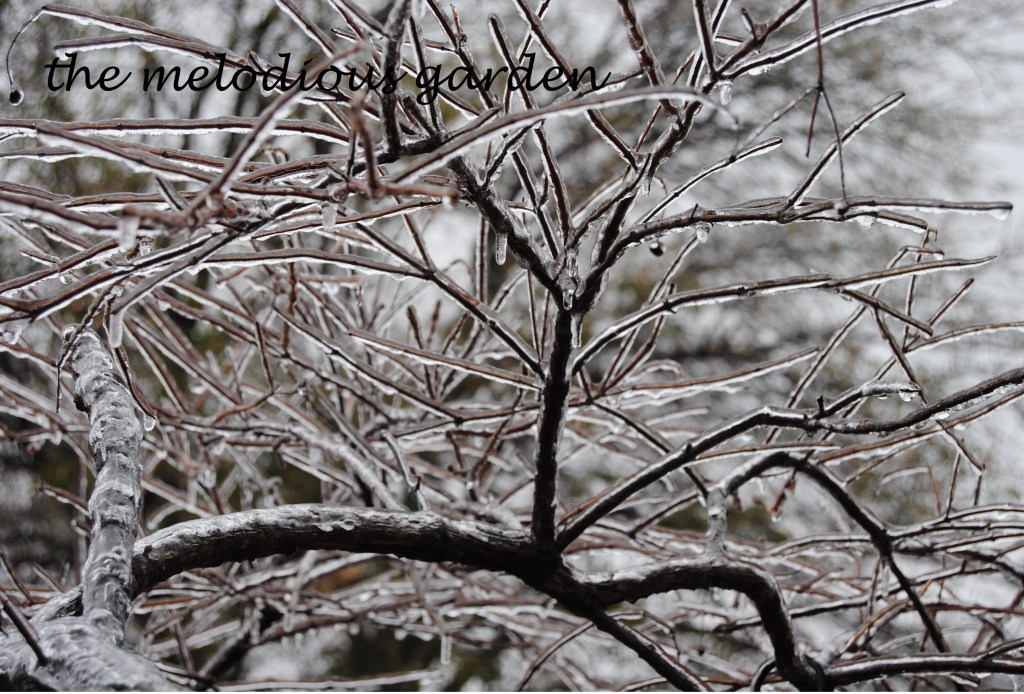
Mother Nature, it seems, likes to keep us gardeners on our toes. From deep freezes, to prolonged droughts and epic heatwaves, to December tornadoes and back around to another deep freeze. January here in North Texas ended with round one and round two of a four day ice event and made way for February to usher in the final, round three, of ice. In its wake, trees are bent and broken, encased in a thick layer of ice.

“Keep faith in beautiful things; in the sun when it’s hidden, in the spring when it is gone.” (Roy R. Gibson)

It is easy to see the stark beauty of the garden when the sky is dark and heavy with clouds, where few colors remain but shades of gray and white and brown, to pause and take in the frozen wonder all around us.

Keep faith in beautiful things.

Our native buttonbush, shown above, is one of my favorite plants for summer pollinators, though summer seems a long way off today. Still, I can stand under its frozen branches and feel and hear the buzz of bees, a promise that the seasons come and go, winter folds in to spring, then summer.

Keep faith in beautiful things.

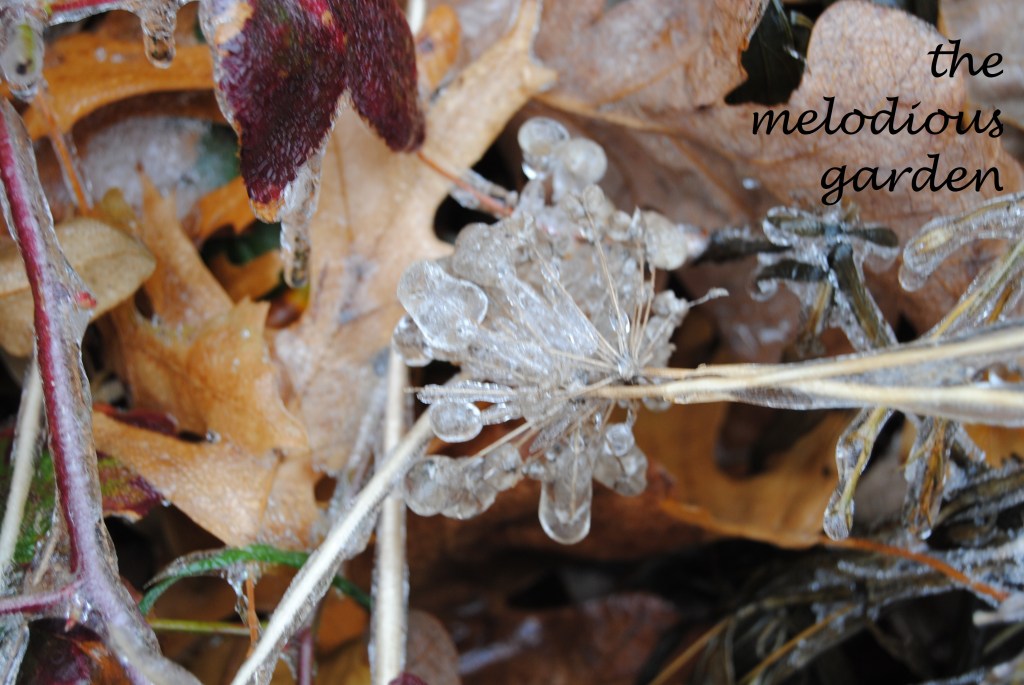
Garlic chives (shown above), originally planted 25 years ago, have seeded themselves happily around the property. Every fall, I say I will be diligent about removing the spent flowers before they go to seed, as I really should do more to prevent their onward spread. Every fall, I fail that garden chore and only get a fraction of the seed heads cut down. Today, though, I was lead to this frozen garlic chive and am thankful I hadn’t gotten around to removing its flower. The garlic chive’s umbel flower head, perfectly frozen in time and perfectly representing its Latin meaning: Umbel, meaning “umbrella,” a flower bloom that resembles an umbrella flipped inside out.

Keep faith in beautiful things.

“While it is February one can taste the full joys of anticipation. Spring stands at the gate with her finger on the latch.” (Patience Strong)

We are still unsure if my beloved fig tree (shown above) will ever fully rebound from the hard freeze of February 2021. It was knocked down to the roots and has struggled to regain even a fraction of its once grand size. On good days, I say it is in an important life lesson that we can all learn from the garden. Get knocked down seven times, get up eight times – or so the proverb goes. On bad days, I find myself perusing garden catalogs and planning a replacement, knowing there is likely a life lesson in there, as well. If at first you don’t succeed, try, try again. And sometimes that may simply mean moving on. Longtime followers of my garden know the hard pivot I made when the one-two punch of rose rosette virus and young onset Parkinson’s altered my garden (and life) plans. Moving on doesn’t mean defeat. Moving on may simply mean cutting your loses and forging ahead on a different path. Only time will tell. This tree produced a few tiny figs very late in the summer, which never ripened, and now remain frozen, shriveled and suspended in ice.

“From December to March, there are for many of us, three gardens: the garden outdoors, the garden of pots and bowls in the house and the garden of the mind’s eye.” (Katherine S. White)

While the garden outdoors is awaiting sunshine, warmer temperatures and a chance to thaw, the garden of pots and bowls inside is sprouting tomatoes, peppers and basils. The anticipation of the spring garden is real. The garden in my mind’s eye is taking shape bit by bit. Seeds have been started. More seeds have been ordered and I anxiously await their arrival so I can expand my indoor seed sowing adventures. My pivot from ornamental gardening to “growing nutrient dense organic foods for my health” is entering its second year. Last year saw the near total deconstruction of the previous garden and the renewal of the garden and the gardener. I enter this year stronger physically and mentally, nourished by a year of tending the vegetables, eating green beans and tomatoes and okra straight off the plant, seeing the garden through last year’s unending summer of record heat and record drought, knowing that we can still thrive in the face of adversity.

herbal fare

Cool as a cucumber salsa

Many years ago, Lucinda Hutson’s Cool Cucumber and Dilled Artichoke salsa was my first introduction to “salsa that isn’t your typical salsa.” It remains one of my favorite recipes both for its unique combination of flavors and for its cool and refreshing taste. I also find it highly adaptable. If I am leaning more toward Mediterranean, I will pretty much make the recipe as intended. If I am leaning more toward Tex-Mex, I will often omit the dill and artichoke and go heavier on the hot pepper. I always use salad burnet, as I find it pairs beautifully with the other flavors. Lucinda’s beautiful cookbook was one of the first herb gardening / cookbooks I bought 20+ years ago and one that I still pull out and reference often. The photographs of her garden are so inspirational and her plant knowledge is excellent. The recipes? Always amazing! And always filled with wonderful herb combinations!

Cool Cucumber and Dilled Artichoke Salsa

2 medium cucumbers

1/2 teaspoon salt

1 shallot, minced

2-3 serrano peppers, chopped

1/2 cup red onion, finely chopped

1 1/2 teaspoons whole mustard seeds

2 tablespoons white wine vinegar

1/2 teaspoon sugar

12-ounce jar marinated artichoke hearts, drained and chopped

3 tablespoons fresh dill, chopped

1 tablespoon fresh mint or salad burnet

2 teaspoons olive oil

Cut the cucumber in half lengthwise and scoop out the seeds. Chop cucumber halves and sprinkle with salt. Place chopped cucumber in a colander and allow to drain for 10 minutes to remove any bitterness and excess moisture. Mix cucumbers with the remaining ingredients. Chill for at least one hour before serving.

Recipe from Herb Garden Cookbook: The complete gardening and gourmet guide By Lucinda Hutson, copyright 1998

gardening, nature

Go hug a tree, it’s Arbor Day!

Happy Arbor Day!

I hope you are celebrating by planting a tree, or at least hugging a tree. Now I know if you are out of state, you may be thinking, “Wait. Isn’t Arbor Day in April?” Yes, it is in April. For the rest of the country. In Texas, we celebrate Arbor Day on the first Friday in November. While you can technically plant a tree any day of the year in the south, where the ground never freezes, fall is the optimal time for tree planting in Texas. (And most likely for most of the south.)

The theme for this year’s Texas Arbor Day is “It takes all kinds,” which represents tree diversity, the wide variety of ecoregions throughout the state and the amazing and wonderful diversity of humankind. Okay, I added in the amazing and wonderful, but isn’t our population really amazing and wonderful? Even among gardeners, no two are alike. If we were to make a large Venn diagram of gardening styles and types, the central part would most likely be trees. For every garden, for every property, for every need, there is a tree suited to your space and needs. Interested in native gardening and creating a haven for wildlife, trees will be a central part of your design. Interested in growing your own food, fruiting trees can produce a harvest for years to come. Interested in simply stringing up a hammock and enjoying the good life, surely you would enjoy your serene nook even more if it is shaded by a tree or two. It truly does take all kinds!

Our front yard is dominated by two bur oaks, which a dear gardening friend of mine calls, “The Oakiest of the Oaks.” True enough, of all the oaks, the bur oak has the largest acorns and the largest leaves. The larger of our two bur oaks was planted by the developer about 30 years ago. while the slightly smaller oak was planted by a squirrel about 20 years ago. Every autumn, I threaten to hire a flock of neighbor children to pick up the copious amount of acorns that fall from those two trees…

Ignore the green briar…

As my own gardening style is evolving from ornamental rose garden to an edible food forest, I have been exploring the new-to-me world of fruiting trees. It takes all kinds has been my gardening mantra this year. How can I extend my harvests? Can I harvest different fruits six months of the year? Which fig trees produce a breba crop? Which fruit trees remain small and can be grown in a container? (The driveway is mostly wasted space, amiright? Might as well grow food there, too!)

It really does take all kinds. Go out and explore your local garden centers this weekend and see what tree varieties they have. Surely you will find one that is perfect for your property.

herbal fare

Salad Burnet

If I had to rank the culinary herbs I grow at the melodious garden, from absolute most favorite to very very least favorite, lemon verbena would be at the very tippy top of the list, most favorite, hands down. Second on the list, just a pinch and a speck below my beloved lemon verbena, would be salad burnet. Thankfully asking a gardener to name their favorite plant is akin to asking a parent to name their favorite child. It is simply too hard to compile such a list, with too many variables at play. Are we ranking by usefulness or simply by beauty? It soon becomes problematic, so best to just start rambling on about the merits of all, which is my preferred method. For plants, that is, not children. Having only one child, it is easy to have a favorite. But – if asked about culinary herbs – salad burnet would always land a solid second place.

Salad burnet features petite deeply serrated leaves, which have a clean cucumber-like taste. Now do I use it in the kitchen as much as the old standbys, rosemary, parsley and thyme? Most likely not. But this herb is versatile, unique and quite flavorful. Sadly, it is often overlooked, both by gardeners and by garden centers. When I am able to find it in the nursery trade, I am apt to buy a half dozen or more starts, either for my own garden or to give away to fellow gardeners. (I have not yet tried to grow from seeds, but that is on my list of Garden Goals for 2023.)

I love to use salad burnet in salads, soups, sandwiches and egg dishes. It is especially good mixed with cream cheese as a spread for tea sandwiches. Salad burnet brightens up many beverages, from fresh squeezed juices to homemade lemonade. It pairs especially well with lemon, cucumber and celery.

As the name suggests, it really shines as a salad herb. Simply strip the leaves from the stem and toss with your lettuce greens. Young, tender stems can be minced and added, as well.

The young, vibrantly green leaves make a fabulous edible garnish!

Salad burnet grows in a small clump from one central root, with the soft stems arching out from the center. The younger, smaller leaves have the best flavor, so for that reason I regularly harvest from the outer stems so that none of the stems ever reach their full mature size. That is also a great way to keep the plant looking tidy, as the older stems can get weighed down and create a lovely habitat for pillbugs, if grown out in the garden. If I intend to use as a garnish, I will harvest the youngest, brightest green leaves.

After twenty-plus years of growing salad burnet, I find that I prefer to grow it in a container, where its foliage can cascade over the edge of the pot. If we end up with a spell of brutally hot and dry weather, such as this past summer, I can easily move it to a bit of shade if need be.

This herb is generally considered an evergreen in zones 7 and 8. I have not dried salad burnet for winter use, as it is said to not hold its flavor well when dried. I much prefer to use salad burnet fresh and, thankfully, we seldom get snow cover or long periods of freezing weather, so I am able to harvest fresh much of the year. If I was not able to have fresh year-round, I would most likely freeze salad burnet for winter use.

Depending on what reference book you are reading, salad burnet may be listed as either a biennial or a short lived perennial. In my experience, it is a short lived perennial, generally living about three to four years in my garden. It is listed as invasive in several online references, but I have never seen or heard of it being invasive in the North Texas area. Our growing conditions in zone 8a, Dallas-Fort Worth, are generally nothing like its native habitat.

The flowers are either inconspicuous or fascinatingly Dr. Seuss-ish, depending on your perspective. I find they make an interesting addition to a small floral arrangement.

In my garden, salad burnet generally tops out around one foot tall and maybe as much in diameter if I am not harvesting on a regular basis. It will tolerate full sun if watered on a regular basis in summer, though will well with partial sun.

gardening

Keep Calm and Garden On

It has been an awkward minute since I last blogged and there is no great way to break the awkwardness… There are probably a thousand and one relevant quotes I could toss out, like John Lennon’s, “Life is what happens when you are busy making other plans.” But I will cut right in and simply say:

Keep Calm and Garden On.

Garden On has, indeed, been the motto of my life the past few years. When life gives you lemons, throw them back and Garden On.

Rose Rosette Virus swept through North Texas a number of years ago now, destroying my beloved antique rose collection. As I was trying to regroup and figure out my “What Next,” my body had other plans. In early 2020, as the world was plunged into a global pandemic, I was being diagnosed with Young Onset Parkinson’s Disease. Nothing like going in to an apocalyptic era barely hanging on to the bottom rung of a very real ladder otherwise known as Survival of the Fittest. Add in Texas’ historic winter storm in February 2021, where the entire state was plunged into a deep freeze like never before. And that was just the temperatures inside our homes! We were, of course, destined to have a repeat in February of ’22, though thankfully shorter lived and – this time – with power! Very, very thankfully – with power! But, after all of that, many of my once overflowing garden beds were barren, except for the hardiest of plants.

But gardens – and gardeners – are resilient. And full of hope.

I started on medications for YOPD at Christmas of ’21, which has allowed me to fully resume gardening. I am still stiff and sore, especially between doses of medication, but I am able to get up and down easier again and can again bend my fingers to use pruners. My strength has returned and my balance – while wobbly at times – is getting better. So Garden On I have been. But what to garden?

It is not yet safe (in my opinion) to plant roses in this area. The winter storm of February ’21 killed many of the shrubs I had planted as place-holders after removing the infected roses. Was it even wise for me to start over again, knowing that I face an uphill battle with my health?

To Re-Sod or Not To Re-Sod was the topic of many conversations around the melodious garden. I had spent so much time and energy removing our lawn, did I really want to give up parts of the garden and re-sod our property?

We always circled back around to:

Gardening keeps you young and active.

And:

I would rather die today in my garden than in ten or twenty years, immobile and confined to my home.

And:

What can I garden today to benefit me tomorrow?

Somewhere along those conversations, I stumbled upon the concept of food forests and fruit tree guilds and permaculture and where has this been all of my life?

I have maintained our property organically since we bought this corner of the world 28 years ago and the organic garden center I worked at in the late 1990’s was an early source for heirloom seeds and plants in this area. I think I must have danced around the edges of the permaculture circle for years, as I was far more interested in growing ornamentals with a few herbs and veggies tossed in for good measure than in primarily growing fruits and vegetables. But now, with my health such as it is, turning all of my empty flower beds into extensive food production turns out to be the perfect answer to “What can I garden today to benefit me tomorrow?”

And with that – I hope to chronicle here what changes I have made to my gardens, what I am growing, why I am growing the varieties I am and, maybe most importantly, what I am doing with what I am growing.

gardening, vintage

Potted doll heads…

My husband and I have been married for over 30 years, so he should know me, amiright? And yet we still have conversations like this…

DH: Whatcha doing today?

Me: Giving a doll a hair cut. And a lobotomy.

DH: Whyyyyyy?

Me: Why not?

I have been wanting to make potted doll heads for several years now… For the past three years, I would be busy right now potting up succulents for the local Master Gardener’s fall plant sale. Alas. Covid. Their wonderful event is canceled this year. Every year, ahead of their plant sale, I would ask myself… Is this the right crowd for potted doll heads? And every year, I would say to myself… Um… Maybe not. So I would stick with my tried and true. I would pot up vintage tea cups and McCoy pottery and all sorts of beautiful vessels. This year, I vowed I would do it. I would find some old dolls and cut open their heads and pot them up. But – No Master Gardener sale this year. (Imagine a great big frowning face emoji…) Thankfully, https://www.grapevineantiquemarket.com/, where I have a few booths, is having a super-fun event… Talk Like A Pirate Day! This Saturday – September 19th. Now I know. Pirates have nothing to do with creepy doll heads filled with succulents. But it gave me an excuse to finally lop off some doll heads.


Let me tell you… Finding the dolls was hard! I looked and looked at thrift stores and found nothing interesting. Then along came this auction. Not just any auction, either. A three day auction. In a massive house. One day was just…. the lady’s doll collection. Yes. A whole auction devoted to bidding on dolls.

So you enter the house… Which has been vacant for quite a while…. Go up a steep set of stairs…. Turn a corner and go down a short hall and enter… The Doll Room. A massive room. Floor to ceiling, wall to wall – Built in bookcases. With glass doors. And there on the many shelves….

Dolls.

Dolls.

And. More dolls.

I went for the vintage sewing notions, as this lady sewed many of her dolls’ outfits. I thought I would come home with a few boxes of wooden thread spools, some old buttons and a few dolls. Instead, I came home with… Dolls… And… More dolls. And doll pieces and parts. Yes. I am still sorting out heads and shoulders, and knees and toes. What a fun – yet downright creepy – auction!

Now… For the gardening part!

I gave the dolls a shave and a cut, then found a suitable base. The doll heads are glued to their base, then green moss was glued around the edges to make them look mossy and neat. I used long tweezers to attach the moss, to save my fingers from getting super-glued to the moss and the doll and everything else. If you don’t have long tweezers, you can use regular ones, but I happen to love long tweezers because… well, they are long. And big. And great for so many uses. I bought mine from a pet store many years ago. I think they were sold as “cricket feeding tweezers.” And. Yeah. That is what I initially bought them for. Back when we had an aquatic turtle who loved him some fresh crickets.

Aside from holding the moss, the tweezers were also great for pushing the small cuts of coco liner into the dolls heads. (I decided on coco liner as the best way to cover any openings in in the doll, like at her neck or mouth.)

I used a quality cactus potting mix to fill the heads. (And one leg… More on that later…) When transplanting succulents, it is best to knock off all the potting mix that is on and around their roots and give them fresh soil to grow in. Below are photos showing what a succulent looks like straight out of the container and the other photo shows what it looks like with its soil knocked loose. The goal isn’t to strip the succulent of all of its soil, but to break up the soil and encourage the roots to grow outward instead of the spiral they were used to growing in.

And…

After planting, I covered the soil with additional green moss. I normally top-dress my succulents with tumbled glass or pebbles. I am hopeful the moss won’t retain too much moisture. Potted succulents should always be watered in small quantities and at the soil level. Do not water from overhead.

Now… For the reveal…

Potted doll heads! And one leg…

As I mentioned earlier, I also got a number of doll pieces and parts, including this broken doll leg.

Most any item can be used underneath the potted head (or leg), as it just needs something to stabilize it… As you can see, I used a plate under the leg and this head…

an old canning jar lid…

a demi cup…

and a small vase…

All my pretties together…

They will be available at Grapevine Antique Market Friday afternoon, through Halloween or while available. Please drop by Saturday and talk like a pirate and shop for some super cool vintage and antique fall decor!

Be safe!

herbal fare

Lemon verbena scones (Gluten-free)

Lemon scones are perfect for so many occasions – bridal showers, baby showers, tea parties, quiet summer breakfasts on the patio, large family Sunday brunches. They are quick and easy to make – and beautiful on a serving tray.

If you have read my blog more than once or know me IRL, you know I add the herb lemon verbena to Every.Thing! Quick tip: For any recipe calling for lemon… Add some fresh or dried lemon verbena leaves to a food processor, along with the amount of sugar the recipe calls for. Give them a whirl together, until the leaves are minced finely. This releases the oils from the leaves into the sugar crystals. When added to the recipe, you will have an extra dose of lemon spread throughout!

lemon cutting board

Most of my baking these days is gluten-free. I was diagnosed with celiac back in the dark ages, long before there were good options for baking. I am so thankful today that there are gluten-free flours available at most any grocery. For these scones, I used a regular scone recipe, but exchanged the flour with Bob’s Red Mill gluten-free flour mix.

And! Did you see my new board, above?! I will give it it’s own post later on… I bought it from a local gentleman, retired military, that is making and selling amazing handmade woodwork items.

lemon scone1

Lemon verbena scones

For the scones:

1/3 cup sugar, whirled with a handful of lemon verbena leaves

Zest from one large lemon

2 cups gluten-free flour

1/2 teaspoon salt

1/4 teaspoon baking soda

1 teaspoon baking powder

8 tablespoons cold butter (freeze for a bit before or use straight from the fridge)

1 egg

1/2 cup heavy whipping cream
Preheat oven to 400 degrees.

Mix sugar and lemon zest together in a bowl. Add flour, baking soda, baking powder and salt and mix well. Grate the butter into the flour mixture. Cut the butter into the flour mixture until coarse crumbs form.

In a separate bowl, mix together the egg and cream. Add to the flour mixture and stir until ingredients are combined. Make sure to scrape down sides of bowl to fully incorporate all ingredients.

Shape the dough into a ball and place on a lightly floured surface. Roll dough out into a 7 inch circle. Cut into 8 wedges.

Place the wedges on a parchment covered baking sheet. Separate the wedges, so there is a bit of space between each one.

Bake in preheated oven for 15 minutes or until lightly brown.

Let scones cool for a few minutes, then transfer over to a wire cooling rack.

Make glaze (recipe below) and brush over cooked scones. Enjoy!


Lemon glaze:

1 cup powdered sugar

3 tablespoons fresh lemon juice

1/2 teaspoon vanilla

3 tablespoons melted butter

Mix all glaze ingredients together, making sure all powdered sugar is fully incorporated.


gardening, herbal fare

Lemon herbs… Lemon verbena and Lemon balm

I rave about lemon verbena most any chance I get.

Meet a new gardener? I am bound to ask them if they grow lemon verbena, then I will start into a five minute mini-lecture on why everyone should grow the herb.

Talking to an experienced cook about using fresh herbs versus dried herbs in the kitchen? I am likely to start talking about my passion for using lemon verbena.

Discussing flower gardening with a grower at the farmer’s market? Yes. Even then I will recommend lemon verbena.

If the botany world had Super Fans, I would be Lemon Verbena’s biggest fan.

But why lemon verbena when lemon balm is so readily available? Following is a bit of a compare/contrast of the two herbs… (I will leave lemon grass for another day, as that is in a league of its own.)

Let’s start first with a side by side look at the herbs.

lemon verbena and balm

This collection of potted plants is right outside my front door, where I can run my fingers through the leaves of the herbs or run outside to snip off a bit of herb for cooking. I grow both lemon verbena and lemon balm in containers, though I will also plant lemon verbena in the ground.

Lemon balm is in the mint family, which means… It would overtake the world if given the chance. I always, always, always plant lemon balm (and mints) in containers. For me, one lemon balm plant is sufficient. It has an impressive root system and will readily spread to fill a container. Or the neighborhood.

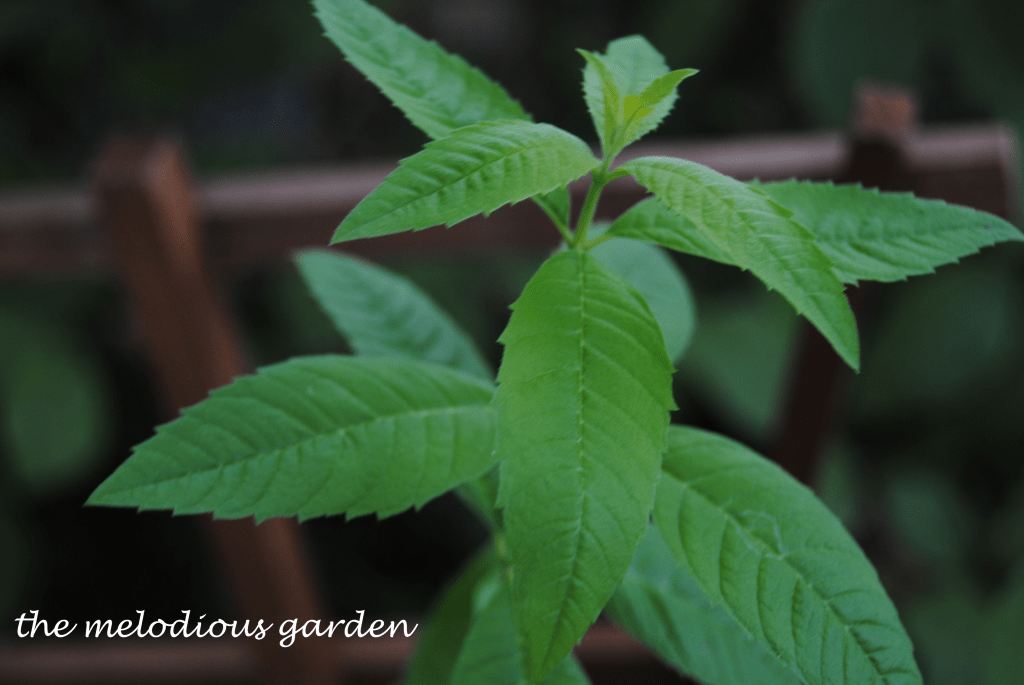
Lemon verbena is a woody annual herb, which grows and produces leaves along one central woody stalk. I generally plant half dozen plants each spring, some in containers and some in the ground. I don’t use all that I plant, but it is a lovely carefree addition to the garden. I love the way it tends to sprawl around other plants and I love brushing against its fragrant leaves whenever I am in the garden.

Lemon balm is extremely winter hardy and can survive temperatures up to 20 below. Lemon verbena, however, is frost tender around 30 degrees. I have had a few plants overwinter in sheltered locations in my zone 8a garden, but they are nowhere near as robust as they were the previous year. Likewise, I have overwintered the plants in a container in the garage during cold spells and it comes through just fine, just not as full and lush as a new plant.

The most important comparison, for me, is in the leaves…

lemon verbena and balm2

Lemon verbena has long, thin leaves with smooth edges. Pinch off a leave and crush it to release the oils and you will smell a cool, refreshing scent. Lemon balm has short leaves with scalloped edges. Crush a lemon balm leaf and you will smell warmth. To me, that is also a great indication of how I use the two herbs. If I want to make lemonade or iced lemon tea, lemon verbena is my go-to. If I want to make a warm cup of tea to soothe a sore throat, lemon balm is my first choice. I also prefer to bake with lemon verbena, as I find it brings a bright zest to most recipes.

Both lemon verbena and lemon balm can be easily dried for winter use. (My preferred lazy drying method is to put a baking rack over a cookie sheet and place the cuttings out flat to dry.)

Likewise, the leaves of both can be used in soap making, tea blends, baking, etc.

My preferred method for using their leaves in baking is to add several leaves (fresh or dried) into the sugar portion of the recipe. Whirl in a food processor to finely mince the leaves and release the oils directly into the sugar. The sugar is then incorporated into the recipe where the scent and taste can be enjoyed throughout.

lemon verbena1

Lemon verbena will flower, however I am always pinching leaves off so do not get any flowers on my plants. Lemon balm does freely bloom, which the bees and small butterflies enjoy. Lemon balm can and does spread through seeds, in addition to its spreading roots. The photo below shows, just above the center leave, where the lemon balm had earlier bloomed.

lemon balm

Lemon verbena and lemon balm grow in very similar environments. Both do well with adequate water and are not happy with dry conditions. Lemon balm would love an extra drink or two of water, but certainly does not need it. But it is forgiving to occasional over-watering. When grown in a container, allow for good drainage for both herbs. Both herbs prefer a sunny location, but are happy with some afternoon relief in the hottest of Texas summers. Mine are near a large bur oak tree and get bright light in the morning until early afternoon, then a bit of shade until evening.

Now… For the million dollar question… Why do I prefer lemon verbena over lemon balm? I think its leaves are prettier and I love the coolness of its scent. It has more of a crisp summer smell, in my opinion.

Whichever one you plant, I hope that you enjoy experimenting with herbs in your home.