
The best time to plant a tree was twenty years ago. The second best time is now.
This past Friday, April 24th, was Arbor Day. The best time to write about Arbor Day would have been on Arbor Day. The second best time is now. Thankfully, Texas actually celebrates Arbor Day in November so I am technically really early to write about the tree loving and tree planting day instead of a few days late. But I do have a great excuse to be late to the April Arbor Day party. I was busy celebrating Texas Wildflower Day. (More on that another day!) I do still want to discuss Arbor Day – why we should love and (possibly) plant them any day of the year instead of waiting for an Arbor Day – April or November – to plant a tree. There is no denying that our planet is getting warmer. If you are a gardener, you feel it. The science continues to show it. Planting a few tress may seem a bit like putting your finger in a dike to hold back water. Such a small act, would it even help? Yet it is a tangible thing that all of us can do. And a lot of smaller actions, taken together, can have larger impacts.
I would first like to circle back around to Texas and why we celebrate Arbor Day on the first Friday in November instead of the last Friday of April like the rest of the country. In Texas, we are fortunate to be able to plant year round. Now “can” and “should” aren’t always one and the same. Our ground never freezes as it does in colder regions, meaning you can go outside and dig a hole in the ground 365 days of the year in this region. Planting in the fall and early winter takes advantage of cooler temperatures and more abundant rainfall, both of which help new plantings get established before the heat of the summer kicks in the following year. Now about that “can” and “should”… You can plant trees in April. You can also plant trees in August. (And I have done that before.) Just know that they will need monitoring and hand watering. You can’t plant a tree in the summer, then go on an extended vacation and expect your sprinkler system to provide adequate watering because it just won’t. Newly planted trees need supplemental watering to get established. Depending on your exact region and soil type, a deep watering twice a week with a garden hose may be needed.
And circling back around the Texas Wildflower Day. As much as I am on team Plant More Trees, I am also on team Restore The Prairie. I acknowledge that the two may not always seem compatible. My property, though, is situated in the Cross Timbers ecoregion, which originally would have been a mixture of prairies, savannas and woodlands. My own personal belief is that planting trees and restoring native prairie plants are equally important to the overall ecological goals of lessoning our impact on the planet, creating valuable habitats for wildlife, conserving water and bringing our own bit of property back to a balanced ecosystem. This was my second year attending Texas Wildflower Day at Texas Woman’s University and it will (hopefully) get its own blog post (or two) in the upcoming days.
It can be overwhelming to visit a garden center and select a tree, but doing a bit of research and reflection beforehand pays off. Do you want a tree that produces an edible harvest, a flowering ornamental tree or a tree that will one day shade your home? What mature size can your space handle? These are all questions one should consider before stepping foot in a garden center. Go in with a plan.
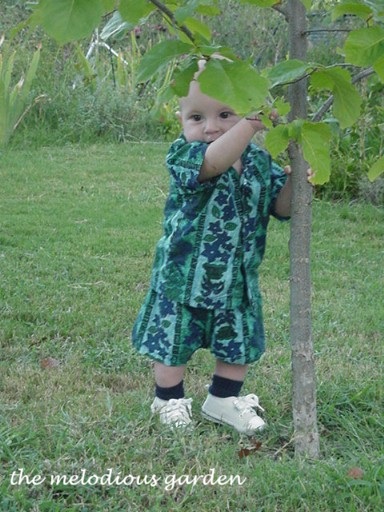
I have planted a number of trees on our property over the 30 years I have gardened this piece of Earth, but my favorite tree would be the chinkapin oak we planted in honor of our son’s birth 24 years ago. I won’t post a picture of my son today with “his” tree, but suffice to say that both my son and the oak now tower over me.
If one wants a tree that produces an edible harvest, a fig tree is one of the easiest pest-free trees available. Sizes vary widely depending on variety. Be sure to check out both of my earlier posts on fig trees. Persimmon is another fruit tree that does well in North Texas.
The pecan is our state tree, but one would do best planting this if they have an acreage and a strong back. My experience with the pecan is limited to dealing with our neighbor’s pecan for the past 30 years. It is a large messy tree, dropping branches whenever the wind flutters. It should not be planted anywhere near a house, let alone sandwiched between two homes in a suburban situation, as our neighbor’s tree is. It needs plenty of space. Now about that strong back… One will need a strong back to pick up the thousands of pecans that fall every autumn. Our neighbor’s tree has never produced anything near edible or desirable to humans. I have been told this is because it is our native pecan tree and not one that has been hybridized for larger, meatier pecans. Our neighbor’s pecans, however, are very desirable to every rodent (ie: rat, squirrel…) in the entire county and we fight endlessly to keep the rodents from bringing pecans in to our attic and garage. In the nursery trade, one can spot a pecan tree from across the grounds because of their distinct nursery pot. Pecans have an incredibly long taproot, requiring them to be grown for the horticulture trade in incredibly deep nursery pots. Squirrels bury what seems like an endless sea of pecans and one will also need that strong back again for dealing with the junk pecan trees that sprout up everywhere. Those long taproots take a sharpshooter shovel and a hearty heave-ho to dislodge the unwanted pecan sapling’s long taproot. This is where an acreage comes in handy. One could leave them be and have their own pecan forest within a few years or possibly mow right over them. But digging out several hundred unwanted pecan trees from a flower bed is exhausting work, necessitating a very strong back.
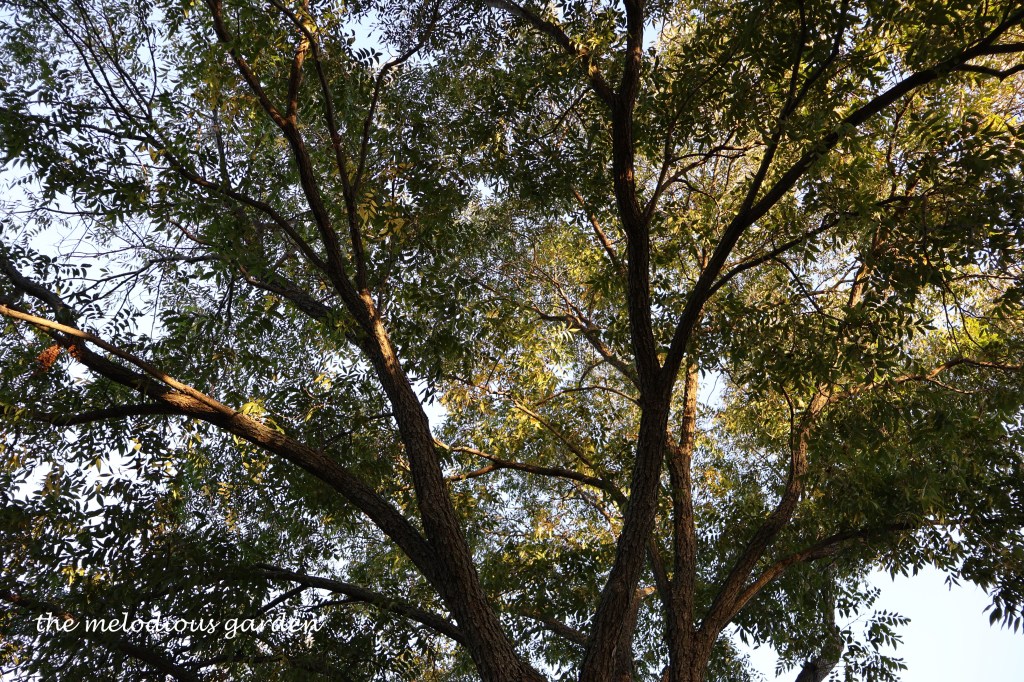
Above photograph: Our neighbor’s pecan tree
Midsize native trees that I grow and love include redbud, rough leaf dogwood, buttonbush, Mexican plum, cherry laurel and yaupon holly. We also have two bur oak trees on our property, which I have a solid love/hate relationship with. Love the shade…
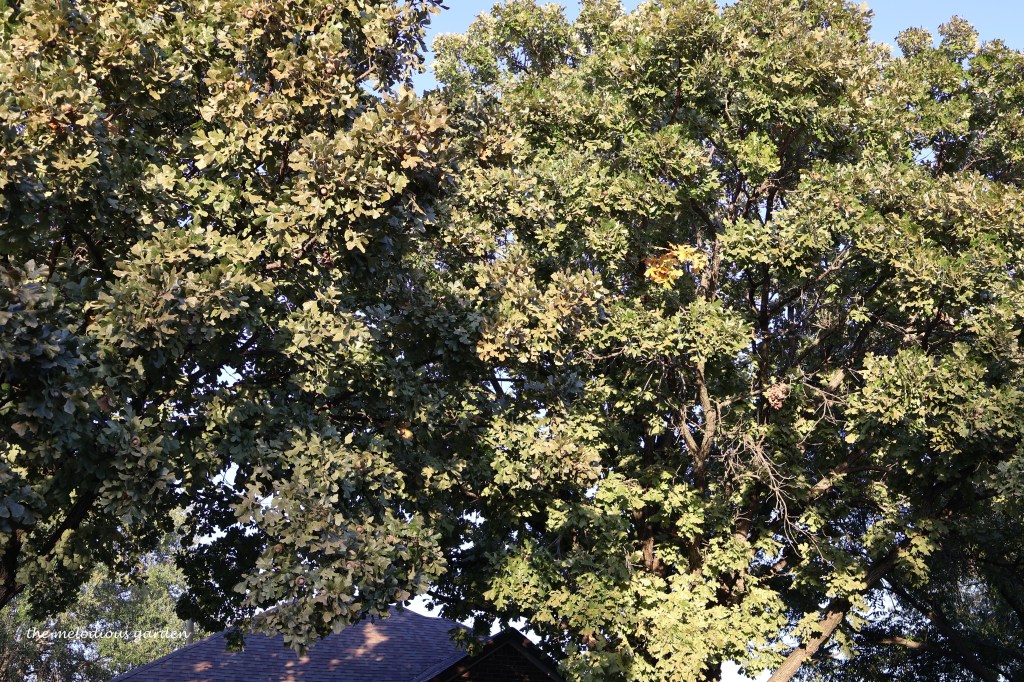
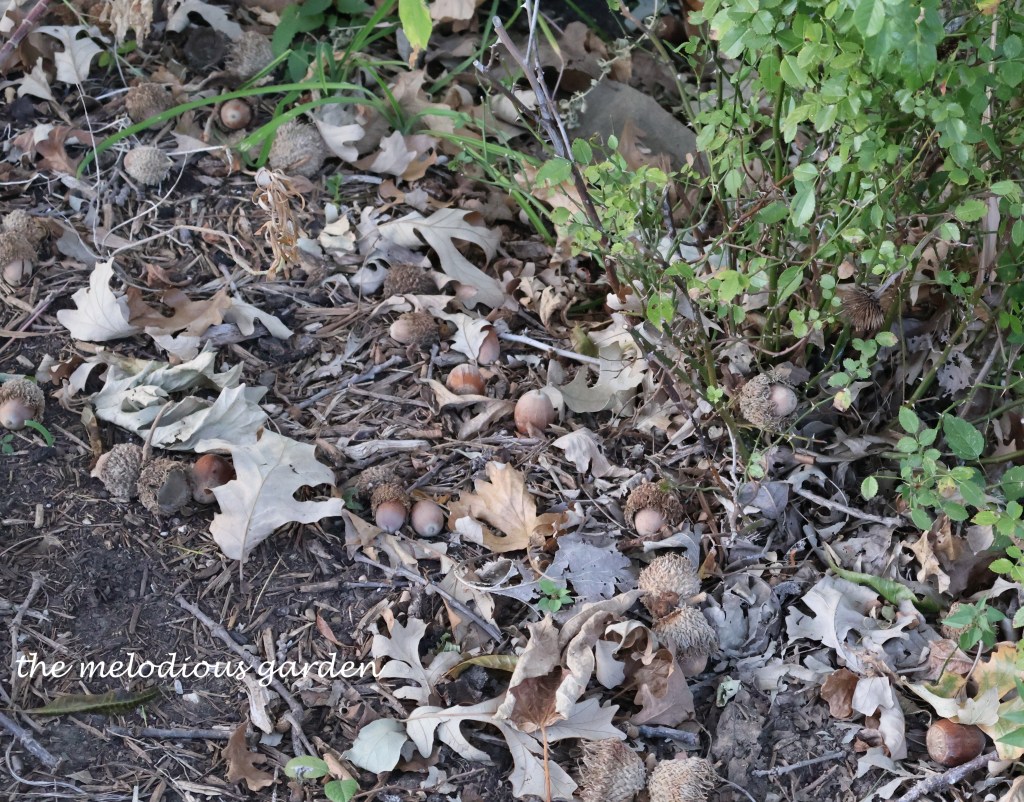
Hate picking up thousands of large acorns each fall… One also needs a strong back when dealing with acorns!
A society grows great when old men plant trees in whose shade they know they shall never sit.
Keep calm and garden on – and please considering planting a tree or two.
All photographs taken in my zone 8b southern Denton County, Texas, garden.


