
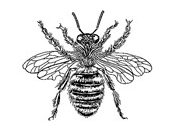
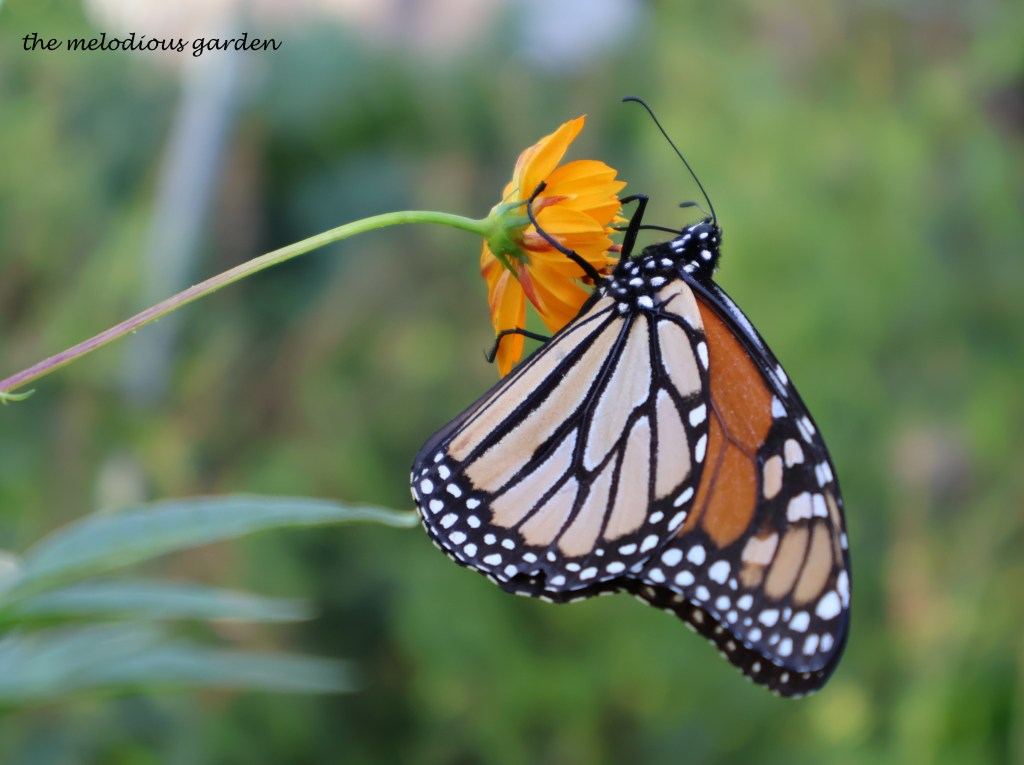
I felt a bit like a mashup of Paul Revere and the poet Richard Le Gallienne today, though instead shouting that the redcoats were coming nor penning about a poem about a brown bird singing in the apple tree and pulling me out to the garden, I was all abuzz that the monarch are here! In my garden! Not one. Plural. Monarchs. The monarchs are here!
My garden happens to sit perfectly along their migration path. Each spring, the monarchs emerge from their winter habitat in Mexico and travel north for the summer. Along the way, they search for milkweed – the monarch’s host plant – to lay their eggs on. But now it is autumn and they are migrating south for the winter and they are in search of fuel – in the form of nectar – for the long journey that still lies ahead of them. Fall blooming flowers are critical for their survival.
Insects may be our canary in the coalmine – the warning sign of environmental troubles ahead. They are the most vulnerable to shifts in climate and weather extremes. As more and more wild lands are destroyed and either conventionally farmed (ie: with chemicals) or paved over for subdivisions and highways, insects – including the beloved monarch butterflies – find less and less food in the wild. Restoring native habitat is critically important. But it doesn’t take an acre to help. Anyone with a bit of space, even those with balconies or a small patio can grow a container of fall blooming flowers for the monarchs to feed on as they are passing through.
My own garden right now looks a bit worse for the wear, as I have been out of commission for the past two months. Thankfully, I do favor plants that not only grew in my absence, some seemed to thrive on my neglect! As I was getting around to leave for physical therapy earlier today, I happened to notice one, two, four, six and more monarchs fluttering about my garden. I quickly grabbed my camera and out to the garden I went. I did manage to make it to therapy on time, though I was still picking dried leaves and seeds off my clothes and shaking them out of my hair as I walked in to my session. As soon as I was finished, it was back out to the garden, which is where The Husband found me some time later, still laughing and flitting about my garden, as I snapped dozens and dozens of photographs of the monarchs.
Following are a few easy steps we all can take to help the monarchs.
1.) No pesticides or insecticides. Even organic ones can and do kill beneficial insects. The majority of insects in the world are harmless. Plants that are grown specifically for butterflies, from their host plants to flowering nectar plants, must be organic.
2.) Water is crucial for butterflies. Provide a shallow basin with pebbles or shells for them to land on.

3.) Trees provide much needed nighttime roosting spots for butterflies, as well as shelter from stormy weather.
4.) Plant natives whenever possible! Many of the hybridized plants on the market have been bred for larger flowers, but they often lack the rich nectar that the native variety have. When shopping for plants, avoid ones that have a specific name in quotation marks or have a trademark emblem next to the name. Those are easily identified as hybridized varieties.
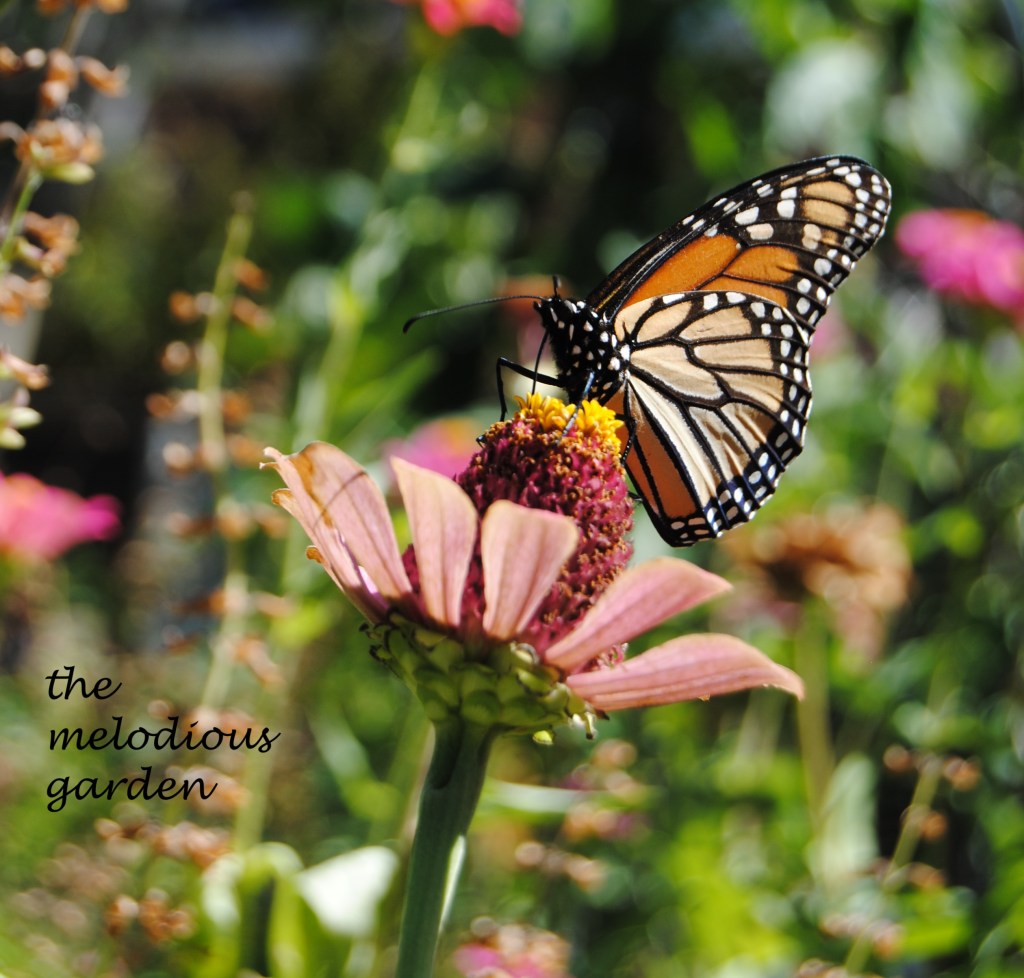
5.) Plant well adapted fall blooming plants that will survive our summer heat and drought. Some examples of plants that will bloom in North Texas during the fall monarch migration include: zinnias, cosmos, tithonia (Mexican sunflower), Mexican mint marigold and pentas. The two flowers the monarchs were nectaring on in my garden were cosmos and zinnia, both well adapted annuals.

6.) Plant a wide variety of plants so you always have something in bloom. A variety of flower colors and flower shapes will also attract a wider variety of butterflies, not just monarchs.
7.) Plant in groupings of three or more as a larger expanse of blooms will be more visible to butterflies flying overhead. This also allows butterflies to nectar from multiple plants without needing to fly off so soon in search of additional food.

Some fall blooming Texas natives include: Anise hyssop (Agastache foeniculum), Frostweed (Verbesina virginica), Gaillardia (Gaillardia aristata), Cardinal flower (Lobelia cardinalis), Ironweed (Vernonia baldwinii), Gregg’s mistflower (Conoclinium greggii), White boneset (Eupatorium serotinum), Zexmenia, Turk’s cap (Malvaviscus arboreus var. drummondii), Prairie verbena (Glandularia bipinnatifida), Gray vervain (Verbena canescens), Aromatic (Fall) aster (Symphyotrichum oblongifolium) and Coneflower (Echinacea purpurea).
Varieties of Rudbeckia/Black-eyed Susan: Rudbeckia hirta, Rudbeckia fulgida, Rudbeckia laciniata, Rudbeckia maxima, Rudbeckia texana, Rudbeckia triloba.
Varieties of Liatris/Gayfeather: Liatris acidota, Liatris aestivalis, Liatris aspera, Liatris elegans, Liatris lancifolia, Liatris punctata, Liatris tenuis.
Lantana urticoides is native to this area. There are numerous other lantana varieties available — a few are perennial, but many on the market are annuals in our area. Special note: The berries on Lantana urticoides are poisonous.
Fall blooming salvia varieties include: Pitcher sage (Salvia azurea), Scarlet sage (Salvia coccinea), Mealy sage (Salvia farinacea), Autumn sage (Salvia greggii).

Keep calm and garden on and consider planting a butterfly garden.
All photographs were taken October 22nd, 2025, in my southern Denton County, Texas, garden. I have organically gardened this piece of earth – a large suburban lot – for 30 years.
I meant to do my work today by Richard Le Gallienne
I meant to do my work today—
But a brown bird sang in the apple tree,
And a butterfly flitted across the field,
And all the leaves were calling me.
And the wind went sighing over the land,
Tossing the grasses to and fro,
And a rainbow held out its shining hand—
So what could I do but laugh and go?

 the melodious garden
These photos are just stunning!! How wonderful to see these gorgeous butterflies in real life. I love your tips – especially the no-pesticides one, which is so important.
And I will definitely be leaving a shallow tray of water out this summer 🙂
LikeLike