Somewhere, lost to the years, is another one of Newton’s laws of motion. Time accelerates exponentially with each of life’s milestones passed. This weekend was my 40th year high school class reunion. I wasn’t able to attend but looking at the photographs online was sobering.
Forty years.
It seems like yesterday that we sat on our school’s football field in cap and gown, then walked across the stage to get a piece of paper that read, “Welcome to adulthood, where time just goes faster and faster.” And yet it was also a lifetime ago. I hardly know the girl I was back then. What were her dreams? Would she ever have imagined her life as it is now? Where did the years go?
I was one of the first in my class to get married, which means my 40th year wedding anniversary is also fast approaching. We are celebrating our anniversary by visiting our young adult son who recently flew the nest and moved to Wisconsin. Another milestone passed, time speeds up even more.
How is it mid-October already? I recently decided to tackle the leaning tower of papers and books that had been growing on our kitchen table. That one must fall under Newton’s first law of motion: A stack of clutter will remain cluttered until acted upon by either person or gravity or random bumps and jostles to said table.
I felt like an archeologist, unearthing my year. Midway down, I found my 2026 calendar, still opened to April. Further down I found the ADHD planner I bought – checks records – on December 28th of last year. Yes, I have yet to use it. Yes, ADHD may be part of the reason. High hopes. Too scattered.
Falling and whirling, and fluttering down, Beautiful leaves, all crisp and brown; Decking the grave where the Summer lies, Under the grey of the Autumn skies… ~ Lizzie Marshall Berry
Do you remember those school assignments from yesteryear? How I spent my summer vacation… “This summer, I took way too many photographs of bees and their butts.”
In August, I fell head over heels in love with iNaturalist and have finally started a longtime goal of photographing pollinators in my garden. ie: I have taken so many photographs of bees and their butts!
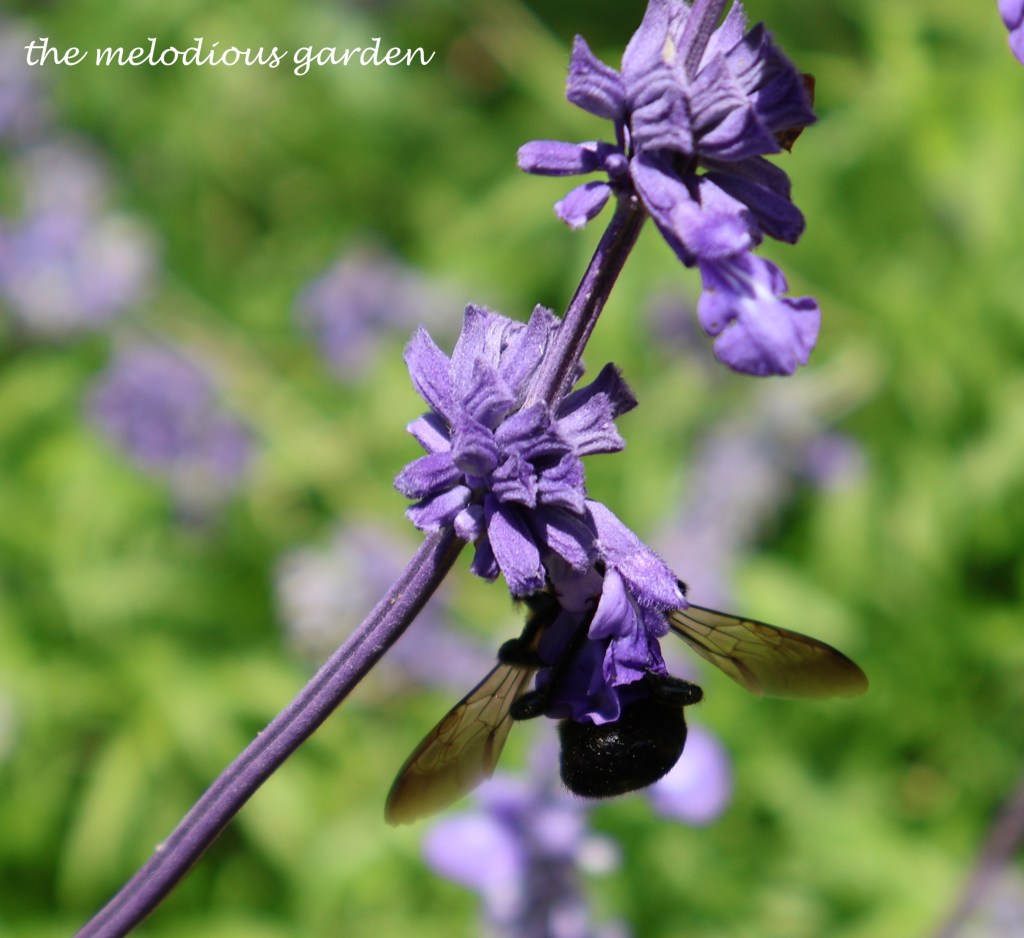
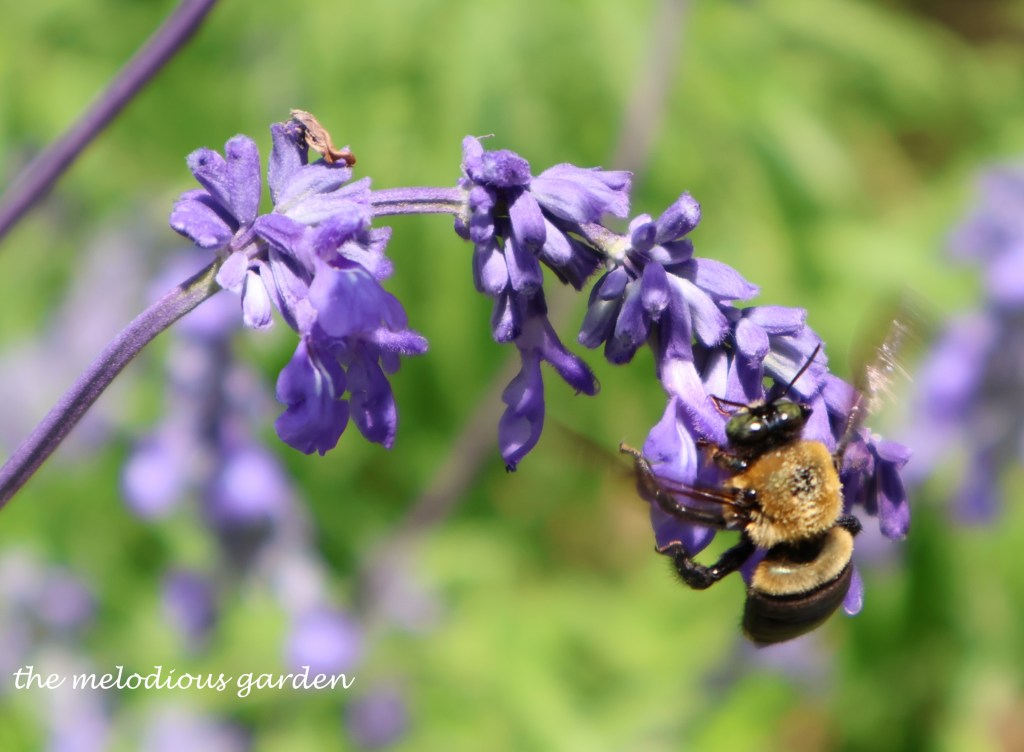
Worldwide, insect populations are struggling due to climate change, habitat destruction and widespread pesticide use. In Texas, three bumblebees have been identified as a “greatest conservation need,” meaning that their populations are facing a significant decline. This summer, I documented two of them in my garden – the American bumblebee and the Sonoran bumblebee. Bumblebees live in colonies, though, and I never saw more than one or two in my garden on any given day and sometimes days would go by without a single sighting. Is that why my tomatoes and squash struggled to set fruit this year? Will I need to hand pollinate my vegetable plants next year? Will my ADHD brain be able to take on that task?
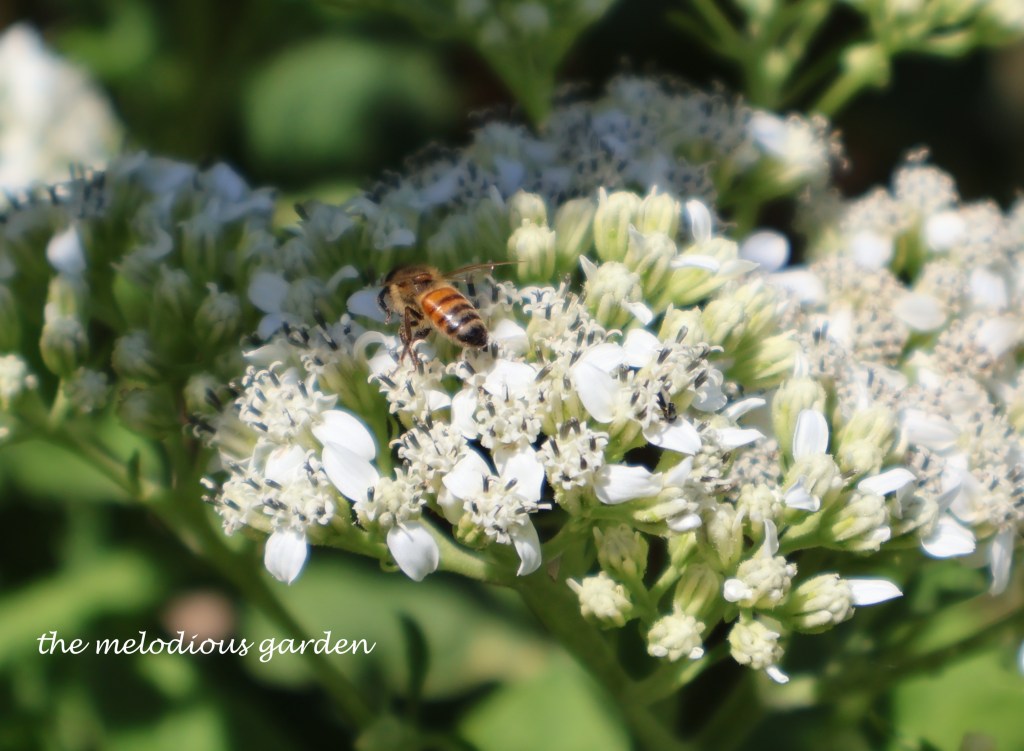
The past few years, I have vowed to keep my garden paths cleared. The past few years, I have failed at that goal. The salvia coccinea that reseeds far and wide throughout my garden love to sprout up in my pathways and push out from the flower beds. This morning – bright blue sky, crisp autumn air – the salvias are abuzz with Western honey bees. While Texas has more than 1,000 native bees, this is not one of them. This honey bee was brought here by Europeans and now is the dominant bee in my garden. On any given day, I have a dozen or more of them buzzing about. I recently pulled “Attracting Native Pollinators: The Xerces Society Guide To North America’s Bees And Butterflies” off of my bookshelf and hope to get it read sometime soon, in hopes that I can find some bits of wisdom to incorporate in to my garden. A garden is ever evolving, much as the gardener. It is never too late to pivot or to learn something new. Life is one glorious journey, full of opportunities. “What do you plan to do with your one wild and precious life,” the poet Mary Oliver asked. I intend to make my life more wild…
…I cannot endure to waste anything so precious as autumnal sunshine by staying in the house. So I have spent almost all the daylight hours in the open air. ~ Nathaniel Hawthorne
(Photographs were taken at the Flower Mound Town Hall’s Monarch Waystation garden on Sunday, October 18th, 2026.)
“Man, however, seems to be the only living thing that gets tangled in time. The trees never fall behind, nor does the grass… Maybe they have better clocks than man has ever made. Or maybe they get along better by not depending on such contrivances as man has devised to split the days into hours and the hours into minutes and seconds. I sometimes wonder just what advantage man ever gained by tying himself to a little machine that goes tick, tick, tick and counts one, two, three up to twelve and then starts all over again.” ~ Hal Borland
I was asked the other day if I still wrote and my answer was… well, time has a way of getting away from you, doesn’t it? How has two months passed since last I wrote? Where has that time gone? I have been off in my own head, with an article rattling about, just waiting for it to spill out on to the keyboard. Alas. Now is not the time for that piece; it needs to wait, bouncing around my head some more. In time, I will get a round tuit.
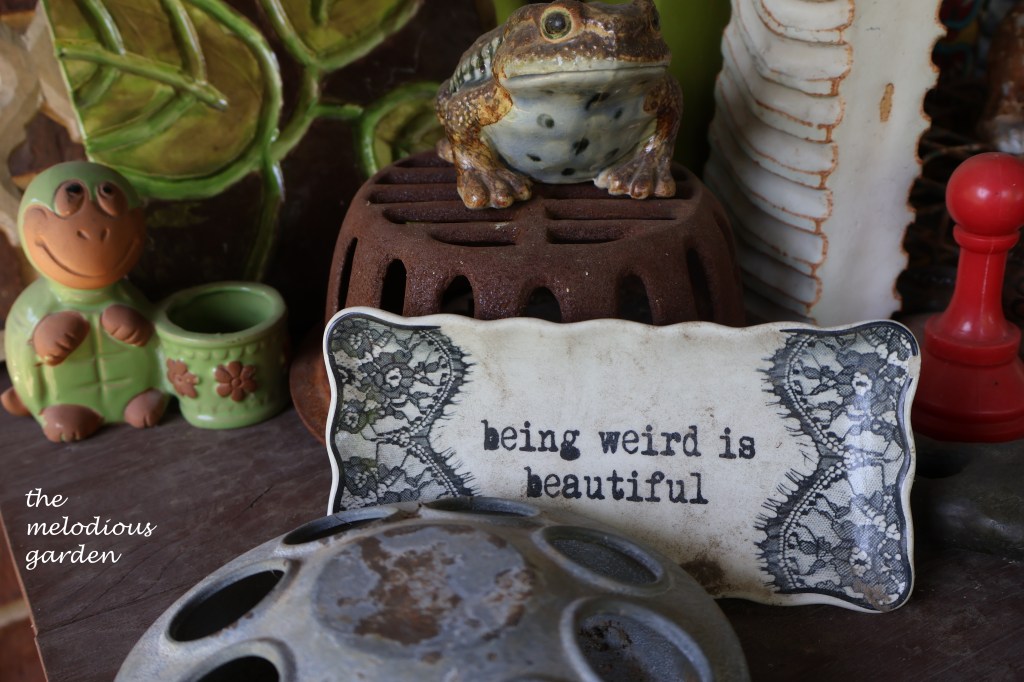
I have an affinity for weird things, odd cast-offs and such. Estate sales, antique markets, thrift stores and Etsy make my heart flutter – so many random and curious things, all in need of a new forever home. I know I can’t rescue all of them, but I do my darndest to save the ones I can.
A round tuit is one such thing.
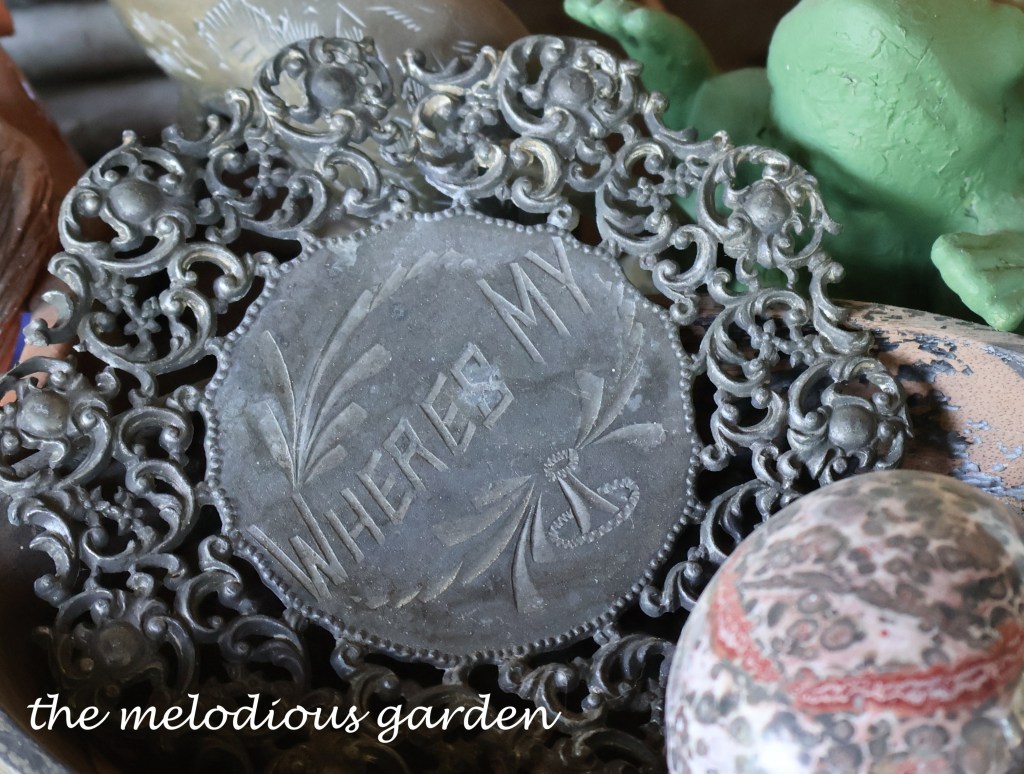
Is that the meaning of this? I actually have no idea. An old piece of ornate metal. “Where’s My” engraved in the center. Does it mean, “Where’s my round tuit?” I haven’t a clue. But it is wonderfully weird and so it feels right at home with me.
“The round tuit” – meaning “I will do it when I get around to it” – has been around since King Arthur’s days. Or since the 1964 World’s Fair. Your choice, I guess, because the internet is full of conflicting sources. I do remember my late grandma making “round tuits” to give out as Christmas gifts sometime in the 1980’s. And, yes, I tend to write When I Get A Round Tuit. Which, I know, has been much too long ago.
In all honesty, though – I have felt a bit of Imposter Syndrome of late. Am I a gardener? Or merely one that sticks seeds in the soil, only to see them sprout and — perish overnight?! Mowed down in the cover of darkness. My gardening skills have been put to the test as of late. How can one write about gardening when they are struggling so much with their own garden?
I was slow at first to respond to this gardening test, hoping that my lassez-faire approach to pest management would continue to hold. A well-balanced garden will right itself. For every pest, there is a predator. Let nature be and she will find a way. I finally realized – I Need To Take Action.
Perhaps it’s my own fault, for one of my garden signs reads: A well-planned garden feeds many mouths. Did one of the critters read this sign and tell their friends who told their friends and suddenly there was a major party going on outside every night?
Or maybe I jinxed myself for telling one too many people that a balanced ecosystem has a way of balancing itself out. Ah! Build it and they will come! Another thing I have perhaps said a few too many times could be to blame.
Maybe it was my absence from the garden last year as I recovered from shoulder and bicep surgery that opened the gates and rolled out the welcome mat to every critter and pest this side of the Red River?
No matter the reason, this has been a downright soul-sucking brutal gardening season. The pepper plants are constantly getting nibbled to the nubs. The tomatoes have been shredded. Literally! The stems, are being gnawed and shredded and destroyed one by one. The green beans? Mowed down. The peaches? Gone. Overnight. Every last one of them, not even ripe! The figs? Yes, they have suffered the same fate.
In desperation, I purchased a night vision trail cam and set it up along the back fence line of my garden. I needed to know what I was up against, right? In hindsight, was that a good garden purchase? Perhaps not. Did I really want to know that I have a virtual Noah’s ark of critters coming, two by two, through the night, scurrying along the fence? No, I don’t think I did.
Fake snakes and fake owls were deployed and moved around daily, all to no avail. Have I scared myself with the fake snakes? Yes. Yes, I have. I even said: The fake snakes won’t scare me. I’m not scared of snakes. I know where I put them, why would they scare me? Yes. I jinxed myself yet again.
One morning, a few weeks ago, I was hauling a large trash can full of garden prunings through the garden, on the way to the compost bins. Little did I know that I bumped against said fake snake. Little did I know that said snake fell off his perch above a tomato plant, where he was unsuccessfully scaring away the critters. Little did I know that said fake snake fell in to said trash can full of prunings. And there was I. Not scared of snakes. Proceeding to dump the trash can when the fake snake flipped out of the can and landed on to my arm. In that moment, it was a snake. A very real snake. Yes. I might have screamed like a girl and nearly fainted straight away.
Enter Plan D. Deterrent of another kind. Garlic is known to repel vampires, surely it would work on the rabbits and possums. Even better: mix the dried garlic with some hot pepper flakes. Alas. While sprinkling said mixture about my poor remaining tomatoes and peppers, I dropped the container and out spilled several cups of dried garlic and hot pepper flakes. Cleaning up that mess nearly did me in and, at that point, it was Me waging war against Myself and neither one of us was winning. And now, more than a week later, my eyes still burn whenever I hand water that area of the garden for those dollar store hot pepper flakes sure are super potent! This all leaves me questioning the old gardener’s wisdom that garlic and hot pepper repel pests. My garden smells like a 1980’s pizzeria at the moment and I can’t help but wonder what new critters have wandered in, in search of some pizza.
I have tried multiple methods of Plan B – Barrier – with mixed results. Covering young plantings with chicken wire or using old animal cages – meant to keep animals IN the cage – as a way to keep them OUT of the caged area. I have found that a determined critter will find a way. Placing mesh bags over ripening tomatoes only slightly annoyed whatever was intent on eating them. I would find the mesh bag, gnawed open, in one spot of the garden, the half eaten tomato in another. Seriously! If they are going to steal my tomato, they should at least have the decency to eat the whole thing, amiright?!
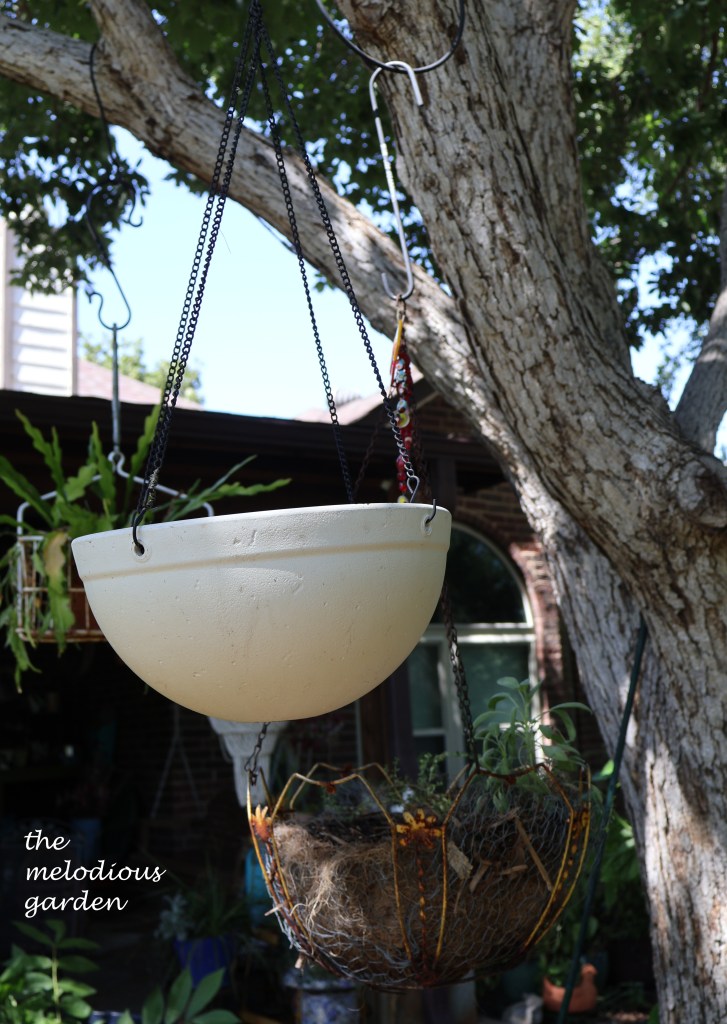
In addition to the nocturnal critters, I also have a squirrel that has decided to use one of my hanging baskets as his own dirt filled swinging hammock in the sky.
He – because all bad squirrels are males – uprooted the Cherry Falls tomato plant in that front basket, shown above. Where the tomato went, I haven’t a clue! Did he eat it or take it off somewhere? It was never found, dead or alive. To add insult to injury, his preferred route to get to said hammock is through another hanging basket, so he jumps down from the tree branch above, on to another basket (shown below), stays there a bit munching on some herbs, before jumping on over to the other basket where he spends his afternoons, happily splooted out where my tomato should be.
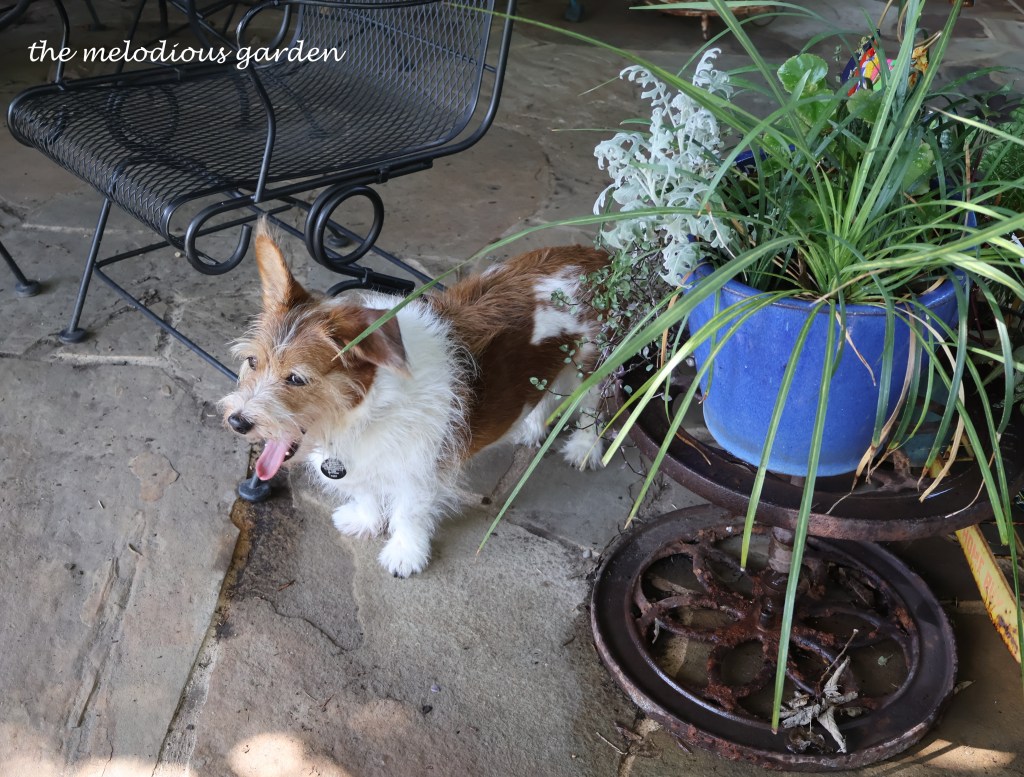
Plan D.O.G. has also been a fail. While my Princess Leia may love nothing more than chasing rabbits and squirrels and wayward neighborhood cats, come summer she prefers to stand and watch life go by from the shade of the patio.
This morning, I swear she looked at me and said, “Mum, it’s a bad hunting day, the rabbits are too fast, it’s too hot, it’s been real, it’s been fun, I’m ready to go inside now.” So she left me to garden by myself – forever hopeful, to continue sticking another round of seeds in the ground, for “Hope springs eternal!” in the garden. I am pretty sure Princess Leia shook her head and uttered “Fool” at me as went back in to the air conditioning.
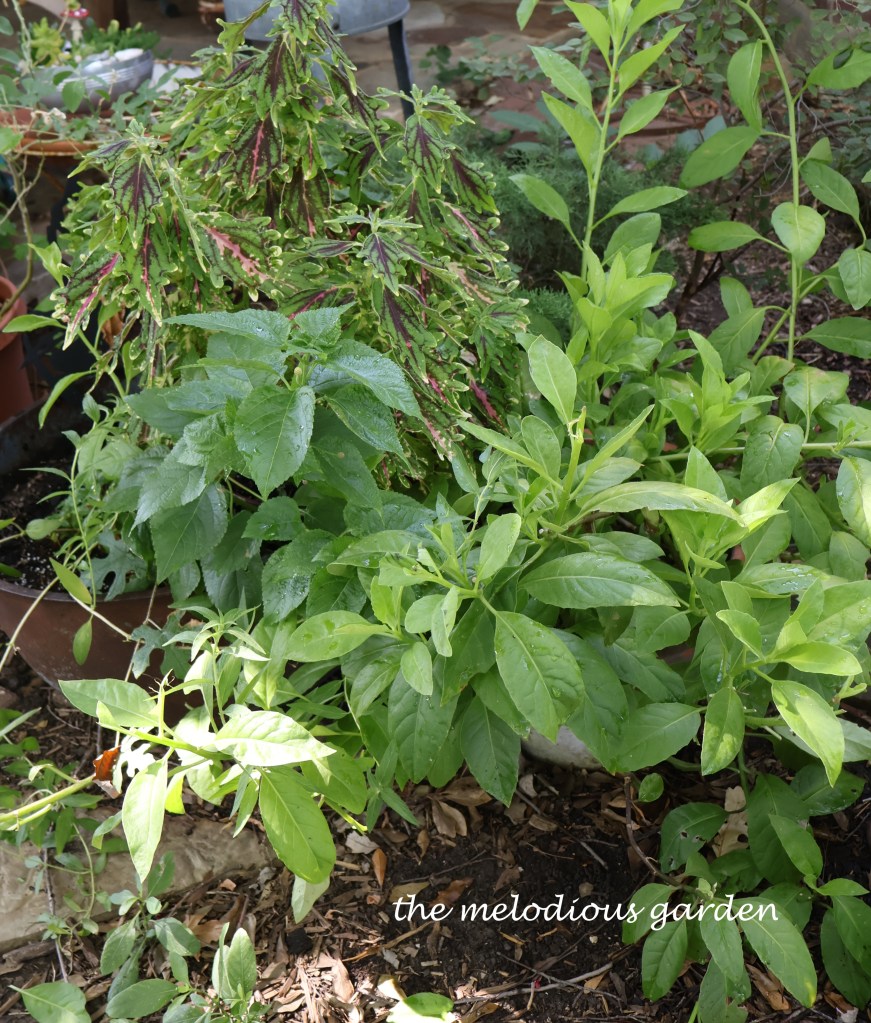
Desperation has set in. What keeps critters away? Or will I eventually have to admit defeat? The jury is still out. I am in discussions about building a legit fortress around the edible portions of my garden, but that will likely stay in the discussion and dream phase of development. So far, I am still in this to win it. I have hopes I will either find a solution or lean in to the crops that haven’t endured pest damage, such as the longevity spinach shown below.
Which brings me to Plan U. Up.
Yes, Up. For several years now, I have grown sissoo spinach, a tender perennial spinach variety, in a container. She has thrived outside in the summer, even in the heat of summer, granting many harvests and nary a pest. In winter, she is cozy inside the house. This year, for the first time, she was mowed down to the soil level one night. So Plan Up was put in to place. UP. And AWAY from the rabbits. Score one for Team Gardener!
Here in North Texas, we are entering one of our best gardening seasons – fall! Yes, the calendar may say it is August and the thermometer may be set to FurnaceHot, but now is the perfect time to be thinking about fall gardening and getting those fall crops in.
Bean and summer squash seeds can now be sown for fall harvests. We are about 100 days from our average first frost, so look at seed packets and see how many days to harvest specific varieties take. Winter squash often take 100+ days to harvest, but each variety is different. It is best to err on the side of caution and look for vegetable seeds that have 90 or less days to maturity/harvest.
Cool season crops, such as broccoli and Brussels sprouts, can be planted out as transplants toward the end of August. Winter greens, like lettuce, chard and collards, are easy to grow from seed, which can be sown directly outside in another week or two. (This gives one time to shop for seeds, either locally or mail order.)
Watering is key when planting (either by seed or by transplant) this time of year. Seeds will germinate quickly in our sun warmed soil but they take frequent watering, so be sure to monitor the soil’s moisture content and adjust watering as needed.
Time, hurries swiftly on, Each fleeting year seems shorter than the last, And many hopes which cheered its opening dawn, Are buried with the past. ~ Mary Ann H. Dodd Shutts
Keep Calm and Garden On.
All photographs taken today, August 13th, in my Denton County, Texas, garden.
“When at morn I saw the world in a dewdrop dress, I knew what had happened. The rain had kissed each flower lovingly. So sweet and so loving was the kiss That it shone like silver And the air was filled with fragrance.” ~Julia Cooley Altrocchi
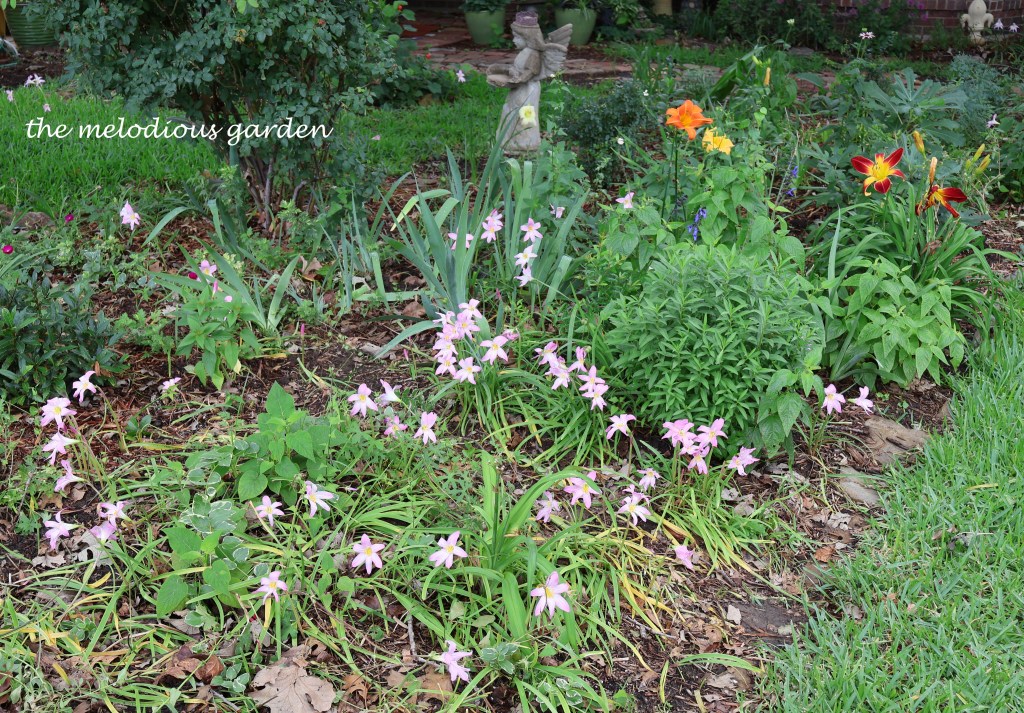
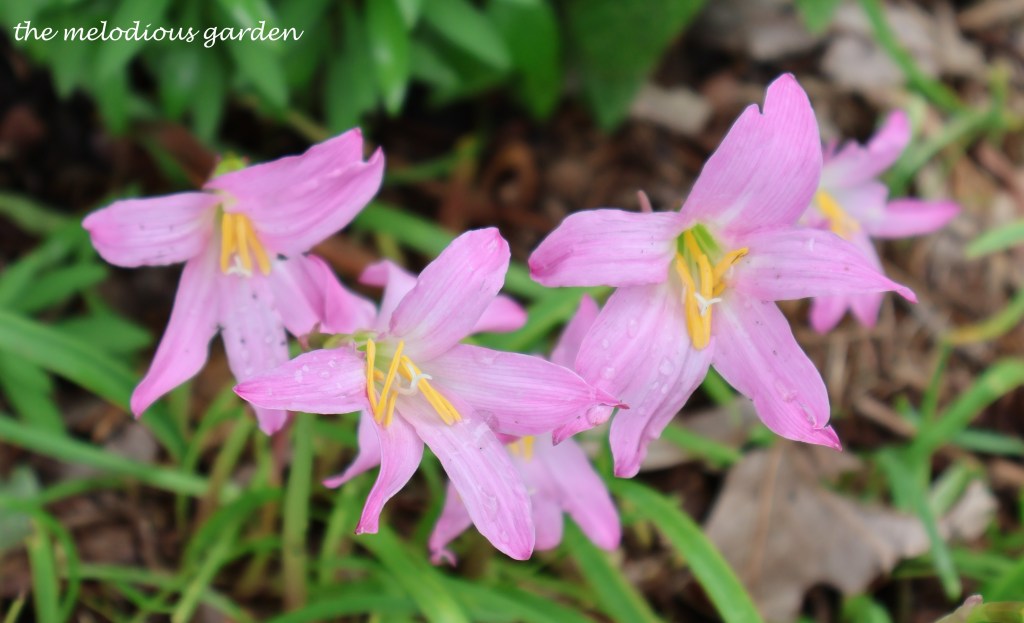
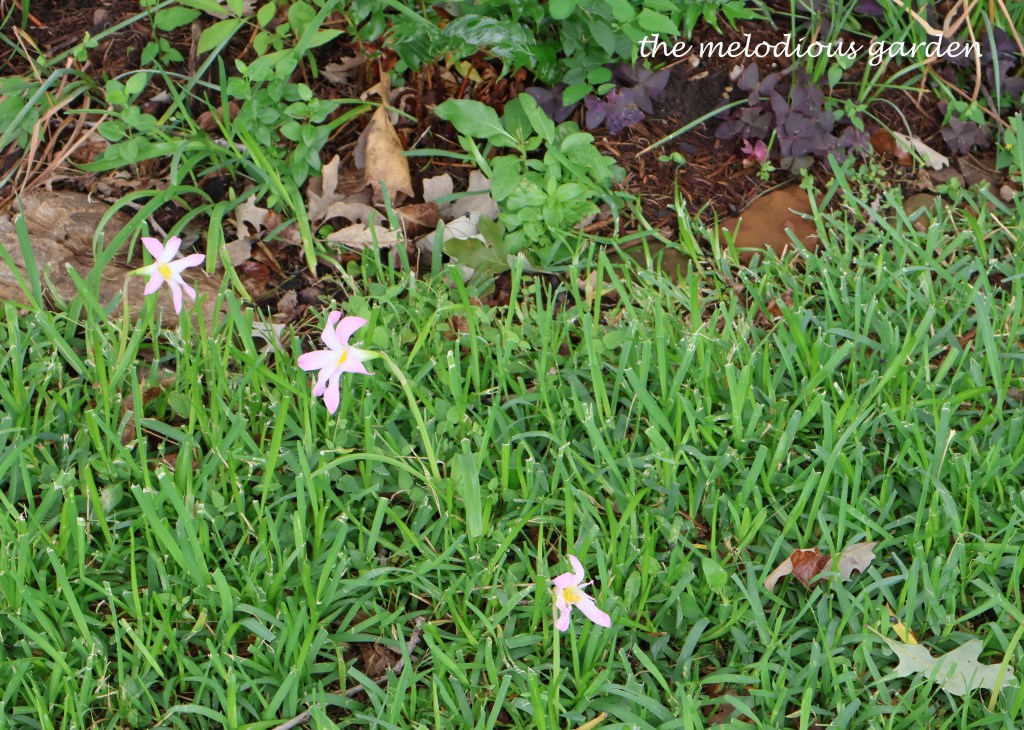
I woke up bright and early this morning to discover that the rain had once again kissed each flower in my garden ever so lovingly. Nearly an inch of rain in the rain gauge – what a glorious sight! The delicate pink rain lilies that freely reseed about my garden were all abloom – another glorious sight!
Zephyranthes – aka rain lily – is a member of the Amaryllis family, with strappy grass like leaves. It flowers off and on throughout the growing season, triggered by rain or supplemental watering.
The rain lilies that dot my garden were originally planted over 25 years ago and I have long ago forgotten the exact variety or name.
My original gardens, started 30 years ago, were – in the words of Shelby’s mom in Steel Magnolias – pink and pink. Blush and Bashful – two shades of pink, one much deeper than the other, to paraphrase the scene from Truvy’s hair salon.
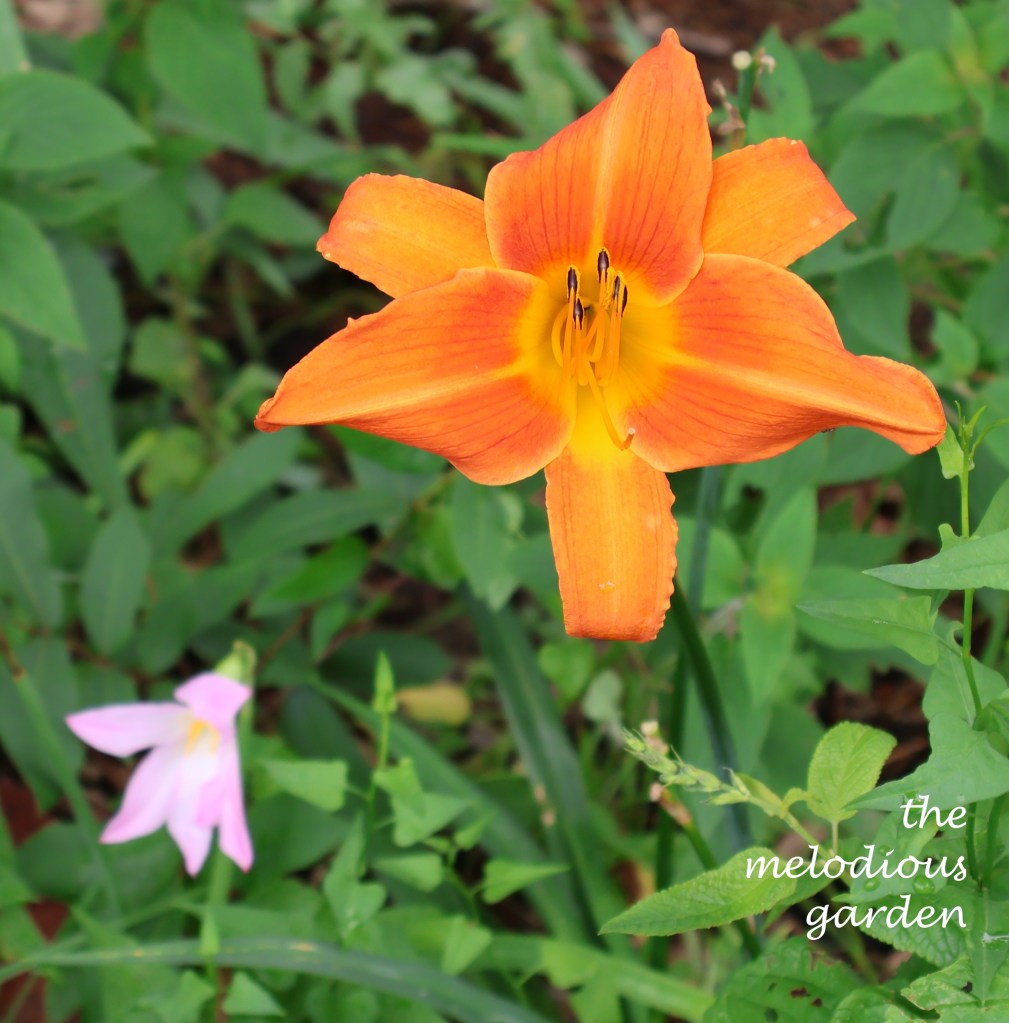
Yes, I loved pink. Pink roses. Pink daylilies. Pink irises. Pink rain lilies. But time marches on and tastes change. My gardens today feature bright and bold colors. Red. Orange. Yellow. But the pink rain lilies will remain. A nod to the former gardens. Of course it helps that the pink rain lily is the perfect compliment to a bright orange daylily.
I also doubt I could dig up all of the tiny rain lily bulbs now if I wanted to!
Did I mention they have even migrated out to our only small patch of lawn? I imagine someday – hopefully years down the road – I will be gone from this space yet the rain lilies will bloom on and on, for future inhabitants of this place to enjoy. Or curse – though I can’t imagine anyone hating such a lovely bloom.
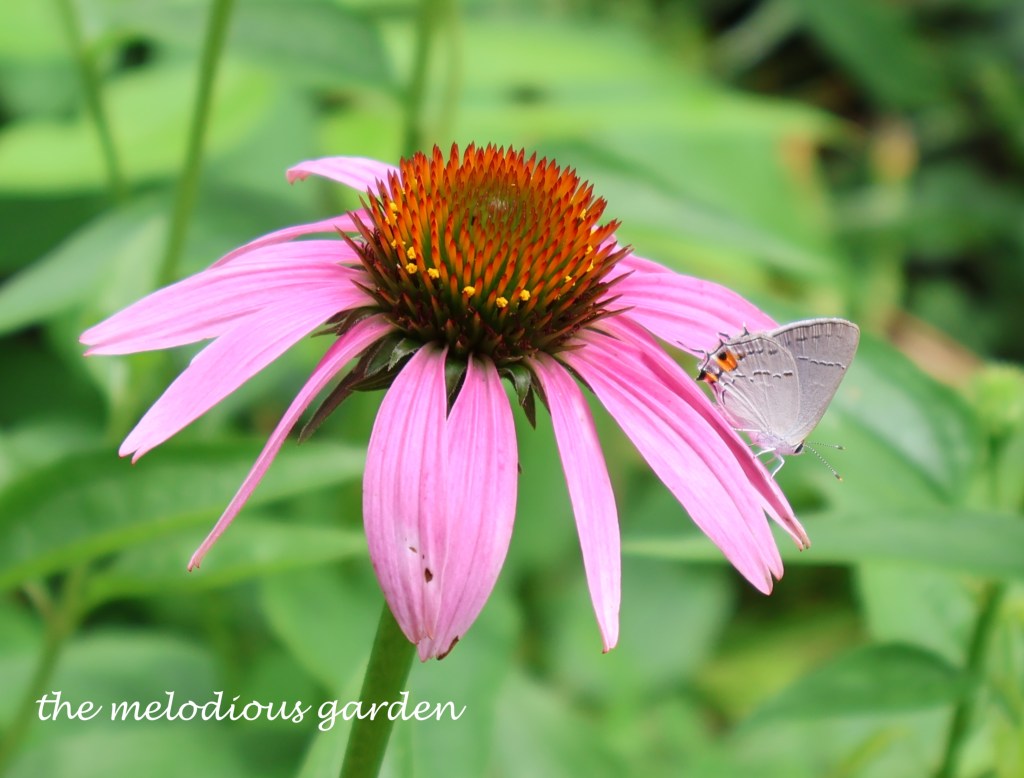
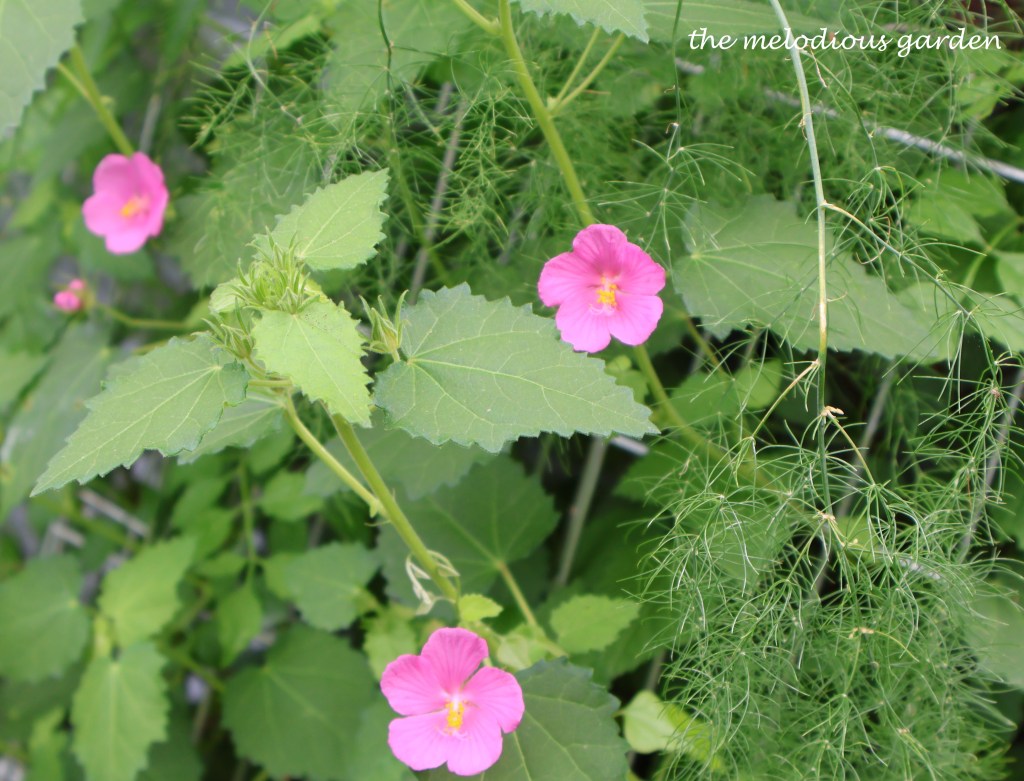
Other soft pink flowers that will always be a part of my garden are the native coneflower (Echinacea) and rock rose (Pavonia). Both reliably draw in pollinators and freely self-sow about the gardens.
(Coneflower, shown above. Rock rose, shown below.)
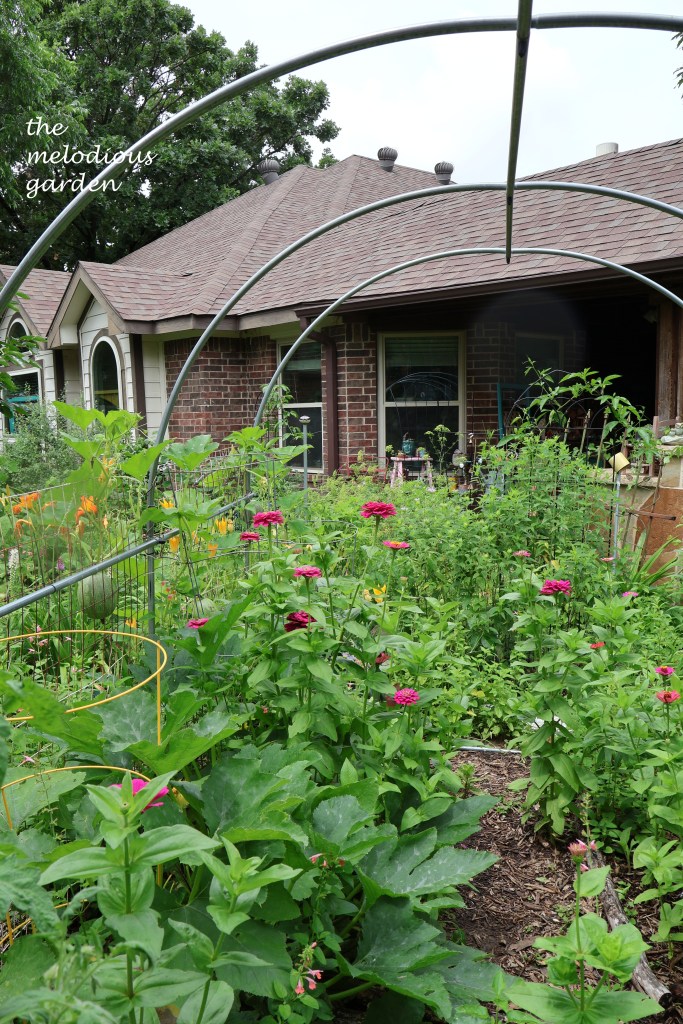
It almost goes without saying, but hot pink is always allowed in my garden because it so nicely fits under the bright and bold category. Pink zinnias are currently blooming in what was meant to be my flower-free, dedicated vegetable growing polytunnel space. The polytunnel will, hopefully, allow me to extend the vegetable growing seasons a bit on each end. A winter cover will give a few tomatoes and peppers some protection against freezing weather, while also allowing me to start peas much earlier in the year. A shade covering in the heat of summer will, if all goes as planned, protect sensitive plants from our brutal August sun. Neither have yet to be tested, but they sound good in theory.
This spring has been filled with rainy days and cool, but terribly humid, overcast days. Alas. Due to our extremely dry winter, North Texas is still almost three inches behind on our average rain amounts. Longtime Texas gardeners know to appreciate this weather while we can because we never know when the faucet might turn off and the heat crank up.
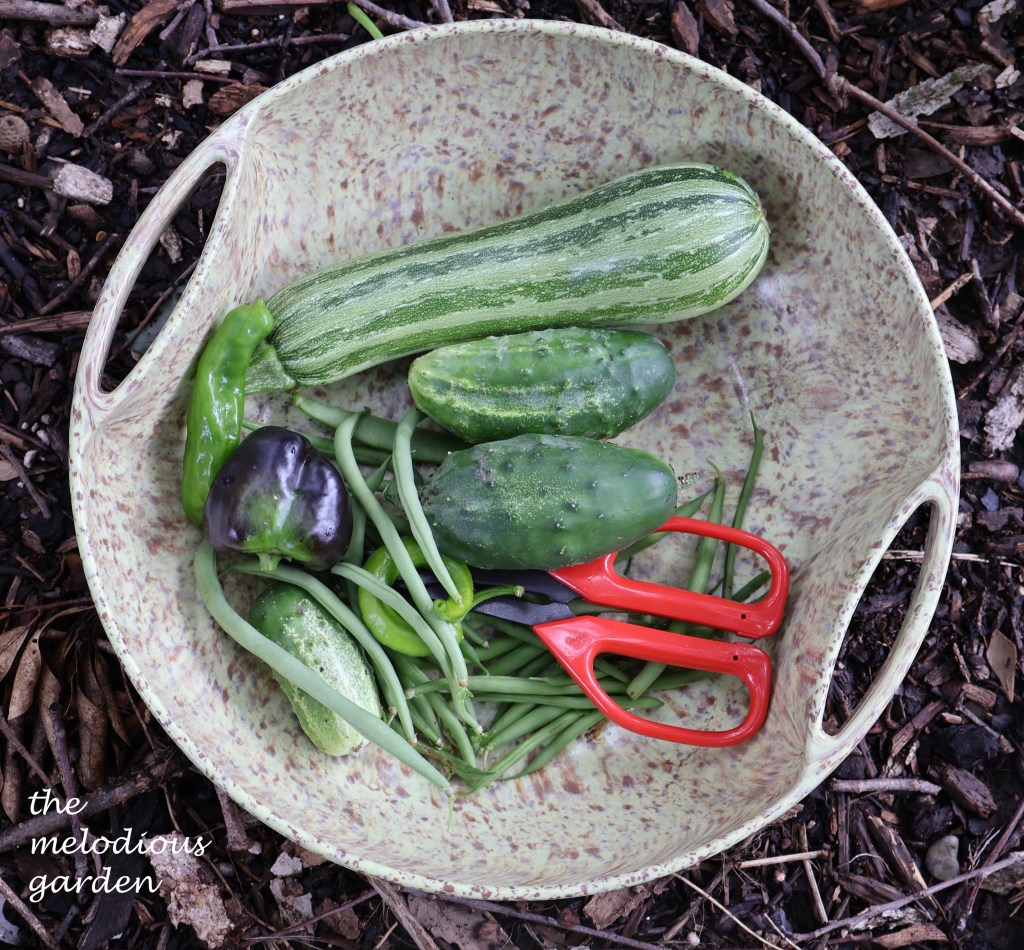
My food forest garden – except for the zucchini – has been slowly turning out vegetables. Nearly every day, I have something to harvest and use as a base for a meal. The zucchini has been – well, it is zucchini, amiright? I froze two zucchini today, after freezing four zucchini and dehydrating three zucchini over the past weekend. We have eaten fried zucchini. We have eaten zucchini fritters. We have eaten black bean zucchini tamale pie, wherein I used two zucchini instead of the one the recipe called for. I have gone to bed confident that I have only two zucchini in the fridge to eat or preserve the following day, only to wake up and discover four zucchini await. It is a great problem to have, though, as I know I will make good use of the excess.
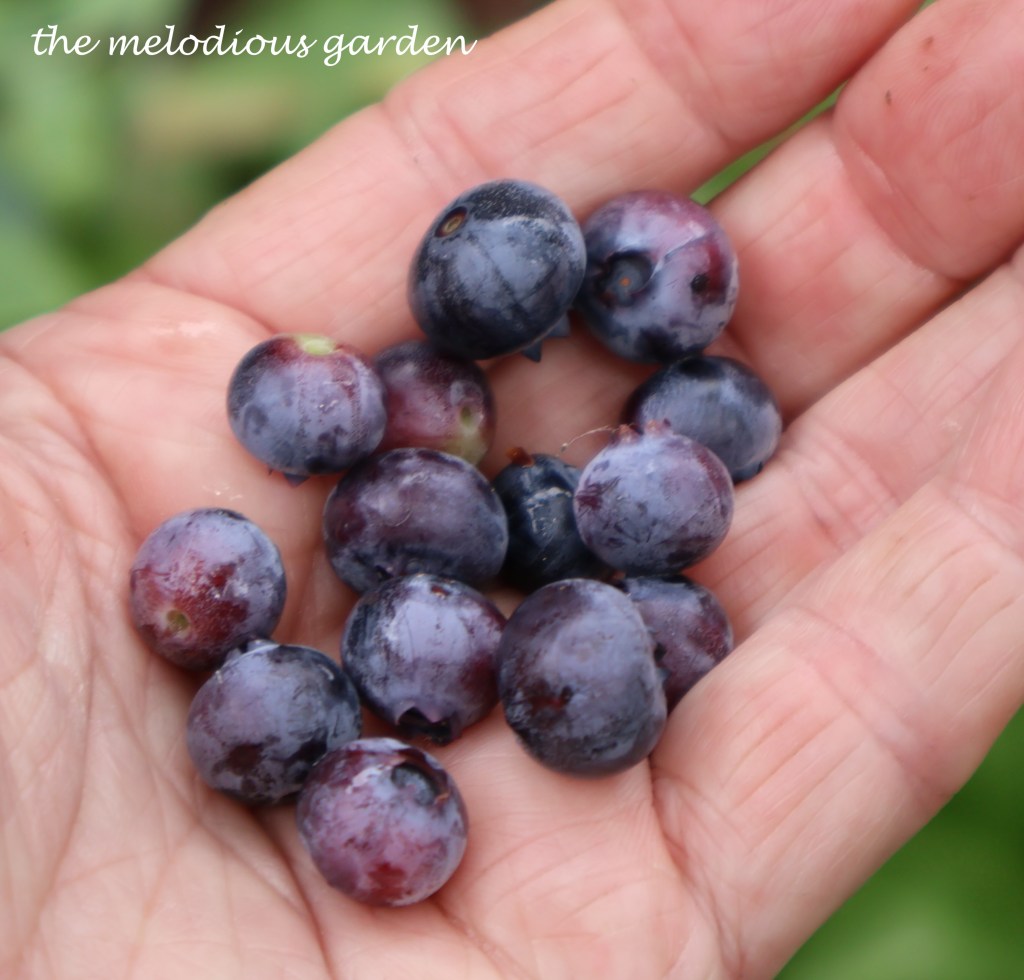
This has been the first year for the blueberries to produce. I am still a long way from having enough to make a pie, but there have been a few days I could possibly have a decent amount for a solo pancake, if they ever made it inside the house. It has been such a pleasure to pick and eat the blueberries immediately while still in the garden.
Keep calm and garden on. When life gives you zucchini, make fritters.
Southern Bulb Company is a fabulous mail order source for rain lilies (and various other bulbs.)
The rock rose photograph was taken earlier this month in my zone 8b North Texas garden. All other photographs were taken today, May 27th.
Today is World Bee Day, a chance to celebrate the humble bee. I don’t know about y’all, but I will likely celebrate with a little trip to a garden center to purchase a bee friendly plant or two. My gift to the bees. It’s the gift that keeps on giving.
World Bee Day is celebrated on May 20th, in honor of the pioneer of beekeeping, Anton Janša, who was baptized on this date in 1734.
“Among all God’s beings there are none so hard working and useful to man with so little attention needed for its keep as the bee,” Anton wrote in his 1775 book A Full Guide To Beekeeping. While 250 years have past since Anton penned his praise of bees, the idea of a world holiday in honor of the bee has actually only been around since 2018. This day may have its roots in beekeeping, but it is a way to bring awareness to all pollinators and their relationships with humans and healthy, thriving ecosystems.
We have all seen the headlines. Pollinators are in trouble. Insect populations are in decline. But many people don’t realize that they have the ability and the power to help. We tend to look at the larger, global issues and feel overwhelmed, but we can dial it down to a local level and have a real impact on our own native pollinator populations.
Bees are the most important group of pollinators for our food supply but many other insects, such as beetles, butterflies, moths, flies and wasps, also play a vital role in pollinating. On a global level, there are somewhere between 200,000 and 350,000 species of pollinators, with an estimated 20,000 species of bees. On a local level, Texas is home to around 1,100 to 1,500 native bees. Many of the actions we can take to support our local bees also support other pollinators. Knowing and understanding why pollinators are in danger is to know and understand what we can all do to help.
Challenge: Native habitats that pollinators depend on for survival are dwindling as construction and development worldwide take over much of our land space. Many new housing developments are ecological dead zones, perfectly manicured suburban lawns that are void of diversity and wildlife. Shopping centers and their parking lots sustain little more than grackles, while streets and highways connect us from sea to shining sea. “They paved paradise and put up a parking lot” is sadly just as true in 2026 as it was in 1970 when Joni Mitchell first sang those lyrics.
Solutions: Reimagine the traditional foundation planting or typical landscape design and embrace pollinator friendly plants. When selecting pollinator friendly plants, it is always best to buy native, non-hybridized varieties whenever possible. In Texas, we are so blessed to have the Lady Bird Johnson Wildflower Center in Austin, which promotes our state’s diverse array of native plants. They are an incredible resource for plant information; I don’t consider any plant buying expedition a true adventure until I have at least one tab open on my phone to their database of native plants. My Mother’s Day trip to Redenta’s Garden in Dallas found me looking up a new-to-me plant: Texas craglily, Echeandia texensis. Yes, my own garden is a long way from its native habitat in the Rio Grande Valley, but I have just the rocky spot to give it a try. Native plants can be utilized in any landscape style, from courtyard formal to cottage abundance. Adding non-native, non-invasive annuals, such as zinnias and cosmos, is perfectly acceptable to bridge gaps in the landscape while waiting on native perennial plants to fill out in size.
Be sure to include native trees, shrubs and vines in the landscape as those are important parts of a thriving ecosystem and many of them are the larval hosts for pollinators, such as butterflies and moths. Avoid monocultures, such as the typical turf grass lawn with a hedge of non-native shrubs along the sidewalk. Plant for diversity. It is also important to have successions of blooms so your garden – however small or large – has something in bloom throughout the seasons. Even a few containers of nectar rich flowers on a balcony or patio can provide important food for pollinators.
Challenge: Extensive pesticide use, both on a home scale and on a commercial scale, which doesn’t take in to account that 90-95% of insects are actually beneficial or indifferent (neither good nor bad bugs.)
Solutions: Eliminate unnecessary use of pesticides. Only about 5% of all insects are actually harmful, yet pesticides are indiscriminate and kill across the spectrum. A chemical that kills a tomato hornworm will also kill a monarch butterfly caterpillar. There are numerous resources available for organic (non-pesticide) gardening, though I have found that a well balanced garden is the best approach to keeping unwanted insects at bay. Kim Eierman, author of The Pollinator Victory Garden, said it so well: Nature is on our side if we support it.It is also important to support organic farmers and growers whenever possible. Ask for organic larval host plants at your garden center. Even though the garden center may not currently carry them, it shows them that customers are interested.
Challenge: But what will the neighbors think?!
Solution: Oh, honey. I gave caring what the neighbors think many plants ago! When my husband and I were house garden hunting 30 years ago, I already had a mental image of what my eventual garden would look like. It took us quite a while to find the property – with a house – that I fell in love with. That extra time and energy was worth it because 30 years later, I still love where we landed. I knew I didn’t want in a neighborhood with an HOA. I knew I didn’t want a typical square backyard where you entered a gate and saw the entire back garden at once. I also knew I didn’t want to be that house on the corner lot that stood out as vastly different from every other house on the block. I do love gardens like that, but – 30 years ago – I wanted tucked away, free to play with my garden without watchful eyes.
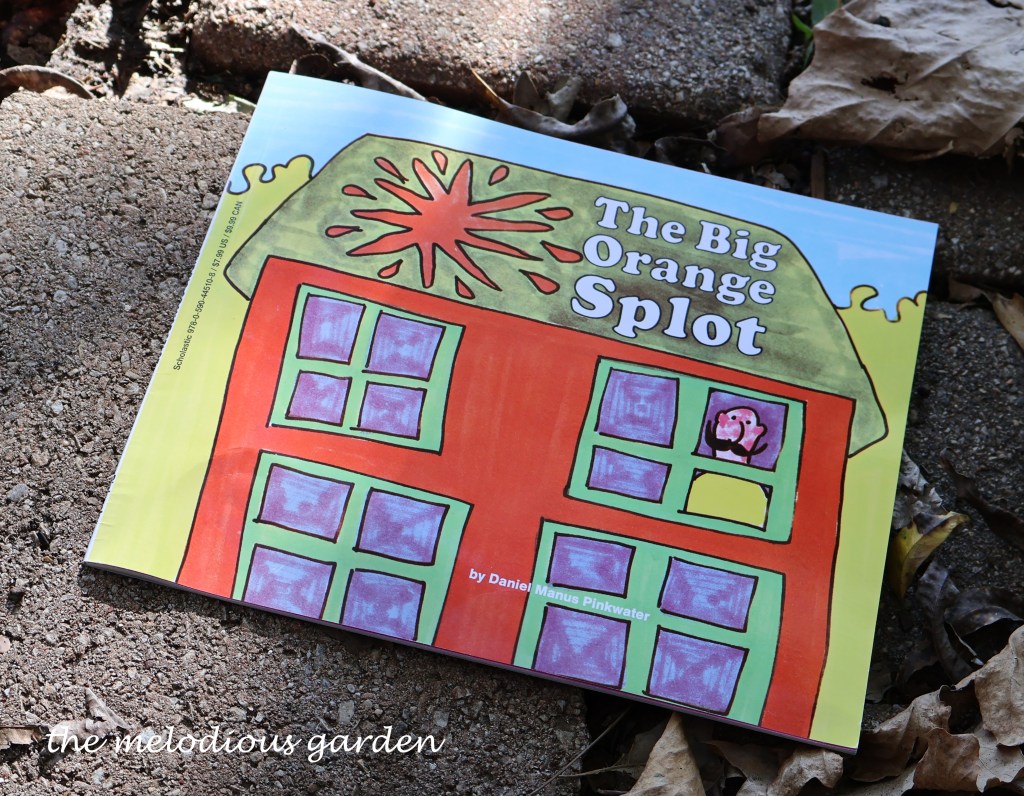
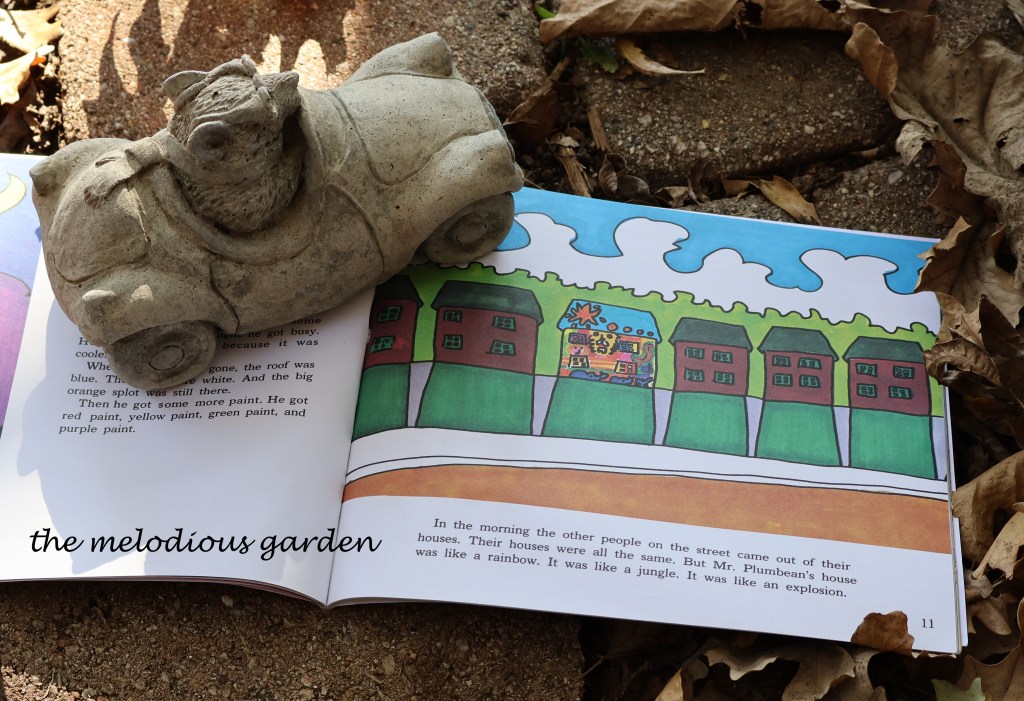
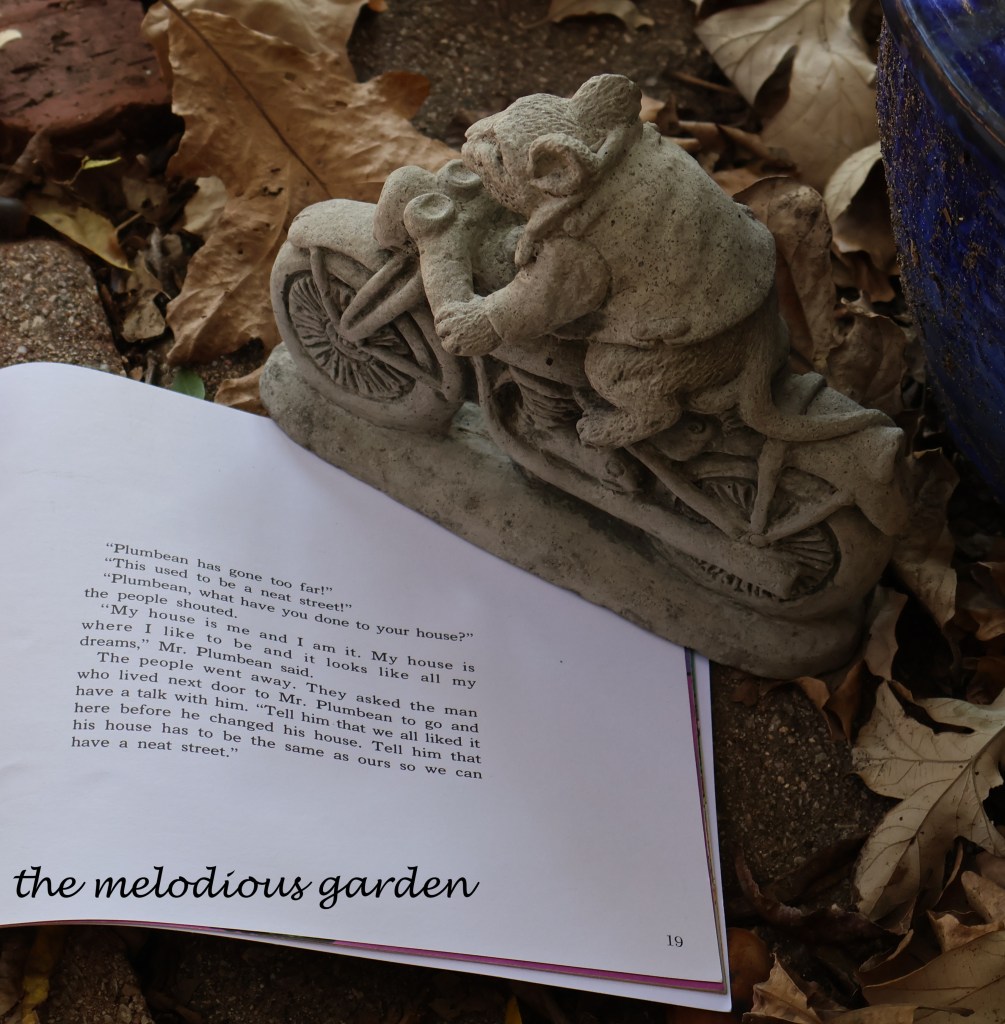
Today, I realize that most neighbors quite love my garden. In the 30 years that we have lived here, I have only gotten one negative comment from one neighbor. I have gotten hundreds of positive comments. Last year, I came across The Big Orange Splot, a children’s picture book which seemed very appropriate for me and my garden.
To paraphrase Mr. Plumbeam, My garden is me and I am it. My garden is where I like to be and it looks like all my dreams.
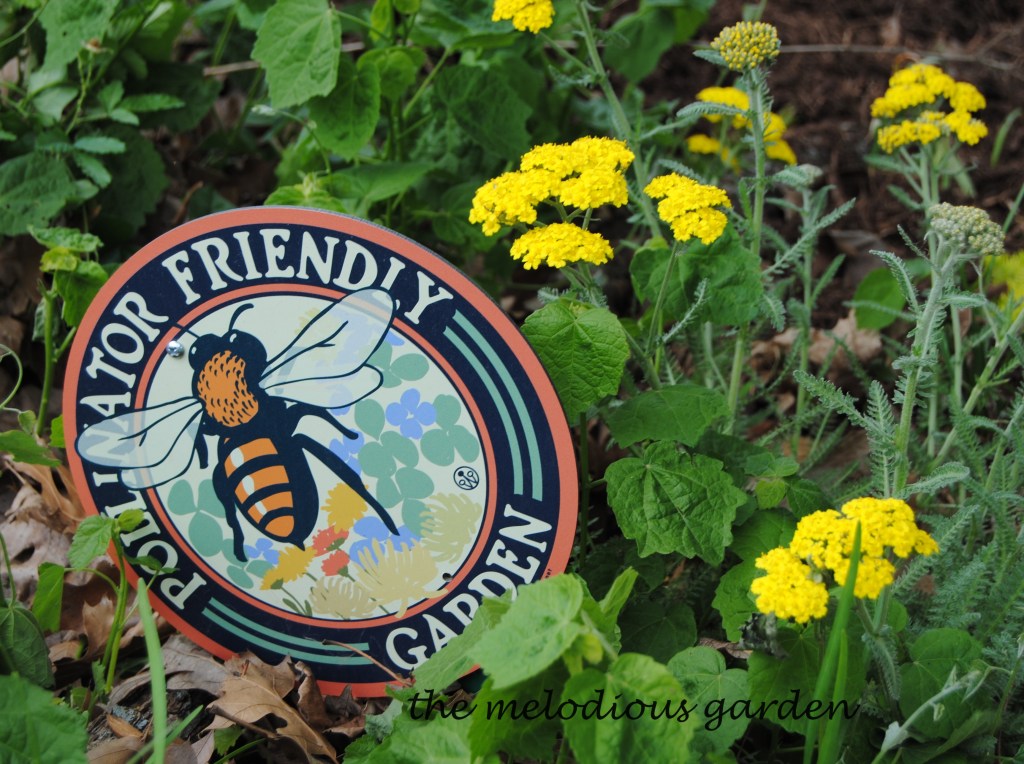
A few years ago, I did add pollinator signs in my front garden beds, as I believe the signs raise awareness and maybe make people curious about what a pollinator friendly garden is. Perhaps they will now associate certain plants as beneficial to pollinators. The signs also show the neighbors that the garden is intentional. It isn’t a weed patch. These are pollinator friendly plants that I selected for that very purpose.
Kim Eierman is the author of The Pollinator Victory Garden: Win the war on pollinator decline with ecological gardening. She spoke at Texas Woman’s University in April.
The first two photographs were taken at Texas Woman’s University in April of this year. The remaining photographs were taken in my Southern Denton County, Texas, garden in 2025.
“In the spring I have counted one hundred and thirty-six different kinds of weather inside of four-and-twenty hours.” ~ Mark Twain
This past week alone has found us with 136 different kinds of weather. Monday, the day I decided to reset my driveway food forest for the summer sunlight, was a stifling 90+ degrees. Tuesday afternoon, I moved half of my driveway food forest (again!) to make a path to get one of our vehicles in the garage due to a severe storm. I have found that an adrenaline fueled mad rush to get a vehicle under cover, as a storm is bearing down on us, is the best insurance against a storm actually hitting us. Tuesday’s storm again proved that, as the storm skirted just to the west of us, with softball size hail 60 miles away. By Thursday, I was back to gardening in winter clothes, as it was cloudy and damp, barely hitting 60 degrees. I planted corn, okra and amaranth on Thursday, though I did apologize to the seeds, for I know they much prefer warmer, sunnier weather. Those days are coming soon enough, but not today. This morning, like most mornings, I grabbed an apple to eat while doing my early morning garden walkabout. Fifteen minutes later, it felt nice to step back inside and feel the warmth of our furnace hard at work, likely its first ever May Day to run. The garden, I am pleased to say, is looking exceptionally good at the moment, as the flora has appreciated the rainy days after such a dry winter and early spring and don’t appear to mind the temperature swings quite as much as I do.
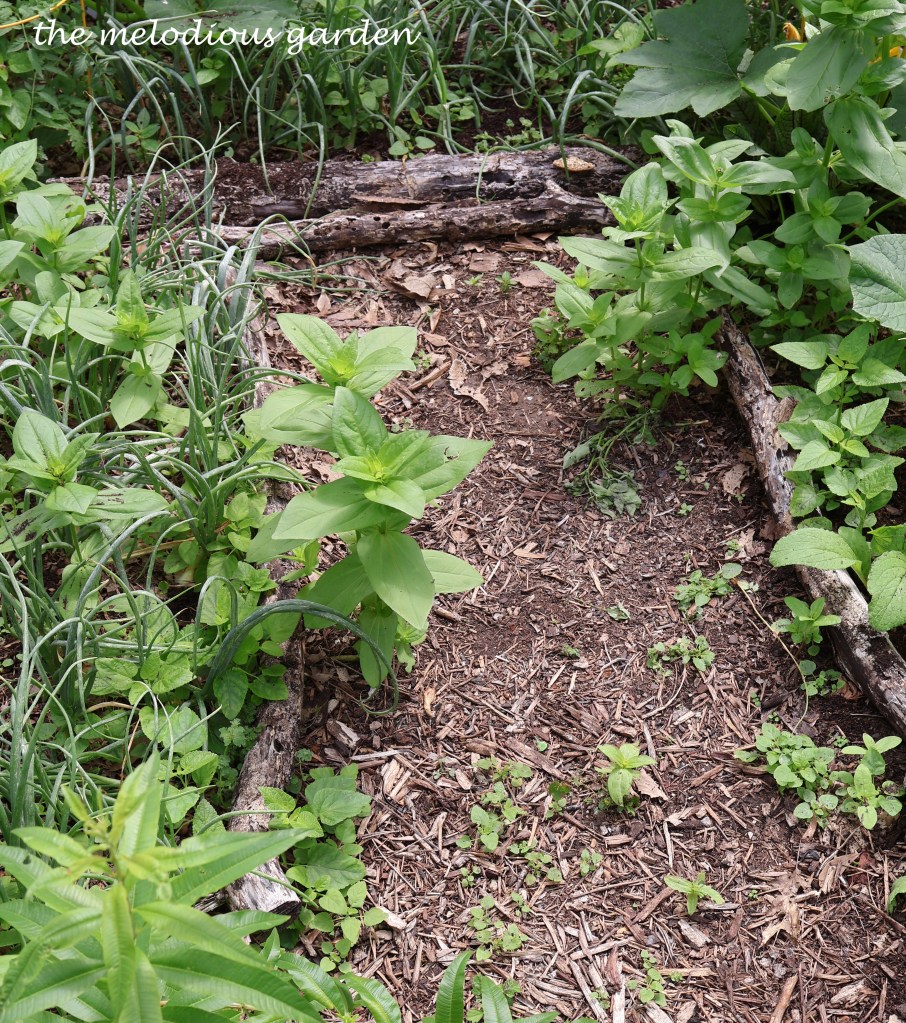
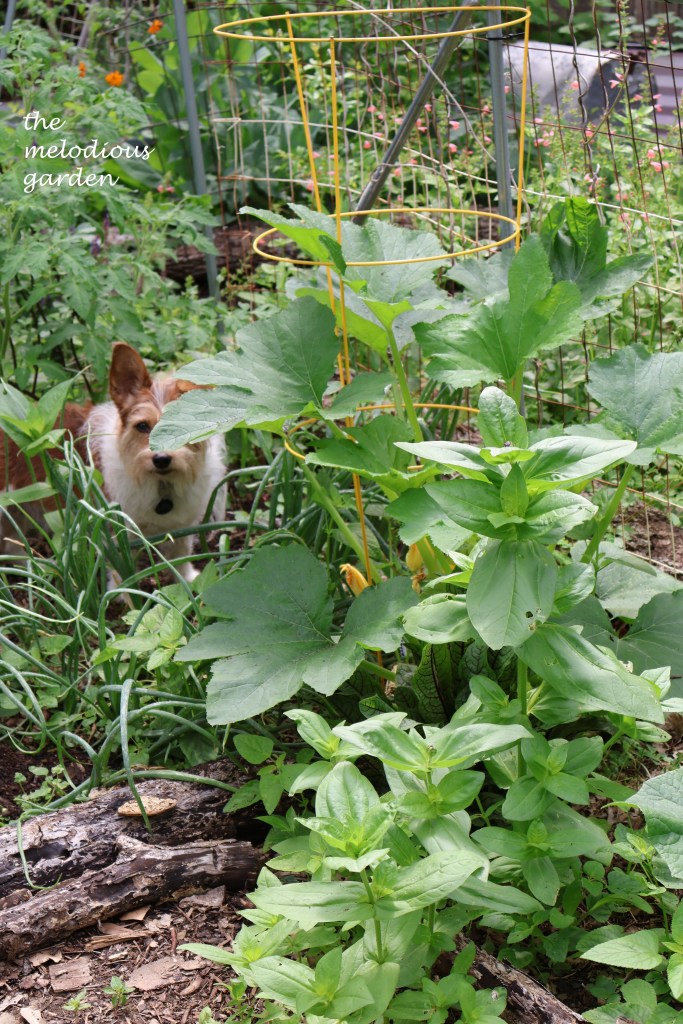
I am not one to make New Year’s resolutions, but I did resolve that this was the year I would not let flowers take over the garden paths or the vegetable beds. I would have dedicated areas for flowers and dedicated areas for vegetables. The two could touch and mingle around the edges, but I would not sacrifice my vegetable beds to wayward flowers. I am, by nature, a bit of a chaos gardener; I garden with reckless abandon and throw caution to the wind. But this year, I would reign that in! And here it is, the first day of May, not even the height of summer blooms, and already I am making allowances. I know I did not sow zinnia seeds inside my polytunnel. Did one of our heavy rains float the seeds here? Did the zinnias reseed from previous years? I really don’t know. What I do know, though, is that I now have zinnias coming up in what is suppose to be a dedicated vegetable bed. And also coming up right in the middle of the path inside this area! I have now failed on my resolution twice over because I just don’t have the heart to pull them or dig them up to move elsewhere. I also have salvia coccinea coming up in this area, but it can be a bit of a thug and I don’t mind pulling up the excess. The zinnias, for now, can stay.
While photographing the zinnias and zucchini, I also solved the mystery of why my onion stalks are falling over prematurely. I have been blaming the rabbits and squirrels, for I have seen both of them running over the onions on numerous occasions. Alas. I do believe it may be the work of my Rabbit Hunter and Squirrel Chaser, my Princess Leia. It’s a good thing she is so cute.
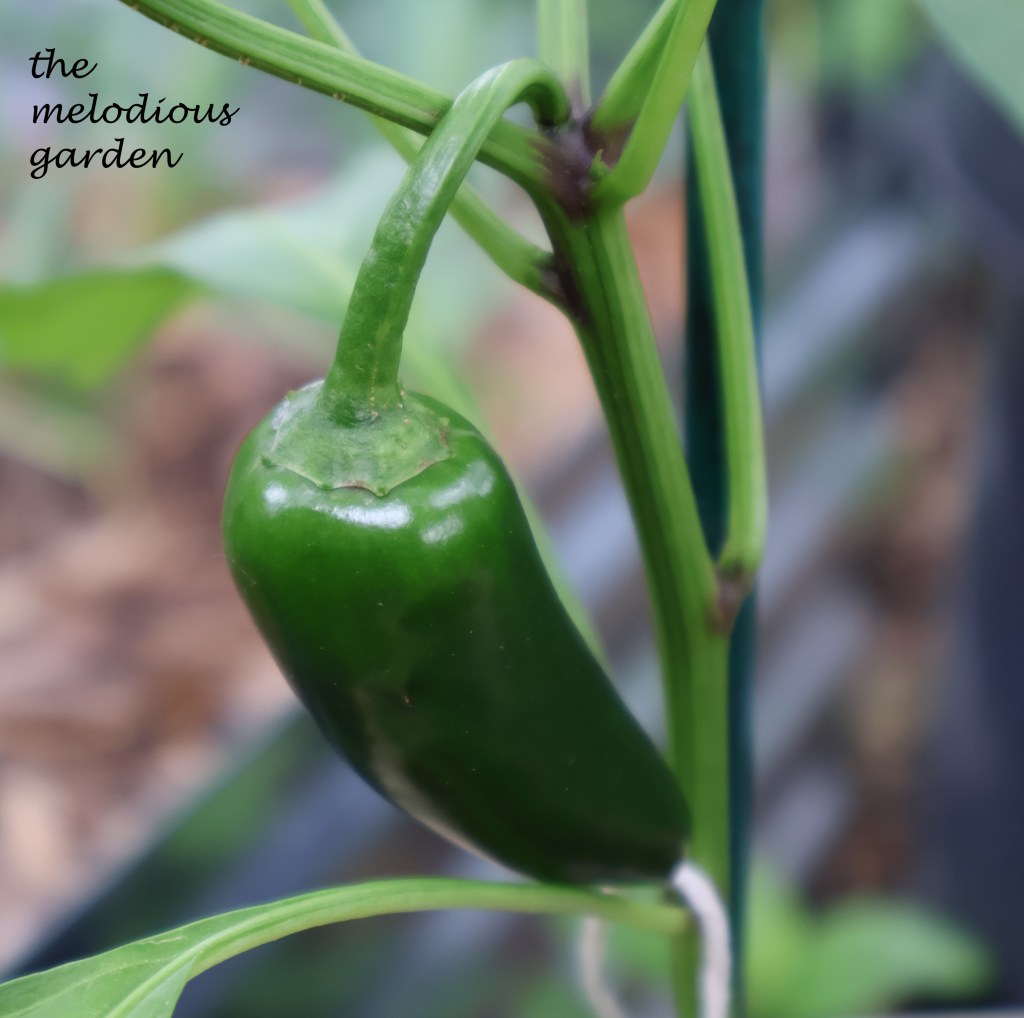
Last year, after my father’s death in March, I struggled to get my head in the game. I spent the spring and early summer floating aimlessly about the garden, needing some sort of direction. In mid-summer, I found out that I needed shoulder surgery and would be out of the gardening game from August through fall and in to early winter. This spring has been a deep sigh of relief, a time to renew my passion for growing an abundance of vegetables. The garden is rewarding me with a few early harvests, not enough to bring inside just yet, but a sneak peak of what – hopefully! – is ahead. I have been able to enjoy a small snack of green beans or cherry tomatoes here and there, eaten fresh off the plant. Peppers, despite some chilly days, are beginning to grow and ripen. (Serrano pepper shown below.)
“The word May is a perfumed word… It means youth, love, song; and all that is beautiful in life.” ~ Henry Wadsworth Longfellow
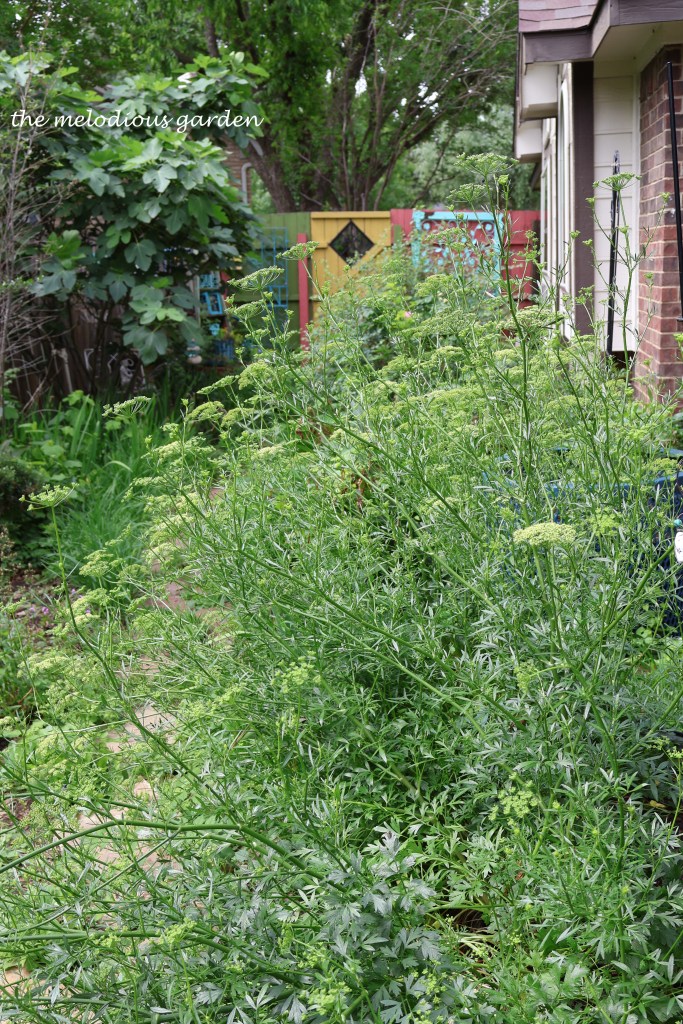
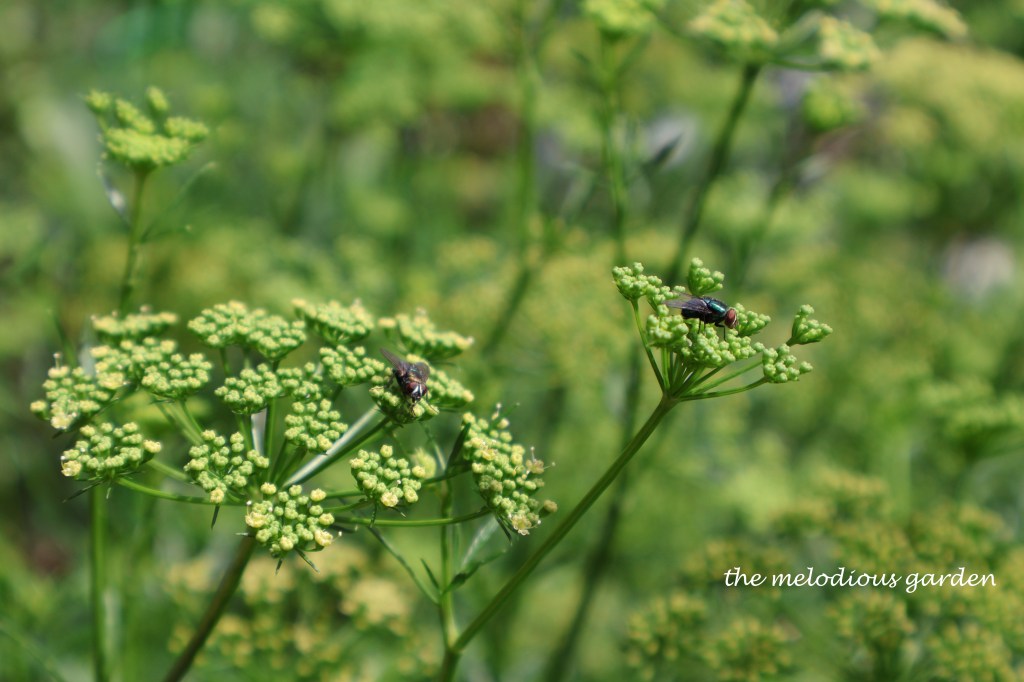
I decided to let the flat-leaf parsley go to seed, for the pollinators love its umbel flowers, held well above the main growth of the plant. (Shown in photographs above and below.) Today, it was abuzz with bees and flies. Flies are much maligned but make excellent pollinators for they will venture out even on stormy days.
May — The very word makes the heart leap. Birds, Buds, Blossoms, Beauty! Break away from every bondage of circumstance or low spirits and go out into the sunshine. Answer back the bird-note in your heart, kiss your finger tips to every new blossom and be a part of the spring. ~ Eva D. Kellogg
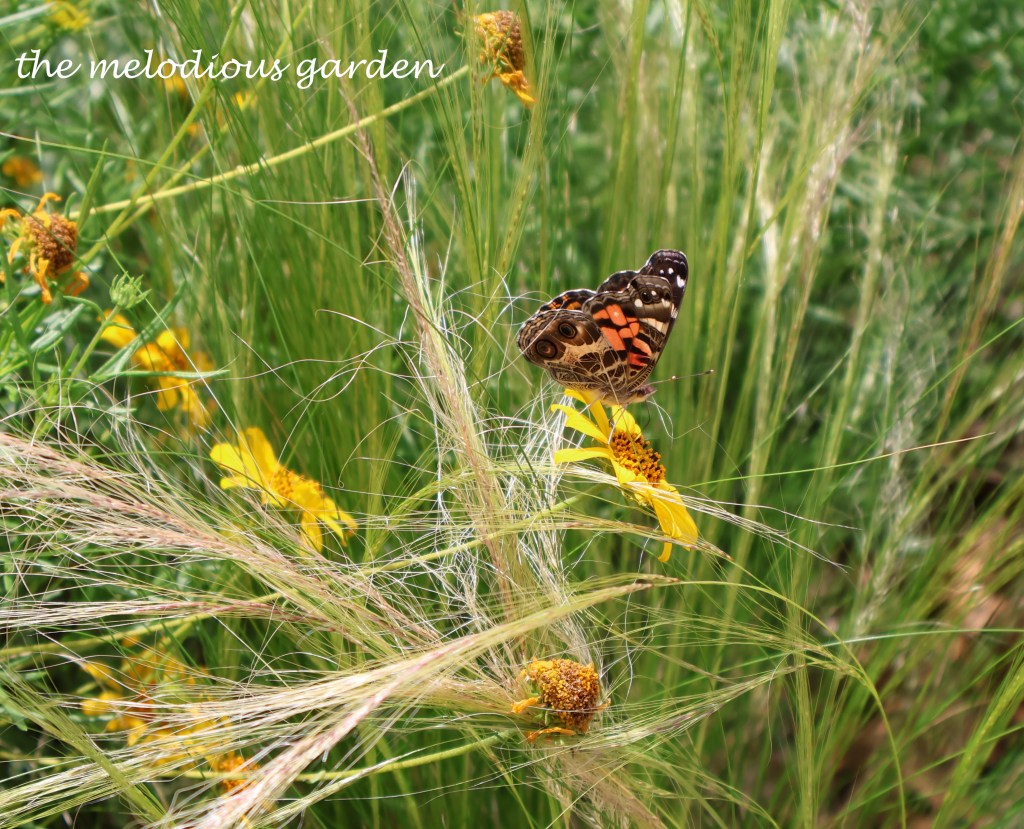
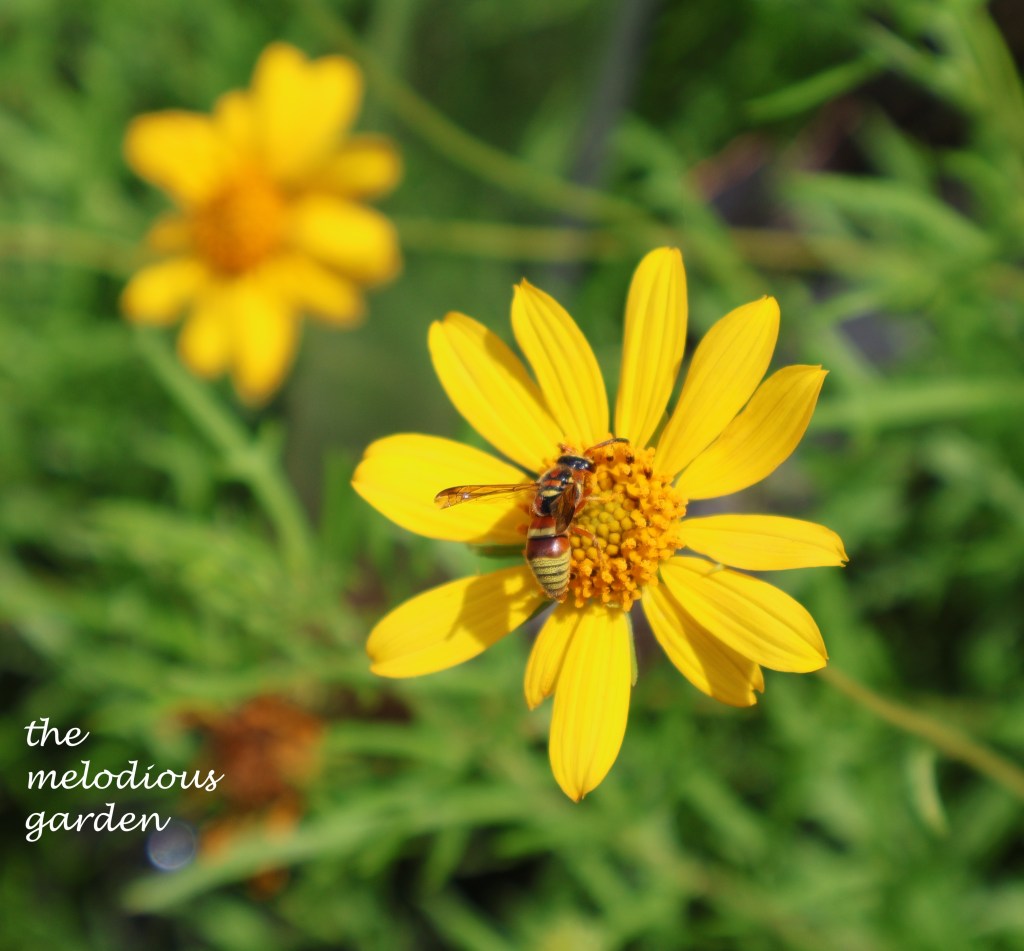
Blossoms and Beauty, indeed! I cannot believe it took me 30 years to plant skeleton-leaf goldeneye, a Texas native wildflower in the sunflower family. It has quickly become one of my favorite plants, as it is a favorite of pollinators and – doesn’t it just look spectacular with the shimmery Mexican feather grass?
Two added bonuses: It blooms from late spring until fall, which is an unusually long bloom time for a perennial. It also thrives in hot, dry environments. Last spring, I first planted one in that “hell strip” area – the small strip between the sidewalk and the street, where it gets baked in the sun, roasted by the reflected heat of pavement and ignored by the water hose.
How beautiful are the rosy footsteps of May! Less showery and changeful than April, and not so heated and burdensome as June, she stands like a gentle mediator between the two… With her soft blue eye, and her mild but radiant countenance, she comes like an angel of light among men… She scatters in her path the sweetest flowers of nature, and everywhere breathes fragrance and joyousness. The birds of the air are caroling her welcome, and even the mute beasts of the field seem happier at her coming. ~ Eliza Cook’s Journal
Happy May Day! Keep calm, garden on and enjoy these spring days.
All photographs taken May 1, 2026, in my southern Denton county, Texas, garden. Located in gardening zone 8 b.
Ah. Sweet April! You arrived! And despite our drought and extended rollercoaster of temperatures, the garden is shining bright and looking lush and lovely, no jokes about it.
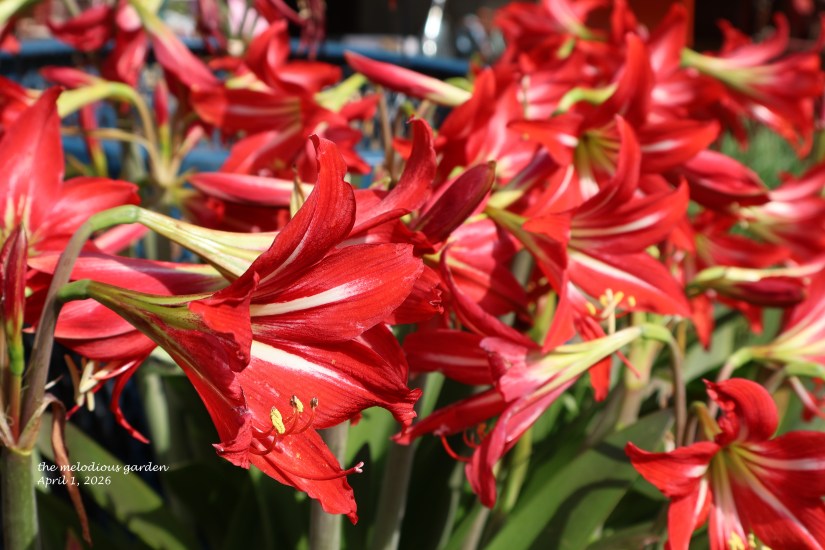
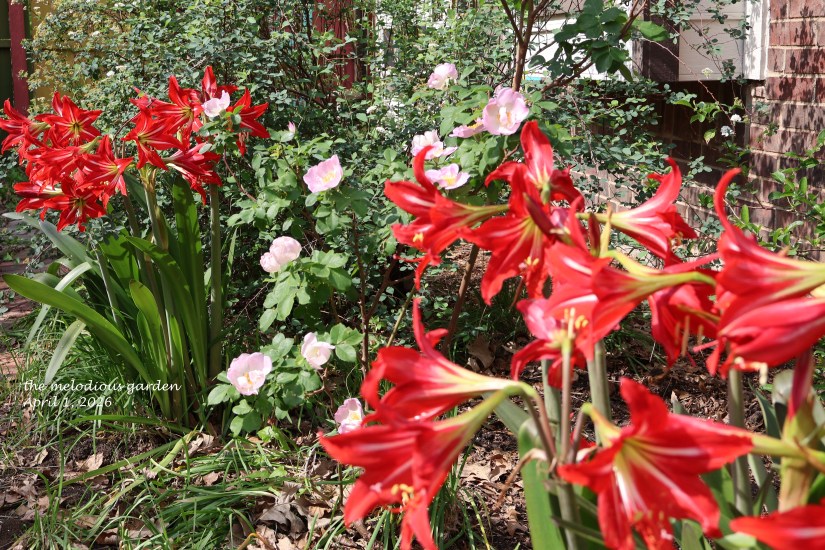
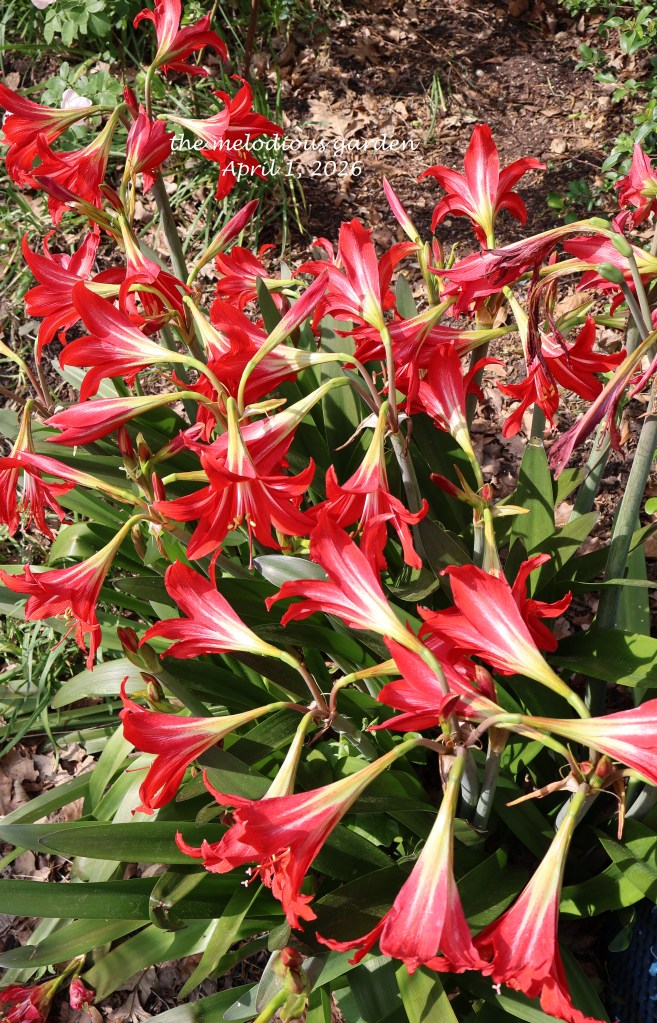
It has been a stellar year for the bright red amaryllis, shown above. I have been digging and dividing many of the clumps about the garden but didn’t make it to this clump one prior to the bulbs sending up flower stalks. I have to say: I am glad I hadn’t divided them yet, as it is so amazing to see 40plus amaryllis blooms all at once!
After losing more than 100 antique roses to Rose Rosette Virus, I swore I would never again plant another rose. And then… I went to The Antique Rose Emporium’s fall rose festival in 2023 and…
I should have seen it coming.
It was right there in the name.
Twice!
Rose Emporium.
Rose Festival.
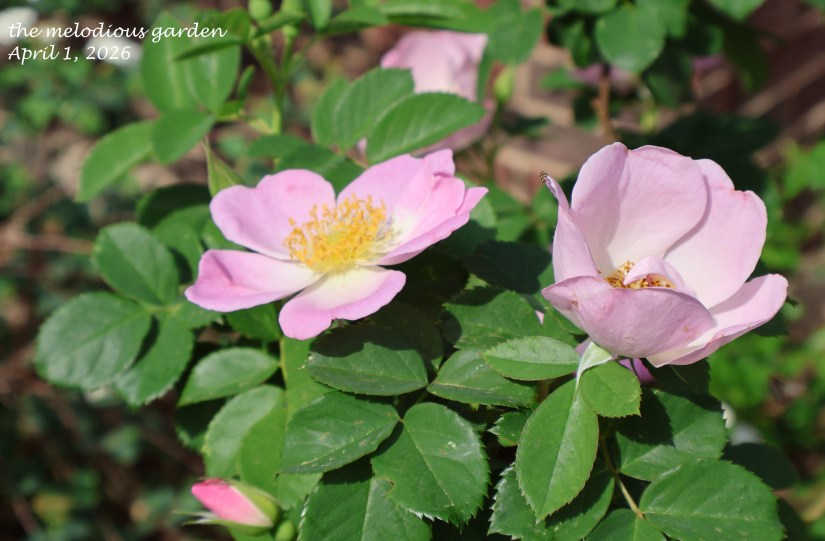
Yes, I bought three roses. One of those roses – Roemer’s Hip Happy – was selected because it produces an abundance of rose hips, which I want for herbal teas. Roemer’s Hip Happy (shown above and below) happens to be sandwiched between two clumps of red amaryllis. A very cheery color and texture combination.
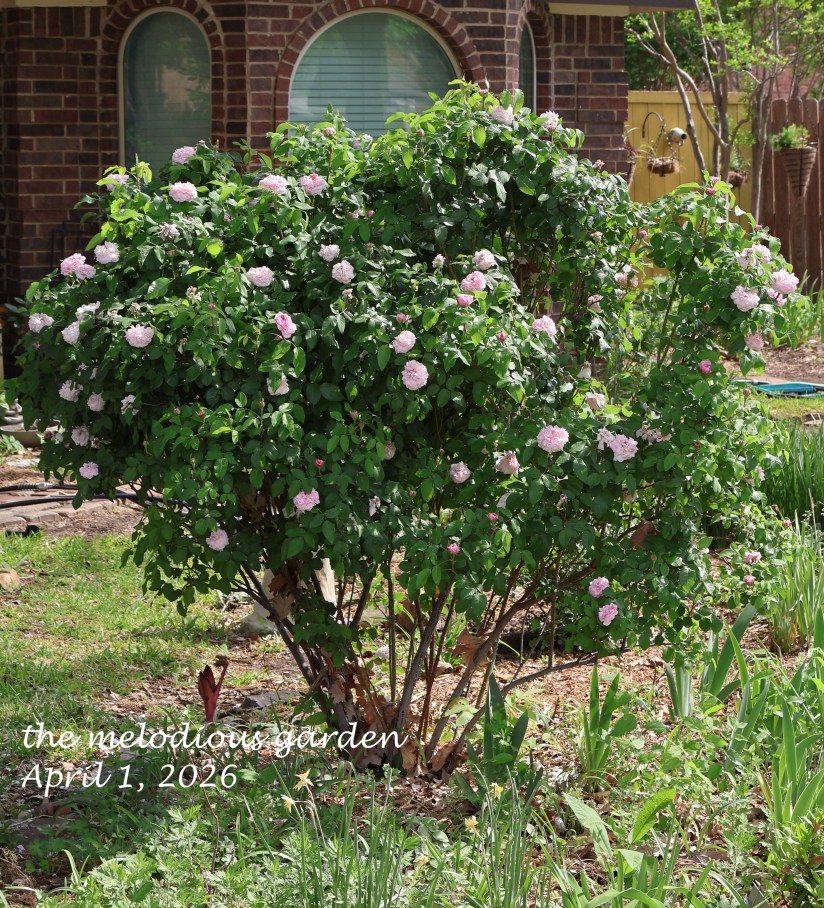
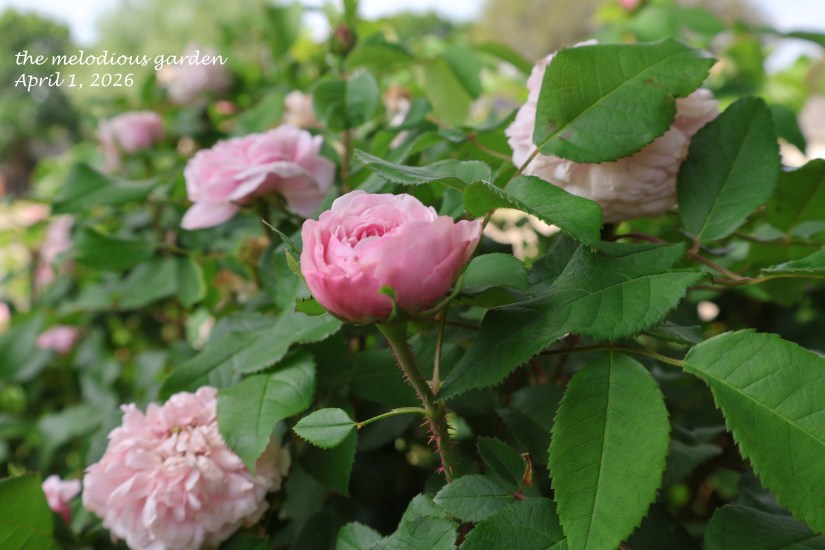
Two of my original roses – the few that somehow avoided RRV – are especially lovely today, April 1st.
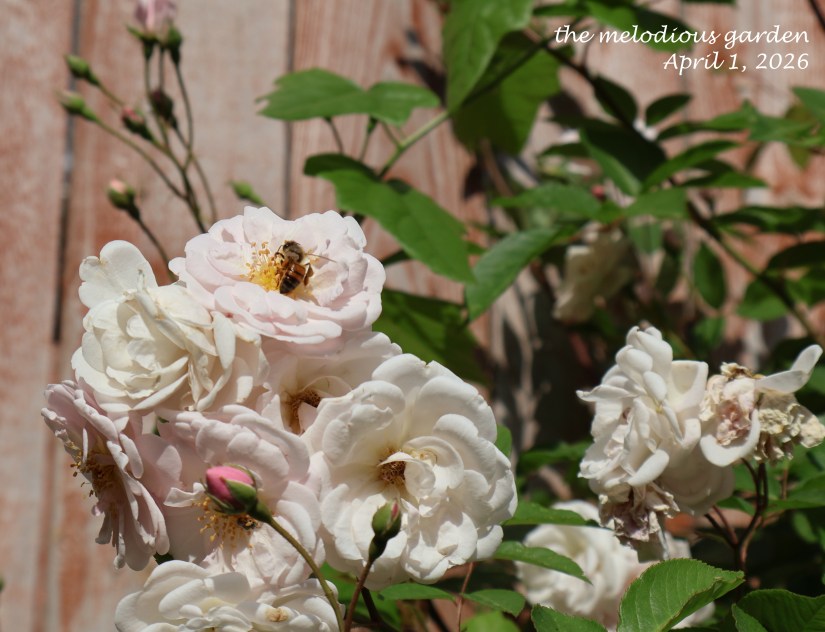
First up: Marie Pavie, shown below, is loaded with delicate soft pink blossoms.
One doesn’t normally think of roses when they picture pollinator friendly plants, but the bees were enjoying Marie this morning, shown below.
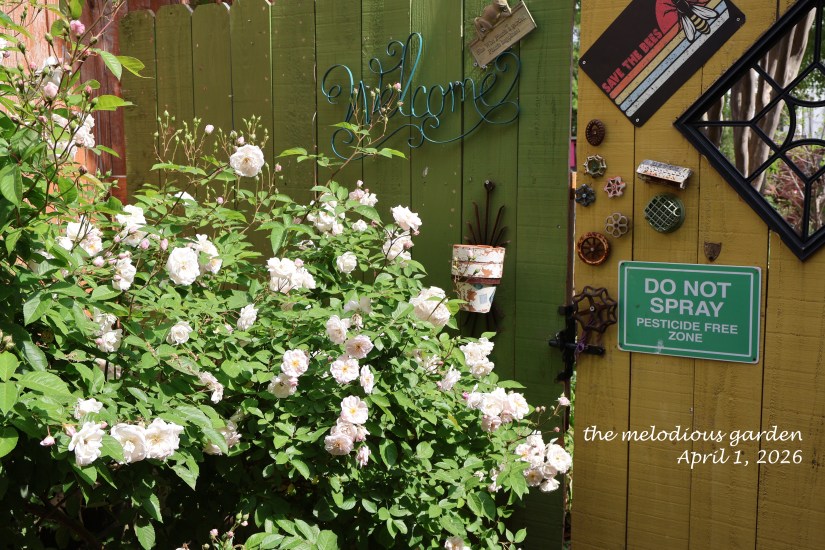
The second rose that avoided RRV is currently the focal point of the front flower bed. (Shown below)
I am still working to verify her name, but I am 99.5% certain she is Marchessa Boccella. The fragrance is outstanding! Classic old damask rose scent. Isn’t she lovely?
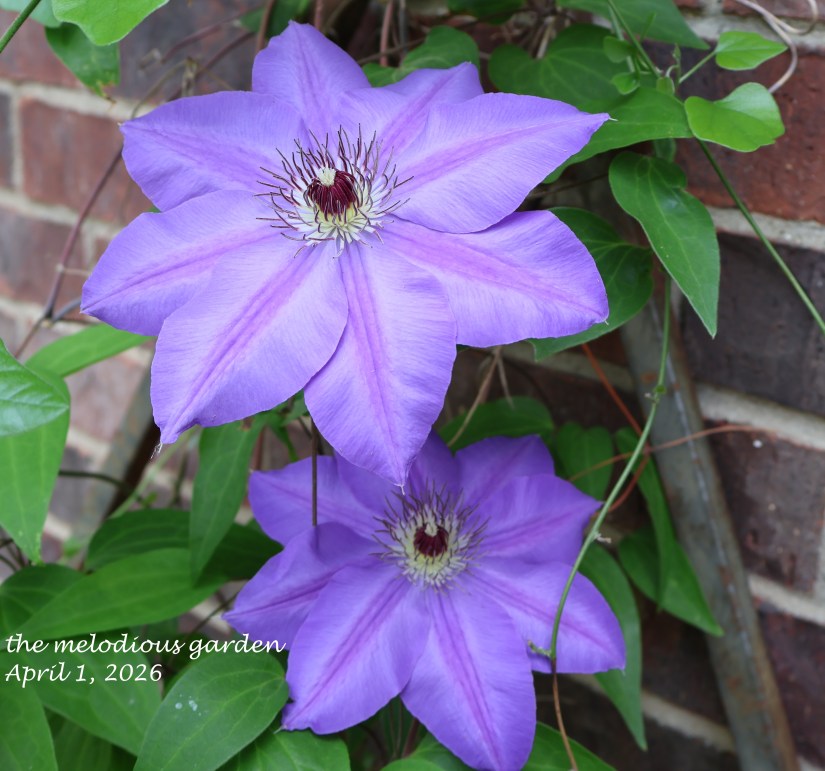
Another plant that is shining bright today is an unknown clematis, shown below. Yes. I have a lot of unknown varieties of plants in the garden. Keeping good records is no laughing matter! It is a skill set that I do not seem to possess. I plant here and there and everywhere, sometimes recording plant names, sometimes not. I have gardened this piece of land for 30 years now. A green thumb, I think I can say I possess. Organizational skills, I do not have.
A rose by any other name would smell as sweet. A unknown clematis by any other name would be as lovely.
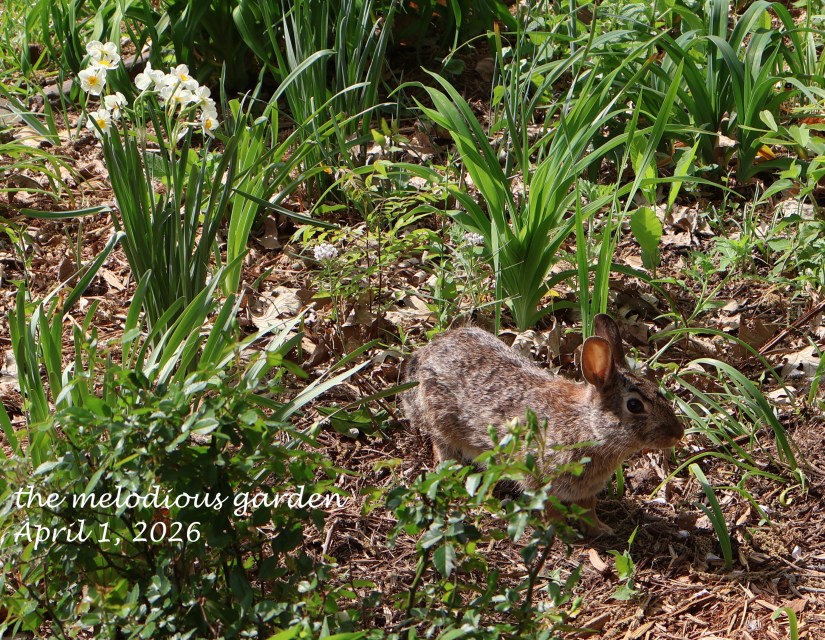
On a serious note: Rabbits.
Those adorable fluffy little evil rodents with an affinity for locally sourced organic veg.
Peter Rabbit, shown below, is all cute and adorable, amiright? Alas. I have turned in to Mrs. McGregor, trying to keep Peter and his siblings and cousins and aunts and uncles out of my garden. For years, I scolded my dog for chasing the rabbits. But it has come down to Rabbits Versus Me Growing Green Beans. I now cheer my dog on, perhaps a bit too enthusiastically, for I don’t know I am prepared to deal with the aftermath if she actually catches a rabbit! (Full disclosure: My dog did “clear out” a nest of baby bunnies earlier this spring. And by “clear out,” I do mean she, um, yeah. It wasn’t pretty. I felt really awful. For about five minutes. Then I remembered It is Me Growing Green Beans Versus Rabbits.)
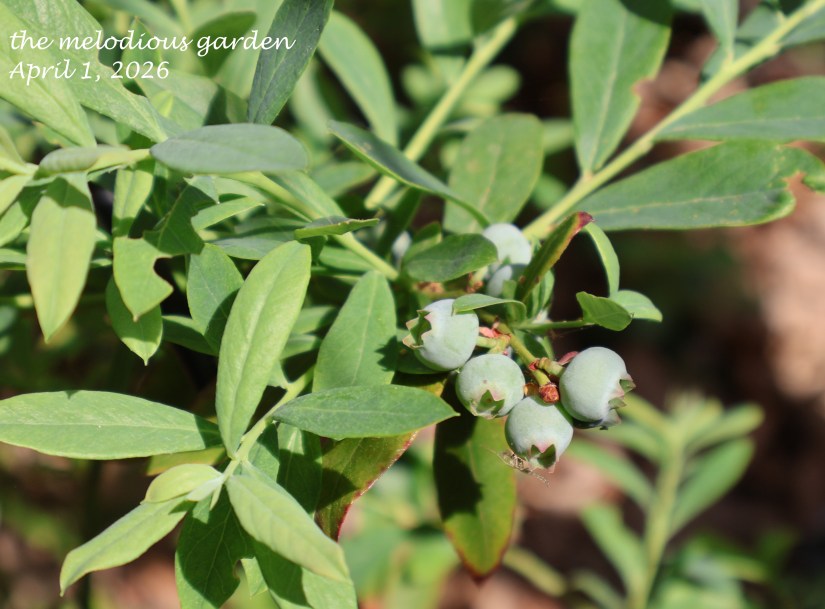
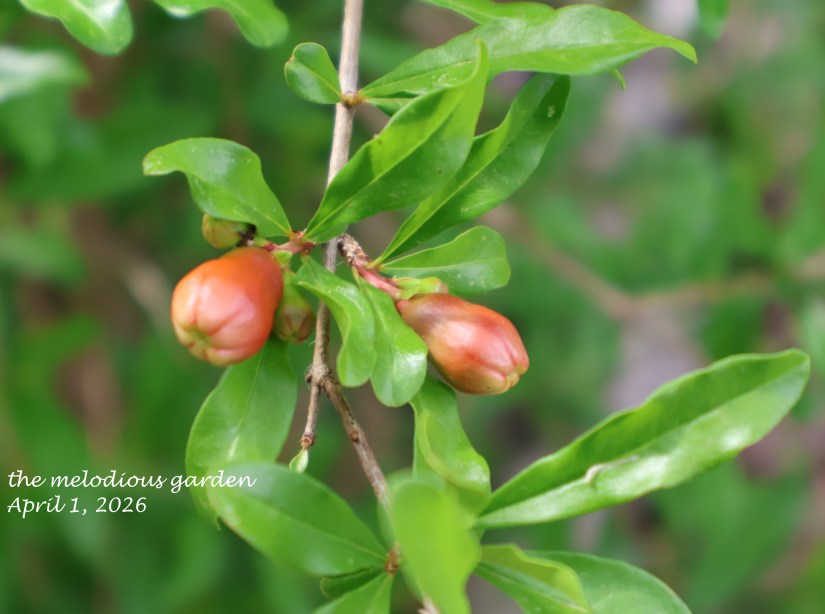
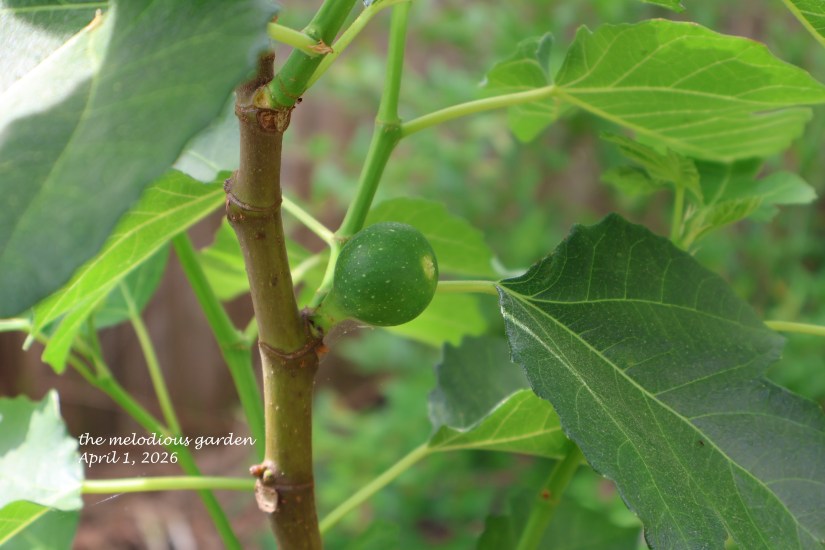
Growing food is no walk in the park. Yes, it is highly rewarding; I have been savoring fresh picked mulberries the past few weeks as I watch the tomatoes get taller and sturdier and setting flowers. Homegrown tomatoes are on the horizon! But it is an endless battle between rabbits and squirrels and who knows what else visits my garden overnight. You win some and you lose some and you learn not to count your chickens before they hatch. And yet! I am eyeing the blueberries…
And the pomegranates…
And the figs!
Will I get a harvest? Or just be pranked?! Stay tuned for updates… But until then… One last photograph of my amaryllis because… Well, aren’t they lovely?! (Overheard shot, shown below)
All photographs taken today, Wednesday, April 1, 2026, in my Southern Denton County, Texas, suburban garden.
I don’t know about you, but I never miss a chance to celebrate, especially when celebrating means buying a new plant. Or two. Or ten. Of course, celebrating Texas Native Plant Week requires gardeners (for me, at least) to visit a garden center. Or at the very least, it allows us to promote the many benefits of our wide variety of plants native to this state.
Rick Perry, our former governor, designated the third week of October as Texas Native Plant Week in 2009. Our state’s Arbor Day is also in the fall – the first Friday in November. Now many people may wonder why we celebrate plants in the fall in Texas when many states are already experiencing their first freezes of the season or will soon be buried under a blanket of snow. Fall is actually the best time to plant hardy perennials, trees and shrubs in southern climates, as our temperatures are cooler and rainfall more plentiful. Fall planting gives plants additional time to adjust before our hot and dry summers hit.
Adding native plants – ones that are better adapted to growing in our soils and climate – preserve our water resources, as they require less water once established. As our state’s population continues to grow, our manmade lakes will feel the strain that traditional landscapes require. Water restrictions will to be the norm for most of the state going forward. Native plants also don’t need special treatment to thrive, no fertilizers or special soil mixes. They also provide much needed native habitat and food for our wildlife and help conserve our wildlife populations.
So here we are – Happy Texas Native Plant Week! Have a slice of cake and plant a few natives in your landscape. Here are some of my favorite native plants, in no particular order.
Echinacea, commonly known as coneflower: A wonderful reseeding perennial. A wide variety of insects will nectar on its blooms and songbirds will feast on the dried seeds through the winter. What seeds remain in late winter, I will cut back and scatter throughout the garden. (Coneflower is shown in photograph above.)
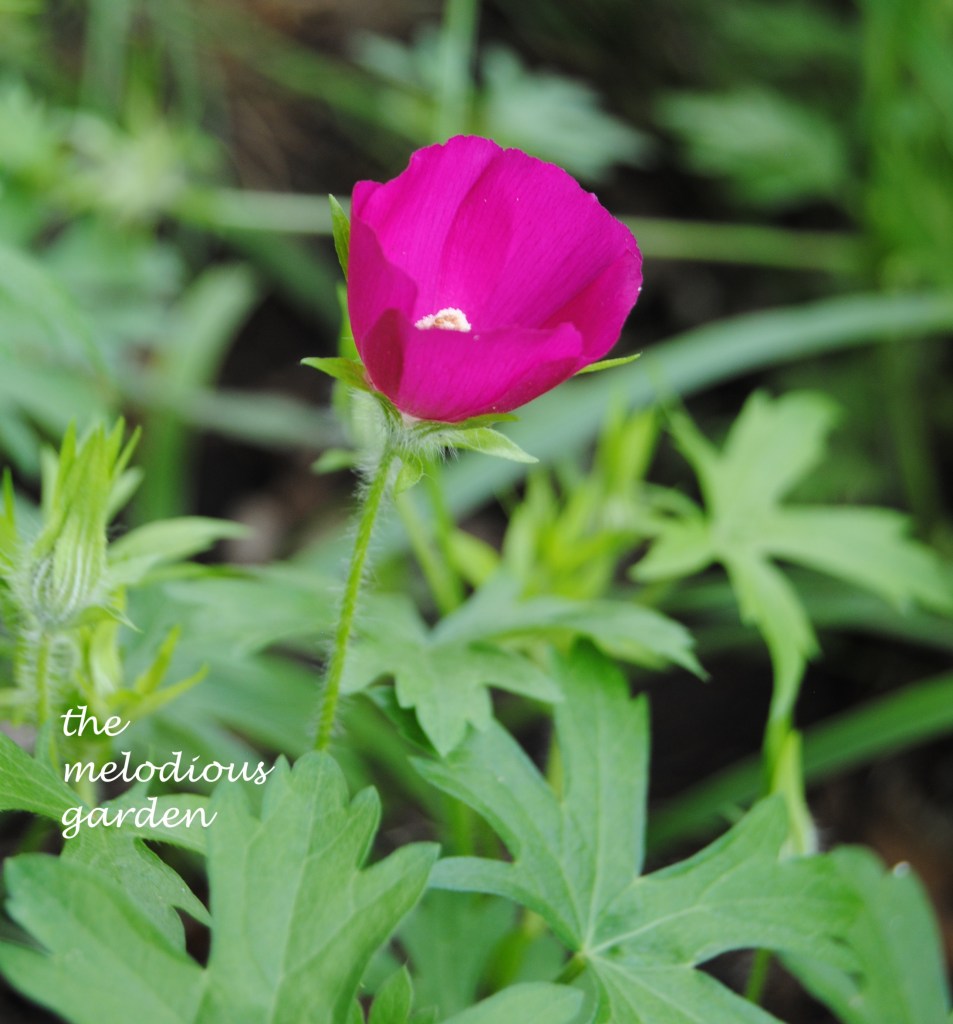
Callirhoe involucrata, commonly known as winecups: A rosette of greenery will emerge from its tuberous root in late winter and will scamper up and over and about the garden. It will start blooming in late spring in to early summer. It is dormant in the heat of summer and fall. (Winecup is shown in photograph above.)
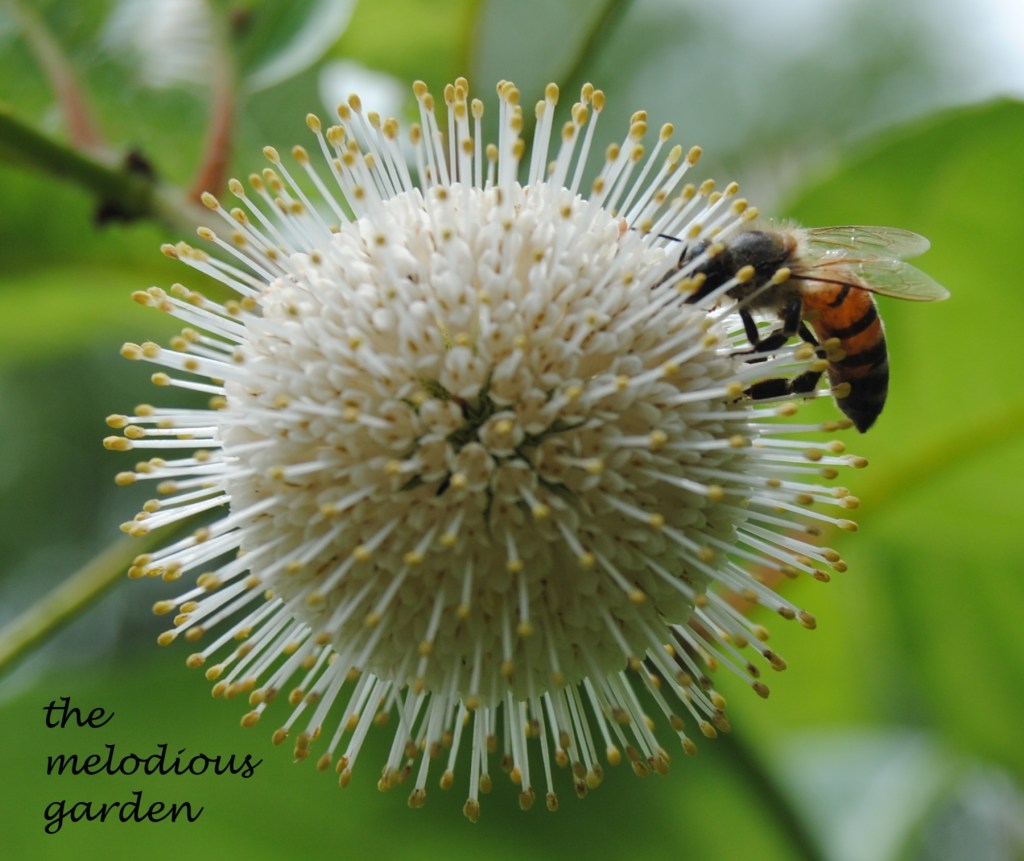
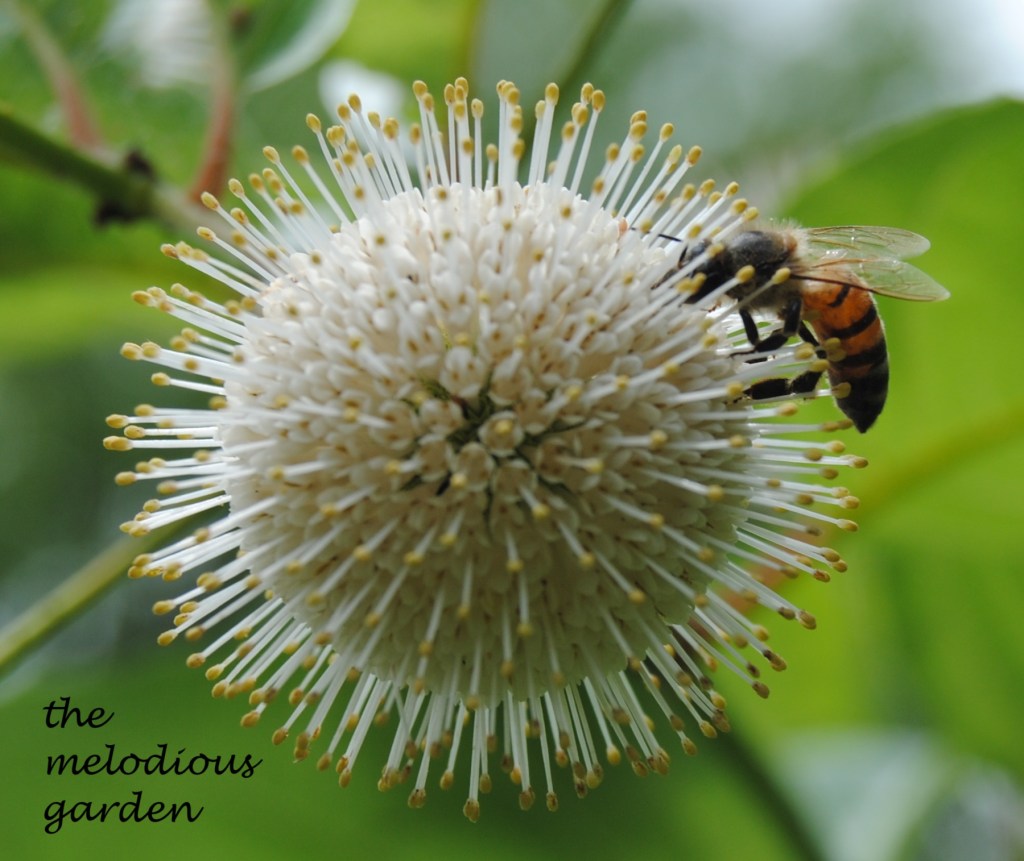
Cephalanthus occidentalis, commonly known as buttonbush: I would have a hard time selecting a favorite native plant, but buttonbush would likely be it. I love standing under the small tree when it is in bloom and watching just an outstanding variety of insects nectaring on the orb shaped flowers. Where else can you get a Dr. Seuss style bloom that is so well loved by the insect world? (Buttonbush is shown above.)
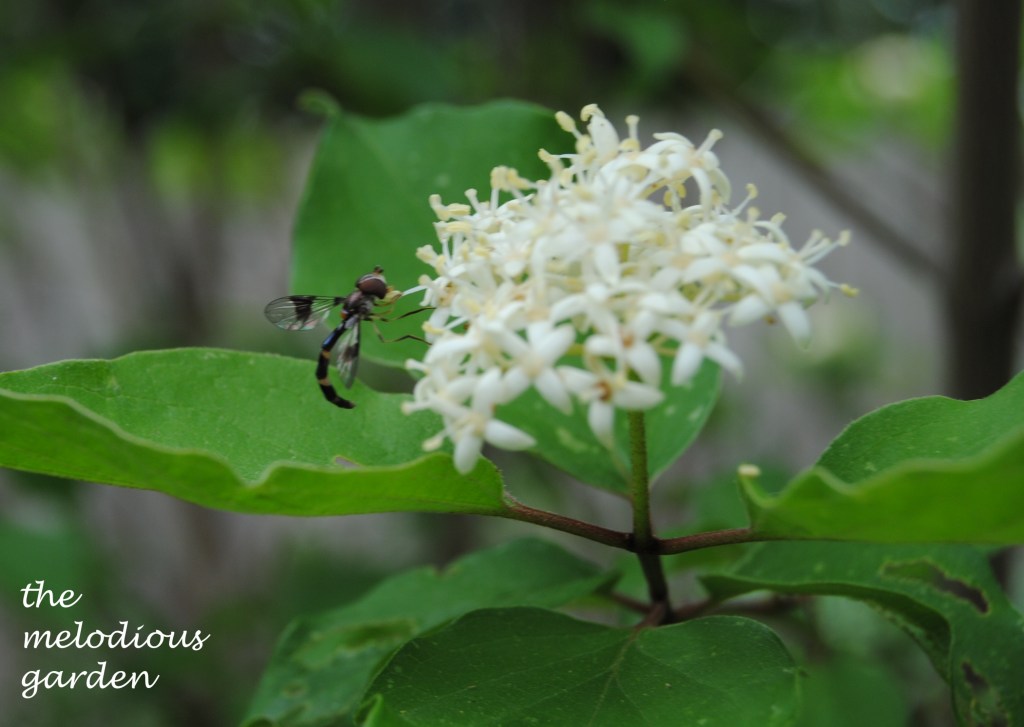
Cornus drummondii, commonly known as rough-leaf dogwood: For years – okay, two decades?! – I tried to eliminate this shrubby tree from my garden, as it wants to spread and take over. Alas. I have given in to its lovely blossoms and its willingness to thrive on neglect. Added bonuses: Insects love the blooms and songbirds love the berries. (Rough-leaf dogwood shown above.)
Twenty five years and another lifetime ago, I worked at a small organic garden center in the Dallas-Fort Worth area. We received a much-awaited shipment of native plants. Alas. As the driver opened the back of the box truck, with a cluster of garden center employees standing ready to Ooh and Aw over the plants, horror awaited. The heavy wooden shelf system had collapsed during transit and crushed everything underneath, including a dozen or so rough-leaf dogwood trees. Nearly everything in the truck lay broken and bruised and little was salvageable. That night after work, I took home a tiny broken twig of rough-leaf dogwood. Within two years, I was trying to eliminate it from my garden because it was like the Little Engine That Could. It thought it could grow. It thought it could grow. And grow it did! Now I absolutely love it and am glad I made peace with its determined growing habits.
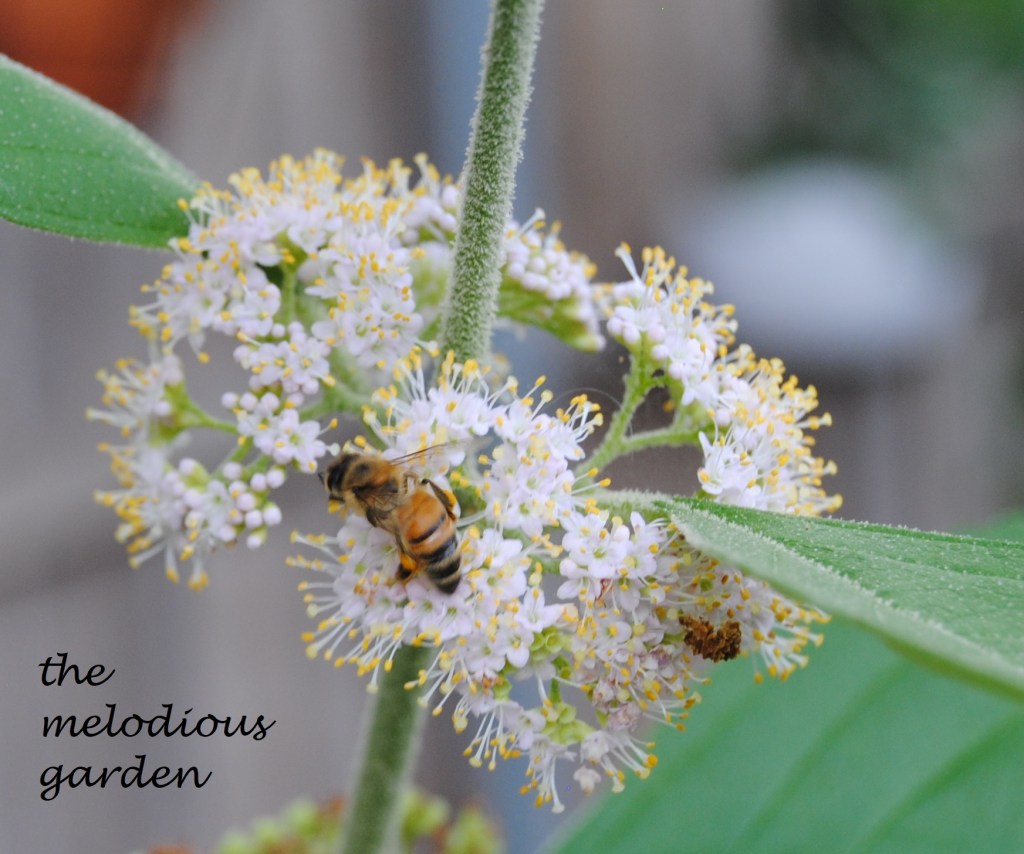
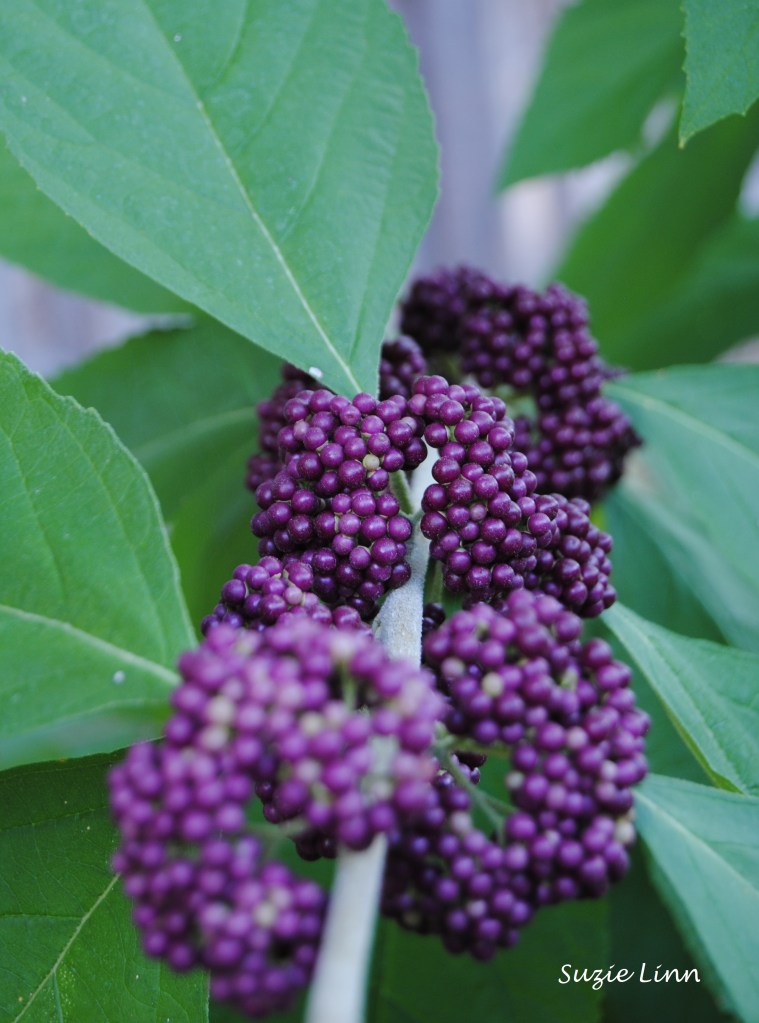
Callicarpa americana, commonly known as beautyberry: A shrub with clusters of flowers in the spring, followed by brilliant purple berries in the summer and fall. (Beautyberry shown in photographs above and below.)
Calyptocarpus vialis, commonly known as horseherb: There is a native plant for every growing situation and need. This is a fabulous lowgrowing ground cover for shady areas. (Horseherb shown below.)
Monarda fistulosa, commonly known as beebalm: There are many beebalms on the market, but the majority of them are hybridized, non-native varieties. Those tend to succumb to powdery mildew in this area and their flowers lack the nectar of the native variety. Fistulosa is the native one; many garden centers offer it in their herb section. This beebalm is especially loved by butterflies as the nectar is deep within the flower. (Swallowtail butterfly shown on monarda fistulosa in photograph below.)
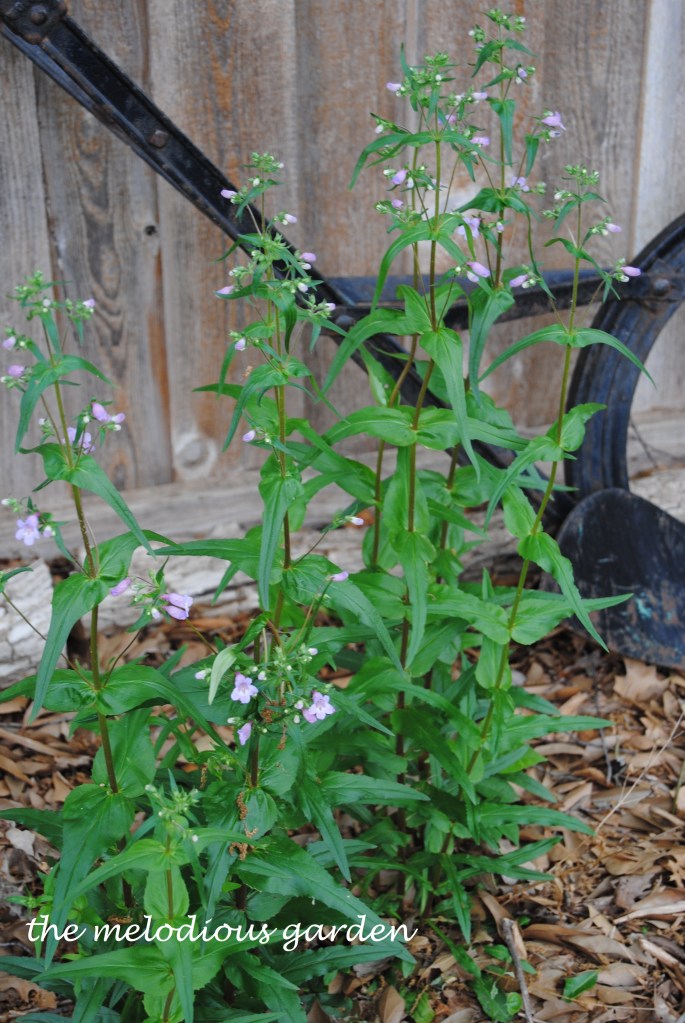
Penstemon tenuis: A lovely reseeding perennial. This penstemon blooms very early in the spring, at a critical time for insects. The plants are light and airy, with blooms held above the foliage. (Penstemon tenuis shown in bottom two photographs.)
There you have it – some of my favorite Texas native plants. No matter how you celebrate Texas Native Plant Week, I hope you get to enjoy some cake and visit one of the many wonderful garden centers we have throughout our state. We are so fortunate to have a number of locally owned garden centers that were early on the native plant bandwagon and really fought to bring native plants to the mainstream. Please seek them out and support them whenever possible!
All photographs taken in my own garden – zone 8b, southern Denton County, Texas.
I felt a bit like a mashup of Paul Revere and the poet Richard Le Gallienne today, though instead shouting that the redcoats were coming nor penning about a poem about a brown bird singing in the apple tree and pulling me out to the garden, I was all abuzz that the monarch are here! In my garden! Not one. Plural. Monarchs. The monarchs are here!
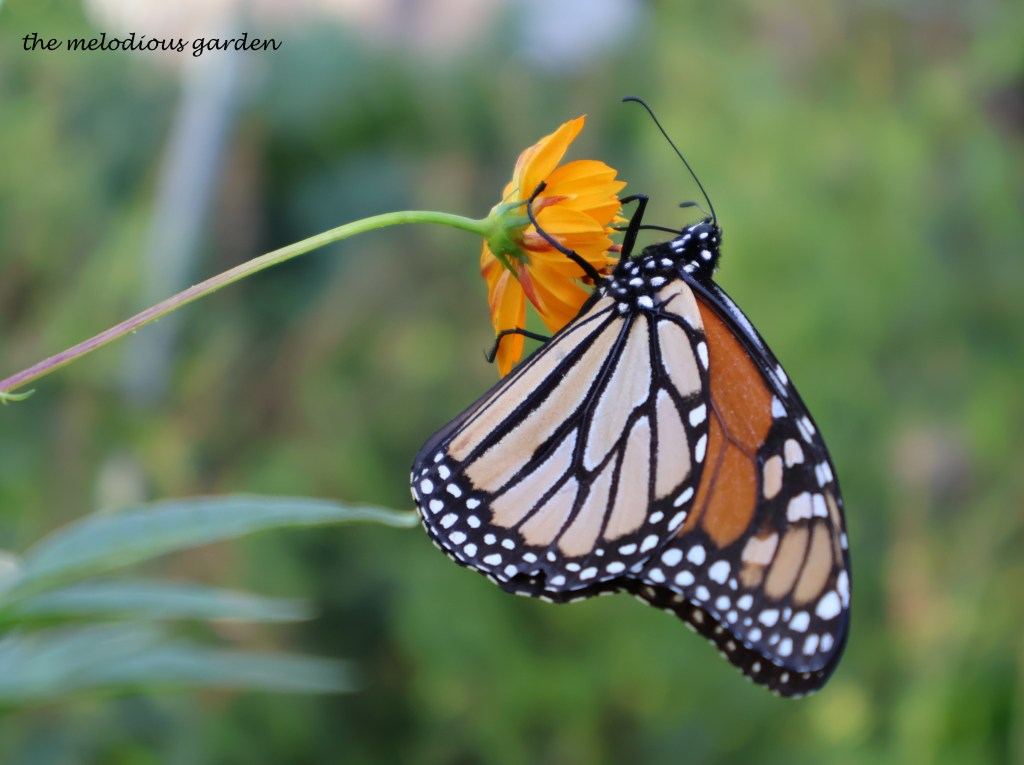
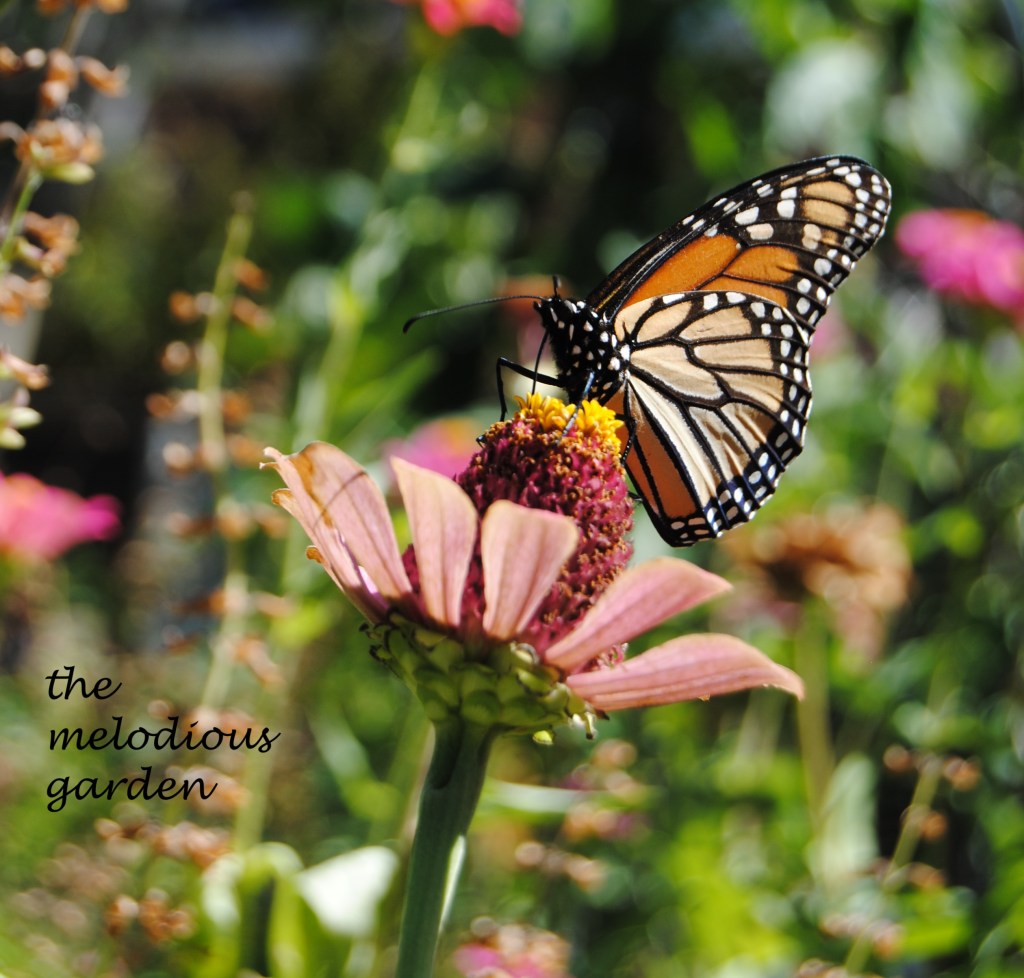
My garden happens to sit perfectly along their migration path. Each spring, the monarchs emerge from their winter habitat in Mexico and travel north for the summer. Along the way, they search for milkweed – the monarch’s host plant – to lay their eggs on. But now it is autumn and they are migrating south for the winter and they are in search of fuel – in the form of nectar – for the long journey that still lies ahead of them. Fall blooming flowers are critical for their survival.
Insects may be our canary in the coalmine – the warning sign of environmental troubles ahead. They are the most vulnerable to shifts in climate and weather extremes. As more and more wild lands are destroyed and either conventionally farmed (ie: with chemicals) or paved over for subdivisions and highways, insects – including the beloved monarch butterflies – find less and less food in the wild. Restoring native habitat is critically important. But it doesn’t take an acre to help. Anyone with a bit of space, even those with balconies or a small patio can grow a container of fall blooming flowers for the monarchs to feed on as they are passing through.
My own garden right now looks a bit worse for the wear, as I have been out of commission for the past two months. Thankfully, I do favor plants that not only grew in my absence, some seemed to thrive on my neglect! As I was getting around to leave for physical therapy earlier today, I happened to notice one, two, four, six and more monarchs fluttering about my garden. I quickly grabbed my camera and out to the garden I went. I did manage to make it to therapy on time, though I was still picking dried leaves and seeds off my clothes and shaking them out of my hair as I walked in to my session. As soon as I was finished, it was back out to the garden, which is where The Husband found me some time later, still laughing and flitting about my garden, as I snapped dozens and dozens of photographs of the monarchs.
Following are a few easy steps we all can take to help the monarchs.
1.) No pesticides or insecticides. Even organic ones can and do kill beneficial insects. The majority of insects in the world are harmless. Plants that are grown specifically for butterflies, from their host plants to flowering nectar plants, must be organic.
2.) Water is crucial for butterflies. Provide a shallow basin with pebbles or shells for them to land on.
3.) Trees provide much needed nighttime roosting spots for butterflies, as well as shelter from stormy weather.
4.) Plant natives whenever possible! Many of the hybridized plants on the market have been bred for larger flowers, but they often lack the rich nectar that the native variety have. When shopping for plants, avoid ones that have a specific name in quotation marks or have a trademark emblem next to the name. Those are easily identified as hybridized varieties.
5.) Plant well adapted fall blooming plants that will survive our summer heat and drought. Some examples of plants that will bloom in North Texas during the fall monarch migration include: zinnias, cosmos, tithonia (Mexican sunflower), Mexican mint marigold and pentas. The two flowers the monarchs were nectaring on in my garden were cosmos and zinnia, both well adapted annuals.
6.) Plant a wide variety of plants so you always have something in bloom. A variety of flower colors and flower shapes will also attract a wider variety of butterflies, not just monarchs.
7.) Plant in groupings of three or more as a larger expanse of blooms will be more visible to butterflies flying overhead. This also allows butterflies to nectar from multiple plants without needing to fly off so soon in search of additional food.
Some fall blooming Texas natives include: Anise hyssop (Agastache foeniculum), Frostweed (Verbesina virginica), Gaillardia (Gaillardia aristata), Cardinal flower (Lobelia cardinalis), Ironweed (Vernonia baldwinii), Gregg’s mistflower (Conoclinium greggii), White boneset (Eupatorium serotinum), Zexmenia, Turk’s cap (Malvaviscus arboreus var. drummondii), Prairie verbena (Glandularia bipinnatifida), Gray vervain (Verbena canescens), Aromatic (Fall) aster (Symphyotrichum oblongifolium) and Coneflower (Echinacea purpurea).
Lantana urticoides is native to this area. There are numerous other lantana varieties available — a few are perennial, but many on the market are annuals in our area. Special note: The berries on Lantana urticoides are poisonous.
Keep calm and garden on and consider planting a butterfly garden.
All photographs were taken October 22nd, 2025, in my southern Denton County, Texas, garden. I have organically gardened this piece of earth – a large suburban lot – for 30 years.
I meant to do my work today by Richard Le Gallienne
I meant to do my work today— But a brown bird sang in the apple tree, And a butterfly flitted across the field, And all the leaves were calling me.
And the wind went sighing over the land, Tossing the grasses to and fro, And a rainbow held out its shining hand— So what could I do but laugh and go?
“Now is it as if Spring had never been, And Winter but a memory and dream, Here where the Summer stands, her lap of green Heaped high with bloom and beam…” ~ Madison Julius Cawein
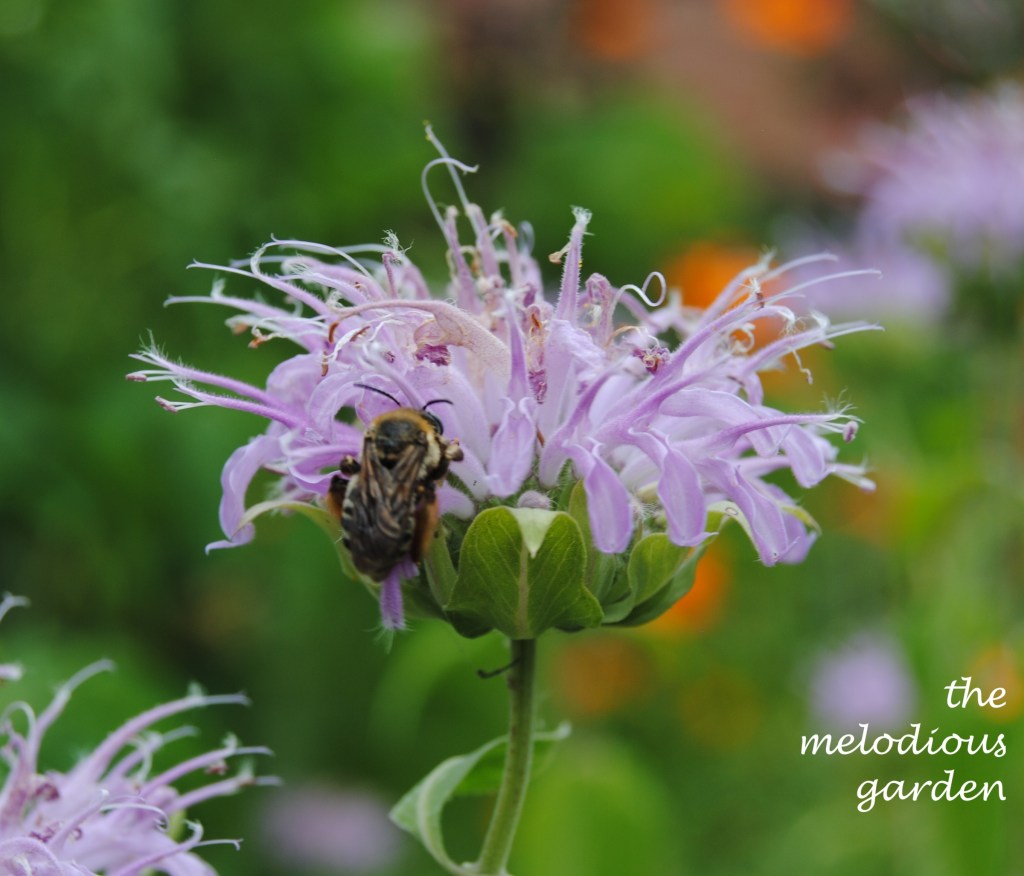
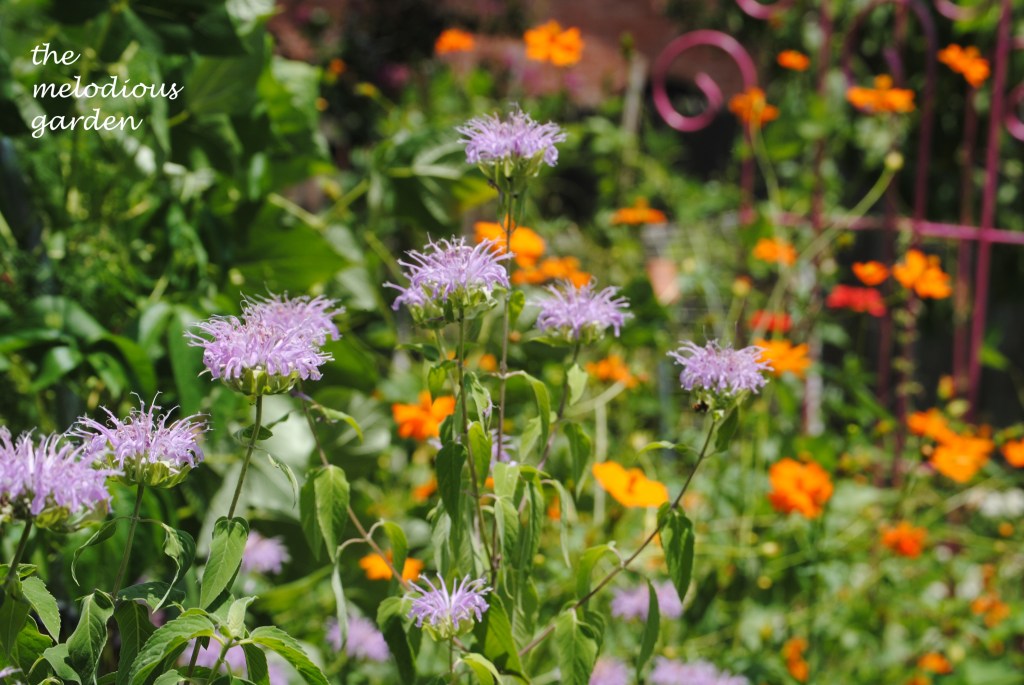
Spring came and went in a blink of an eye and somehow it is July already, the midpoint of the calendar year. The garden is indeed heaped high in bloom – daylilies, hibiscus and coneflowers, oh my! Such a riot of colors! Sometimes color combinations in my garden are planned. Other times, they are quite accidental, as is the case of the lavender Monarda fistulosa (bee balm) and the bright orange of Bright Lights Cosmos. (Shown below.)
Thomas Edison is reported to have only kept a personal diary for a few short days while on a vacation in 1885, but one of his few entries is perfectly poetic:
Arose early, went out to flirt with the flowers.
I feel much the same way each morning. What a delight it is to stroll the garden, camera in hand, and flirt with the day’s flowers and whisper a soft “Hello” to the bees buzzing about.
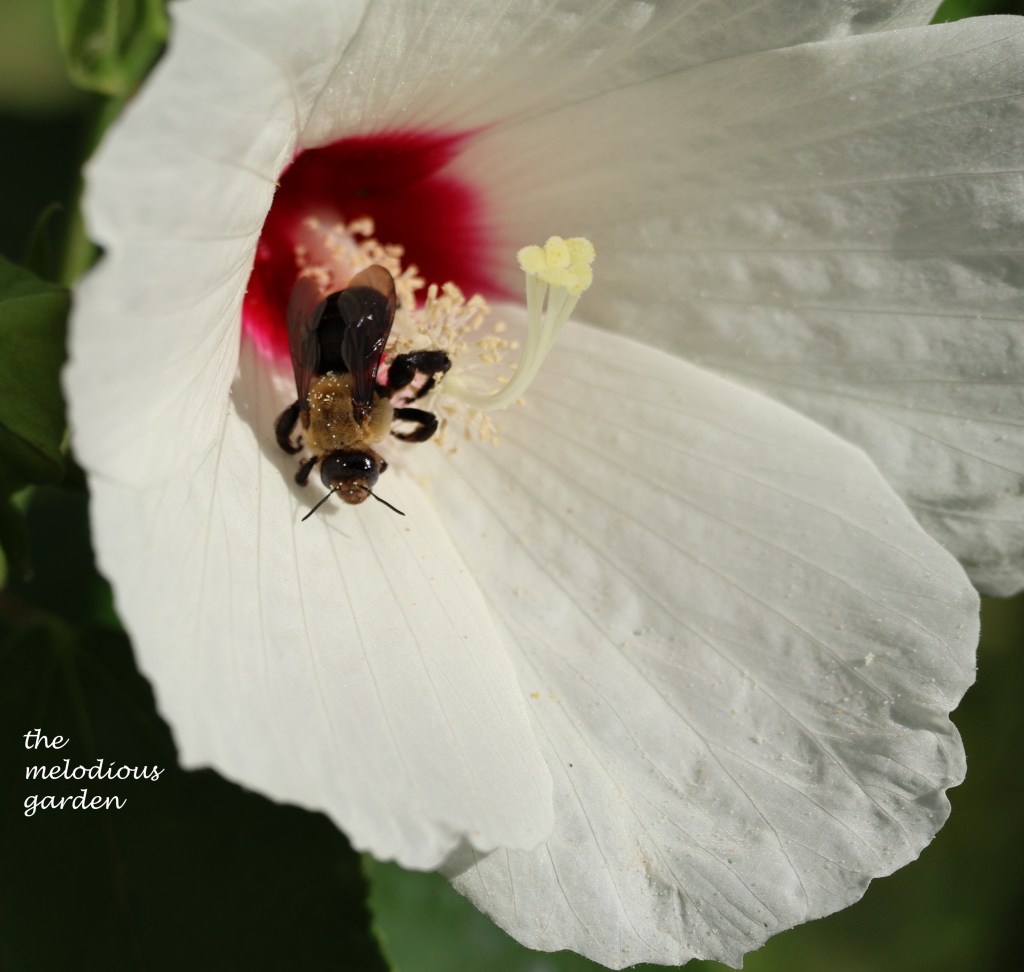
The hardy hibiscus, with their long pistil and ample supply of pollen, lures in bumblebees galore. (Shown above) Bumblebees are quite territorial and it is not uncommon to witness a rumble and a tumble as two fight over their garden space. “Possession is nine-tenths of the law” clearly does not apply to pollen and bumblebees!
“Nature is always beautiful to those who always look for beauty in her.” ~ The Harvest of a Quiet Eye: Leisure Thoughts for Busy Lives by John Richard Vernon
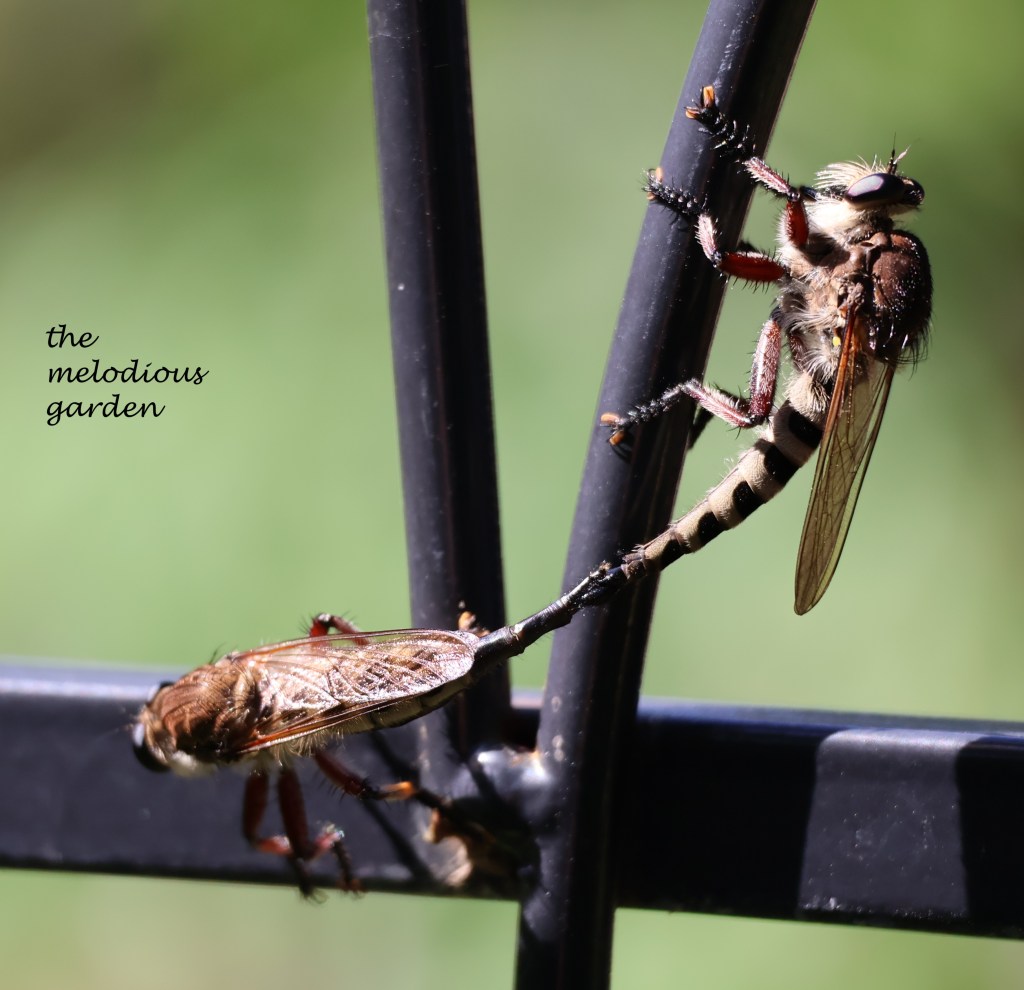
In the bug world, there are beneficial insects and harmful insects and those straddling the middle as either sometimes good/sometimes bad or neither overly good nor overly bad. There are beautiful insects, such as the monarch butterfly or the luna moth. And then there are ugly or creepy insects, such as, well… I don’t want to disturb my readers so we will leave ugly and creepy to your imagination. At first glance, robber flies (shown below) may not be as beautiful as, say, a lady beetle, but they are still… well, Beauty can be in the eye of the beholder, amiright? There is a primitive, utilitarian beauty to the humble robber fly. Large eyes. Long legs. Both beneficial in their quest for prey. Which brings me to their other status in the bug world. Robber flies are beneficial because they kill harmful insects, such as grasshoppers and leafhoppers. Alas. They also eat butterflies and dragonflies, which puts them smack in that middle ground. Beneficial? Yes. Sometimes. …If only we could direct them as to what they should be preying on…
A number of lizards call my gardens home, for which I am eternally grateful. However, they, too, are a species that have both beneficial and sad dining habits. The anole, shown below, had just eaten a grasshopper when I snapped this photograph. Knowing Texas summers and baseball bat size grasshoppers go hand in hand, I am appreciative of this fella’s hard work and dedication to taking one down. I will chose to overlook his ability to also take down dragonflies.
As a child, I memorized Richard Le Gallienne’s poem, “I meant to do my work today.” The words still bubble up in my soul whenever I feel the pull of nature. “I meant to do my work today – but a brown bird sang in the apple tree and a butterfly flitted across the field…”
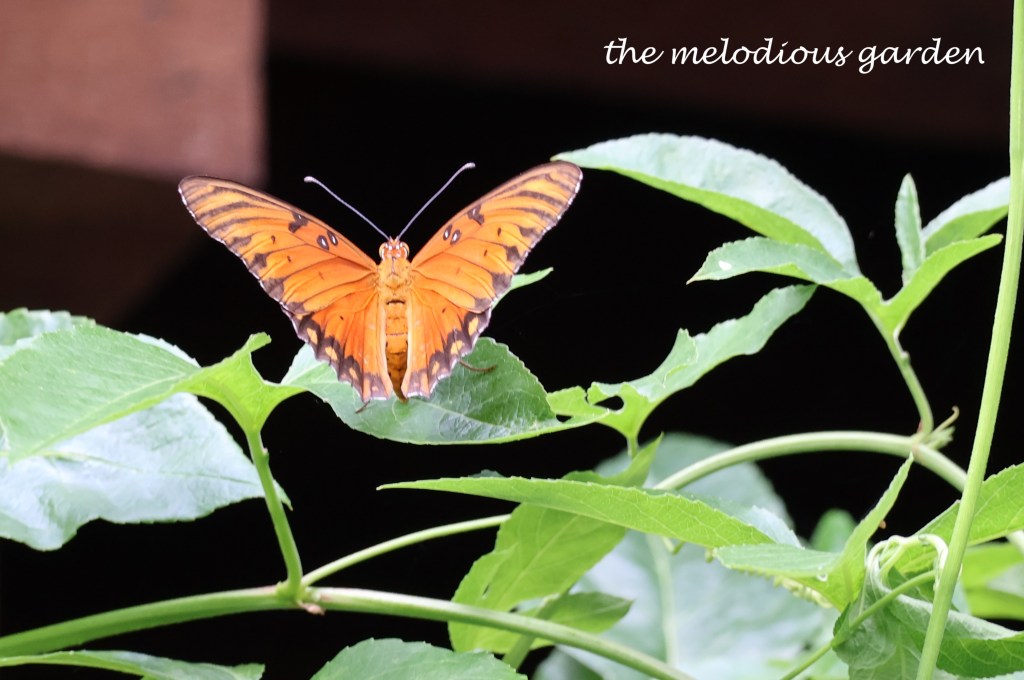
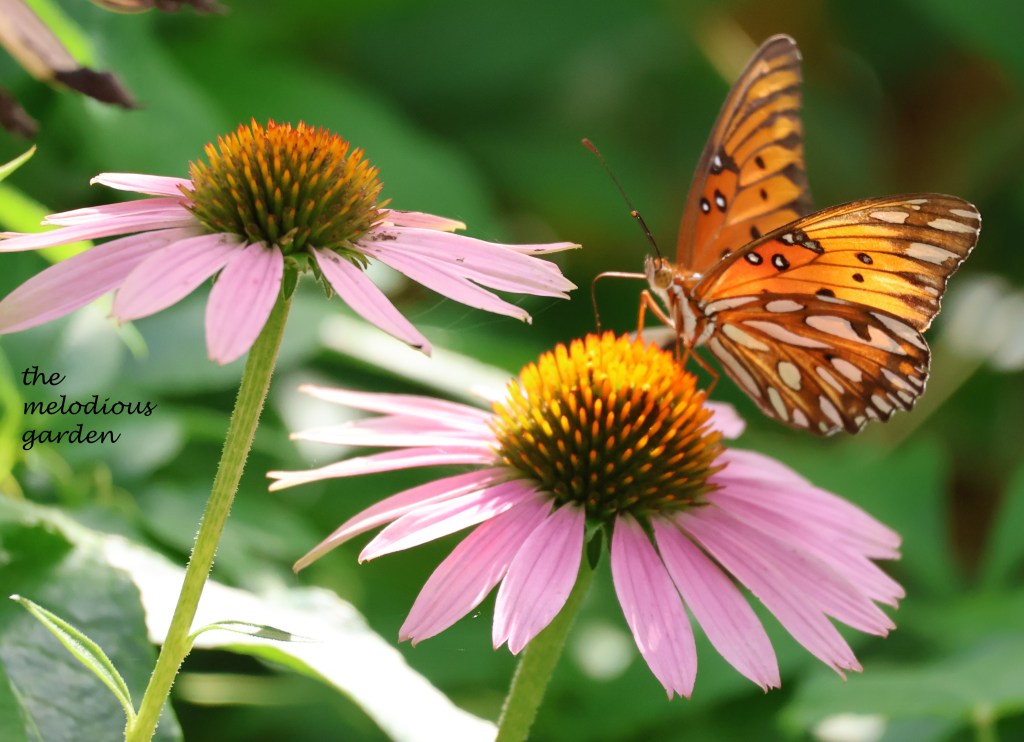
This morning, I found myself with five extra minutes before I needed to leave for a class at the gym, so I grabbed my camera and headed to the back gardens. Not one, but four butterflies flitted across my garden! Gulf fritillary butterflies (shown above and below) had found my garden and were busy dancing about, depositing their eggs on my passionvine – Mother Nature’s way of giving my garden an A+, gold star and seal of approval all in one wonderful moment. As the poem goes, “What else could I do but laugh and go?” And what fun it was to photograph them!
“Here rest your wings when they are weary; Here lodge as in a sanctuary! Come often to us, fear no wrong; Sit near us on the bough! We’ll talk of sunshine and of song, And summer days, when we were young…” ~ To a Butterfly by William Wordsworth
The year has gone by much too fast, as it always has a way of doing the older we get. But here’s to slowing down and enjoying the garden and spending time in nature whenever we can.
“Spring flew swiftly by, and summer came… The earth had donned her mantle of brightest green, and shed her richest perfumes abroad. It was the prime and vigour of the year, and all things were glad and flourishing.” ~ Oliver Twist by Charles Dickens
(All photographs taken in my Southern Denton County, Texas, garden between mid-June and July 3rd.)
I know this gardener will regret uttering those words come August, but today I had plannedneeded to get some gardening done between thunderstorms and soaking rains. Alas. The rain settled in hours earlier than I realized it would. Weeding and planting will have to wait once again.
May Day
A delicate fabric of bird song Floats in the air, The smell of wet wild earth Is everywhere…
By Sara Teasdale
The Dallas/Fort Worth area received nearly two and a half inches of rain on the last day of April and we are forecast to get an additional two to four inches this week. The gardens look especially beautiful at the moment – so lush and so many shades of green. But. The weeds! One needs to be wary of the weeds that are threatening to grab you by the ankles and not let go! I don’t know if the smell of wet wild earth is everywhere today, but my corner of the earth is wet and it is wild!
Of course everything is blooming most recklessly: if it were voices instead of colors, there would be an unbelievable shrieking into the heart of the night.
~ Rainer Maria Rilke
The bright red hardy amaryllis, shown above, is a staple of many southern gardens and for good reason. It is extremely reliable – plant once and it will bloom and multiply for decades to come. The hardy amaryllis is also a great passalong plant, assuming one has a sturdy back and an equally sturdy pitchfork to wrestle a few bulbs out of the ground. In this region, the amaryllis is the year’s first bright pop of color, blooming right as the daffodils are beginning to fade away yet before summer’s riot of flowers take over.
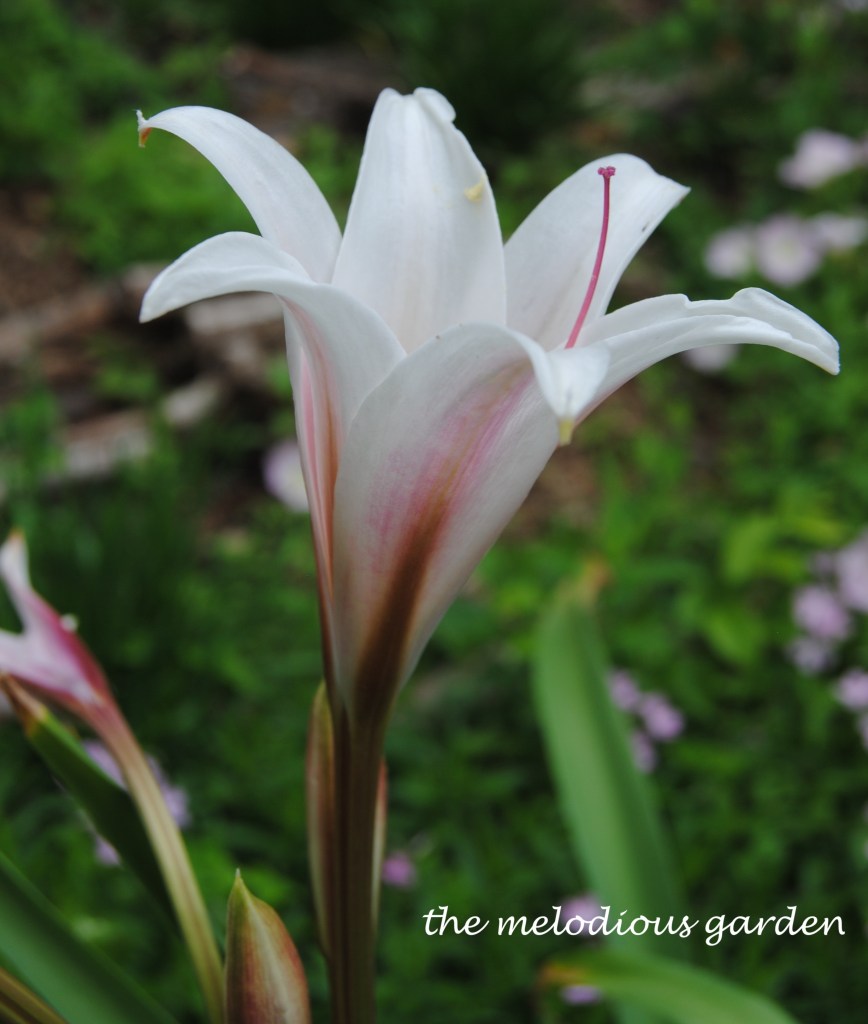
Another southern favorite – Crinum “Milk and Wine Lily,” shown below – is as delicate looking as the amaryllis is bold. The flowers are white, tinged with pastel pink streaks, but don’t be fooled by the softness of the flower. Crinum lilies are Texas tough and able to withstand our weather extremes.
Bulbs for both the hardy amaryllis and crinum lily can be purchased at The Southern Bulb Company. Both are considered heirloom plants – plants that withstand the passage of time, plants that can be passed down from one generation to the next.
To everything…there is a season…
A time to be born, a time to die A time to plant, a time to reap…
And a time to every purpose under heaven
~ Peter Seeger
We describe garden plants as being hardy, but gardeners are also hardy. We take the weather and the seasons as they come. Sometimes we have too much rain. Other times, not enough. Too hot. Too cold. Yes, we complain about the weather, but we garden on. Some seasons we have the time and energy to throw ourselves headlong in to our gardens. Other seasons, our gardens may run feral. This is the season I immerse myself deeply in the comfort of my gardens.
My dad passed away on March 13th, just days after his 78th birthday. My gardens have always been my refuge, my escape when the world is too much. In the days after my dad’s death, I found myself wanting to be alone in the back garden, away from passing neighbors out front, to seek peace and quiet in nature, to reflect on the past, to think ahead to the future.
I grew up in the rural Midwest, surrounded by generations of gardeners and farmers. My dad’s parents – my grandparents – often took me fishing when I was growing up and my grandma and I would pick the gooseberries that grew wild along the path as we walked down to the fishing spot. Fried fish and gooseberry pie would be the evening meal. My grandma’s dad – my great-grandfather – grew red roses over a white arbor at the entrance to his vegetable patch. In the front yard, he grew a hedge of pink peonies and I always loved to watch the ants crawling over the blossoms, though I was years away from knowing or understanding their symbiotic relationship. Those roots – and memories – run deep. I am still the happiest with dirt under my nails, mud streaked across my cheeks and caked on my kneecaps. My dad was the last of his siblings, the last of that branch of our family tree. I have found myself grieving that generation lost as much as the individual. Time has a way of marching on, though, doesn’t it? Time doesn’t cease to move forward just because we are grieving and reflecting on the past. Seven weeks have now passed since my dad died. It may seem strange that I planted tomatoes the day after he died, but deep down in my soul I knew – To plant a garden is to believe in tomorrow. (Audrey Hepburn)
Our lives should not be overcast by gloom of the past or future… Both are mere reflections. The past should reflect the light of pleasant memories upon our present, and contemplation of the future should shed its rays of hope upon our to-day.
~ Ellsworth R. Bathrick
Black strawberry tomato, shown below.
All photographs taken April 28th in my Denton County, Texas, garden.