gardening

Fig 101

If your only idea of a fig is a highly processed cookie with a sticky fig paste inside and a crumbly cake outside, you are in for a wonderful treat when you first taste a fresh fig. Better yet, taste one straight from the tree. Pure bliss.

Figs have been grown in Texas since the early Spanish settlers arrived and brought the trees with them. That variety was later named Mission fig, and it is still grown throughout the state today.

Celeste, the variety I grow, is reported to be the most cold tolerant fig. Indeed, I have not had any freeze damage in the many years I have had the tree. Brown Turkey and Texas Everbearing are two other fig varieties our local nurseries carry.  All varieties grow to about 15-20 feet tall and wide. Once established, they require very little care, aside from watering during dry periods and the occasional application of fertilizer. (Do not fertilize in the fall, however, as you do not want to push out tender new growth before winter.)

Figs require a sunny location for the best fruit production. In dry spells, irrigation is needed to get the fruit to harvest. They are not picky about soil type, though cannot take standing water. My fig tree is in heavy clay soil. I do amend my soil with loads of organic matter, like shredded leaves, compost, earthworm castings and such. This area of my garden, though, seems to resist my attempts to break up the clay. Thankfully, the fig doesn’t seem to mind.

fig tree outside windo

(Ignore the glass glare in the above photo, please. This photo was taken from inside our kitchen, right after we got new windows, removed icky old wallpaper and painted the kitchen a vibrant shade of green. I am excited I had the forethought to plant a beautiful tree outside this formerly awful window years ago, so now I may enjoy this view.)

The Celeste fig is small and ripens to a brown to purple color. The figs ripen over several weeks in mid-July, so not all are ready for harvest at once. (See photo below, with one ripe fig and two figs that needs about a week yet to grow and ripen.)

fig on tree

I use the scientific method to tell when it is time to harvest the figs. If I touch the fig and it falls off, into my hand, it is ready to pick. (Newton’s Law of Gravitation… See? Very scientific.) If it stays tight, I wait another day or two.

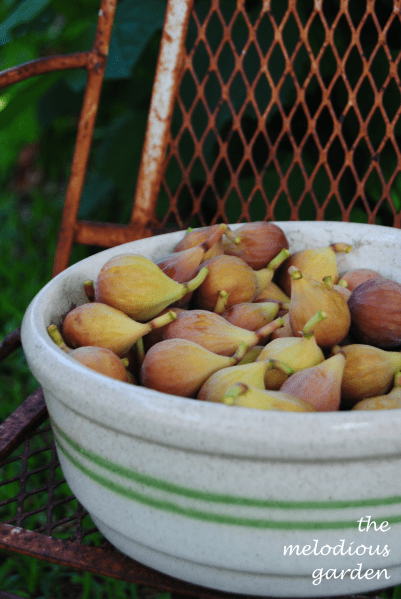
figs

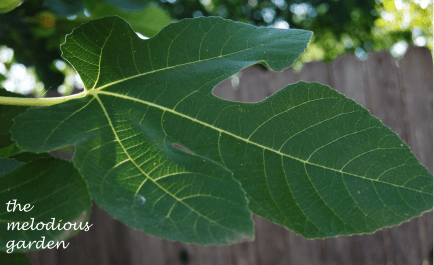
Aren’t the leaves gorgeous? The fact that this wonderful shade tree also produces edible fruits is just a bonus.

fig leaf

(Technically, figs are not a fruit, rather they are a flower… Isn’t botany amazing?!)

herbal fare

Figs… Figs… Ice Cream…

Today is National Ice Cream Day.

With 100+ degree days forecast for the upcoming seven days, I think we should get at least a week to relish in ice cream guilt-free.

I have fond memories of attending ice cream socials at my late aunt and uncle’s rural Nebraska church, with many many hours spent beforehand, cranking the ice cream maker, churning batch after batch of homemade ice cream for the event. There is something so comforting and nostalgic about the old wooden ice cream maker, packed with ice and rock salt, the quintessential sight and sound of summer. I am sure my son won’t have such fond memories of his mom pulling out the Cuisinart ice cream maker, pouring in the ice cream mixture and flipping the switch to On. But there is something to be said for whipping up a quick batch of ice cream on a hot July afternoon… And I love the smaller size of the Cuisinart ice cream maker, as it allows me to experiment with flavor combinations.

(The Cuisinart ice cream maker insert needs to be chilled in the freezer the night before making ice cream. This recipe can be adjusted for other ice cream makers.)

fig ice cream take 2

Fig Chocolate Chunk Ice Cream

1/4 cup sugar
1 tablespoon vanilla
1 cup heavy cream
1 cup whole milk
1 cup fig pulp
1/4 cup chocolate chunks, chopped

Slice the figs and scoop the pulp out with a spoon. Mix together all of the ingredients, except the chocolate chunks. Chill in the refrigerator for a few hours. Prepare your ice cream maker and add the liquid mixture. Churn until it is mostly set. Add chocolate chunks and churn until combined. Once the mixture is frozen, transfer to a freezer-safe container. Cover and freeze for several hours before eating.

(I have Celeste figs in my garden… It took several dozen of the small figs to make one cup.)


herbal fare

The exquisite pleasure of figs

I live in a house of non-foodies. I shouldn’t complain too much. My husband and teenage son will both eat things like Brussels sprouts and endive. They both appreciate fresh well-prepared foods. My son will even eat salmon and sushi. (My husband never eats fish. Ever.)

But cheeses? Fuhgeddaboudit. Both hardly tolerate anything wilder than cheddar, Monterey Jack and Parmesan. Goat cheese? Blue cheese? Feta? Not going to happen. (In fact, the night I served them fried goat cheese with frisee will live on in infamy.)

Figs? Nope. Not going to happen either. Which is fine with me. The fig tree is mine. All Mine. I can pick and eat all the figs I want, give away what I know I can’t eat and let the birds have the rest.

“To eat figs off the tree in the very early morning, when they have been barely touched by the sun, is one of the exquisite pleasures of the Mediterranean.”  ~ Elizabeth David, An Omelette and a Glass of Wine.

Thankfully, fig trees grow and produce extremely well in North Texas, so we can have that touch of exquisite pleasure from the Mediterranean, too. Eating a fig fresh from the tree, like eating a tomato right off the stem, really is a gardener’s delight.

fig rocker

Since I am the only one in this household that eats figs, I look for recipes that I can easily make as an individual serving or freeze portions of individually. This fig tart recipe was easily quartered for the perfect lunch-size portion.

fig tart

Fig Tarts with Honey and Herbs
Makes four tarts

Dough:
1/4 cup corn meal
1 cup all purpose flour (I used gluten-free flour from King Arthur brand)
Pinch of sea salt
4 tablespoons cold, unsalted butter, cut into pieces
8 ounces cold cream cheese

Toppings:
24 small to medium figs
honey
1-2 ounces creamy goat cheese
fresh herbs, washed and chopped fine (I used a mixture of thyme and chives, but rosemary would also be nice)

In a food processor, mix together the corn meal, flour and salt. Add the butter and cream cheese and blend in the food processor until a ball of dough forms.

Separate the dough into four equal portions and place in refrigerator for about one hour. (Can be kept up to three days.)

Line two baking sheets with parchment paper. Preheat oven to 375 degrees.

On a lightly floured surface, roll out each ball of dough until it is about 7 inches across. Transfer the crusts onto the baking sheets and fold up a small edge of dough.

To prepare figs, wash and trim stem end from figs. Slice fruit into quarters. Place figs onto the prepared crusts. Drizzle honey over the figs, then crumble on goat cheese, as desired. Sprinkle with fresh herbs.

Bake 25-30 minutes, rotating baking sheets half way through.

(Since I was making this for lunch, I added a bit of sauteed shallot and pancetta to the crust before topping with the figs.)

herbal fare

Blueberry-peach lavender crisp

While I have long cooked with herbs, I am relatively new to cooking with lavender. Not one to be easily intimidated in the kitchen, lavender intimidates me.

Remember this, more so with lavender than any other herb…
A little goes a long way.
More is not better. Ever.
When in doubt, error on the side of caution. (Add a bit at first, then taste and increase if desired.)

Blueberry-peach lavender crisp is one of the first lavender dishes I attempted. After all –  Fresh blueberries. Fresh peaches. Crispy topping. Not much can go wrong with that.

lavenderblueberrypeachcrisp

Blueberry-peach lavender crisp

For fruit:
4 cups fresh peaches, peeled and sliced
1 cup fresh blueberries
1/2 cup granulated sugar
1 1/2 teaspoon dried culinary lavender buds
2 1/2 tablespoons cornstarch

For the topping:
1/2 cup rolled oats
1/3 packed brown sugar
1/4 cup all-purpose flour
1/4 cup butter

Instructions:
Preheat your oven to 350 degrees.
In a food processor, mix the lavender and sugar and pulse until lavender is infused in the sugar. In a bowl, mix together blueberries, peaches, sugar and cornstarch.
Pour fruit into an 8×8 baking pan.
Reusing same bowl from fruit, mix together oats, flour and brown sugar. Melt butter and add to the flour mixture and combine with a fork until mixture resembles coarse crumbles.
Spread topping mix over fruit.
Bake 25-30 minutes, or until top is lightly golden brown.

My recipe edits:
For the picture above, I had less peaches and more blueberries than called for, but used five cups total of fresh fruit. Also, the blueberries were farm fresh, very large and juicy. The fruit portion is bluer than it would be normally.
I use gluten-free flour and gluten-friendly oats in this recipe, in the same quantities.

gardening, herbal fare, vintage

Garden Travels: Lavender Ridge Farms

Last month, I had the great pleasure of visiting Lavender Ridge Farms, an herbal and culinary destination just up the interstate from my house.

lavenderfarm17

Located in Gainesville, Texas, this two acre lavender farm has been in the family for more than 150 years.

lavenderfarm18

In previous generations, the farm grew melons and strawberries. It opened in 2006 as a lavender farm, one of the few such farms in North Texas. (If you have ever tried to grow just a few lavender plants in your backyard garden, you will understand and appreciate why there are few lavender farms locally.)

Visitors to Lavender Ridge Farms are given a basket and instructed on how to properly harvest lavender.

lavenderfarm8

I was surprised to see that all sorts of pollinators are as attracted to lavender blossoms as humans are.

lavenderfarm7

In addition to growing and selling lavender, the farm’s gift shop houses many lavender items for bath, kitchen and home. (If you are weak and buy all things herbal, take a trusted guardian. Though I don’t regret buying two cookbooks, a package of their house blend lavender tea, lavender pepper spice blend and an enormous bag of dried lavender buds for future craft projects. Plus. A few plants, including the lavender plant Phenomenal. Below is a display of Lavender Phenomenal, not what I purchased.)

lavenderfarm2

Lavandula x intermedia Phenomenal is a new variety of lavender that is marketed as durable in our high heat and humidity better than other varieties. Lavender Ridge Farms has had phenomenal success growing this plant.

The farm also sells irises, which can be viewed and ordered in the spring, with delivery and planting that fall.

lavenderfarm15

Cafe Lavender offers a shady respite, where you can dine in a lovely plant-filled courtyard while overlooking the lavender field. (Sorry, I failed to take a picture looking that direction, I was too enamored by the plants in the courtyard!)

lavenderfarm14

The cafe’s menu features several lavender infused dishes, such as lavender honey chicken salad and lavender cheesecake. (Both were divine!)

lavenderfarm5

The farm’s large pollinator garden was aflutter with butterflies the day of my visit.

lavenderfarm12

I could have spent all day poking around the gardens and viewing the many assorted garden ornaments.

lavenderfarm16

I loved their creative use of rusty saws and garden implements.

lavenderfarm11

Lavender Ridge Farms’ facebook page says it best:
An herb’n experience you can’t get in the city.

lavenderfarm9

bibliophile

Yearning to breath free

colorado

Not like the brazen giant of Greek fame,
With conquering limbs astride from land to land;
state fair
Here at our sea-washed, sunset gates shall stand
A mighty woman with a torch,
zion
whose flame
Is the imprisoned lightning, and her name
Mother of Exiles.
butterfly
From her beacon-hand
Glows world-wide welcome;
colorado3
her mild eyes command
The air-bridged harbor that twin cities frame.
niagra falls
“Keep, ancient lands, your storied pomp!” cries she
With silent lips.
colorado2
“Give me your tired, your poor,
Your huddled masses yearning to breathe free,
The wretched refuse of your teeming shore.
grand canyon
Send these, the homeless, tempest-tost to me,
I lift my lamp beside the golden door!”
~ Emma Lazarus

rwb1

Happy 4th of July from the melodious garden.

(Photos: Colorado, Zion National Park, Niagara Falls and The Grand Canyon)


gardening, nature

Buttonbush for pollinators

When I broke ground on my first garden area 23 years ago, I knew I wanted to create a habitat for butterflies and birds, lizards and toads and such. But specifically bees? Pollinators? It wasn’t until the European honey bee’s population started to decline from Colony Collapse Disorder around 2006 that our pollinators gained some much deserved attention.

buttonbushbee

Eleven years ago, the U.S. senate voted to mark a week each year to address pollinators’ declining populations. What started as an American initiative is now a worldwide movement to “promote the health of our pollinators, critical to our food and ecosystems, through conservation, education and research.” (Mission statement from Pollinator Partnership.)

This week is National Pollinator Week. Somehow a week hardly seems enough time to celebrate our pollinators, so vitally important to our world’s food supply. Currently, about one third of the food we consume is reliant upon pollinators for production.

Pollinator Partnership reports there are 200,000 species of pollinators, with only about 1,000 of those being hummingbirds, bats and small mammals. Bees, ants, beetles, butterflies and moths make up the remaining pollinators.

buttonbushbutterfly2

After all these years of gardening in North Texas, I have several plants that I now recommend for attracting wildlife, specifically butterflies and bees. But one plant, in particular, is my favorite – and it is also one of the unsung natives that, like pollinators, deserves more attention.

Buttonbush – Cephalanthus occidentalis

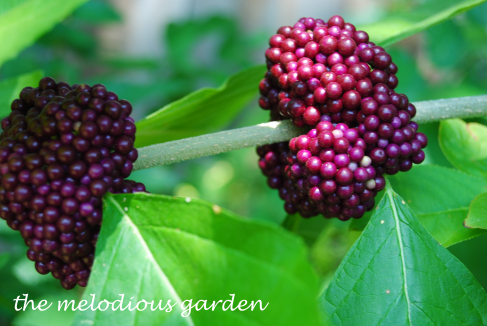
This plant – large shrub or small tree, depending on how pruned – produces white perfectly spherical globes of nectar.

buttonbush3

Butterflies, bees and other beneficial insects dine on the nectar, with birds eating the fruits in the winter. Buttonbush is also a host plant for several species of butterflies and moths.

buttonbush2

Buttonbush is native to many areas of the United States and can be found naturally growing in wet areas. Thankfully it is highly adaptable and will grow in any soil type and in a traditional garden setting. It likes full to partial sun.

buttonbushladybug

To attract pollinators, it is important to select a variety of plants so your garden features blooms throughout the growing season. Native plants are preferred, whenever possible. Be sure to include larval host plants, such as milkweed for monarchs and fennel or dill for swallowtail butterflies. And. Avoid pesticides!

Please visit Pollinator Partnership for additional information and ideas on what you can do in your own backyard or corner of the world to support pollinators.

pwgraphic-for-SM-post

bibliophile, gardening

the summer moon begins to dawn

Spring in North Texas went out with a bang. Correctly, it went out with a rumble of thunder, a flash of lightening and 60 mile per hour winds. And, as a dear gardening friend said, “a legit downpour.” The rain was a much welcome sight. The wind, not so much. And with that —- spring is over and we welcome in the first day of summer.

summer daylily 5

Daylilies have been blooming for over a month now, yet I still walk the garden each morning, eager to see which ones are blooming that day. My garden is in transition – leaving behind the pink flowers and rose-filled cottage garden to a tapestry of bold colors and even bolder blooms, sans the roses. (Rose Rosette is still running rampant in North Texas…)

summer 3 daylily

“Clapping my hands
with the echoes the summer moon
begins to dawn.”
~ Basho

A new daylily for my garden, still in its nursery pot on my driveway. The blossoms are larger than my hands.

summer 2 daylily

“To see the Summer Sky
Is Poetry, though never in a Book it lie  –
True Poems flee”
~ Emily Dickinson

Tropical plumbago (Plumbago auriculata) perfectly echos the color of the summer sky. Though not winter hardy in my zone 8a garden, it has overwintered in a container in my garage for many years now.  It has a sprawling habit, so is great to grow in a container or spilling over a retaining wall.

summer plumbago

“The hum of bees is the voice of the garden.” ~ Elizabeth Lawrence

The coneflowers were abuzz with bees this morning, a good reminder this week – National Pollinator Week – of the importance of planting flowers that attract and nourish our pollinators.

summer coneflower with bee

(I am not sure why bees always pose for photographs on the rattiest flowers available.)

summer coneflower

I cut back the coneflowers once they have bloomed in early summer, allowing for a second or third wave of blooms in the late summer and fall. Below, a gray hairstreak braved the bees to partake of the coneflower’s nectar.

summer sulfer on coneflower

(See above about bees posing on the rattiest flower. This hairstreak sure picked a messed up flower!)

Two of my favorite flowers for pollinators are red yucca and Turk’s cap (Malvaviscus drummondii). Red yucca is extremely drought tolerant, once established, and makes a nice “evergreen” in the winter garden.

summer yucca

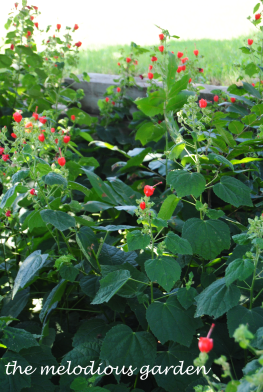
Turk’s cap has proven to be extremely adaptable in my Denton County garden. Originally planted in partial shade in an area that stays relatively moist due to our neighbor’s overwatering tendencies, it has spread into heavier shade and out into full sun and very dry patches. It grows just as well in all areas of my garden, though the leaves are smaller on the plants in full sun. Turk’s cap blooms from May until first freeze. It dies to the ground in the winter. I generally wait to cut it back until new growth is appearing in the spring. Below, Turk’s cap has spread along our driveway. Some of the plants are under the shade of a bur oak tree, while others are out in full sun.

summer turks cap 1

Below, Turk’s cap has seeded out into full sun.

summer turks cap3

“There ought to be gardens for all months in the year, in which, severally, things of beauty may be then in season.” ~ Sir Francis Bacon

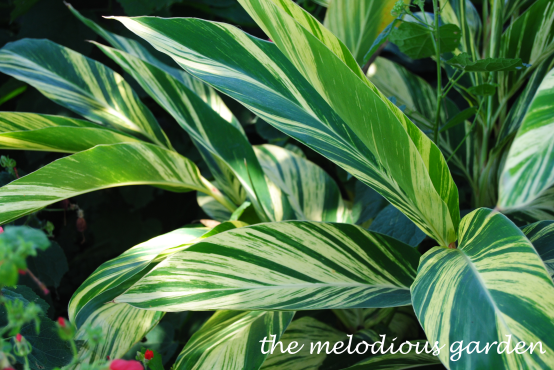
Summer is the perfect time to gain an appreciation for foliage, reminding ourselves that beauty does not only come from flowers. Below, an ornamental banana, which overwinters in my garage.
summer banana

Coneflowers have popped up next to a variegated canna.

summer canna

Caladiums, to me, have always been a foliage filler in a summer container arrangement… And then along came… Frog in a Blender, pictured below. I was wandering around Marshall Grain early this spring, when I spotted the bulbs, in a box labeled… Frog in a Blender. Always game for something unusual, I grabbed a few bulbs. And… I may now be addicted. To Frog in a Blender.

frog in a blender

“Gardening imparts an organic perspective on the passage of time.”
~ William Cowper

We are always reminded to stop and smell the flowers, but we should also be reminded to stop and look up, for you never know where you might find a cicada molt.

 summer cicada molt

The pink rainlilies have been especially beautiful this season. I wait until the seedpod has dried and cracked open to take the fresh seeds and scatter them throughout the garden.

 summer rainlily

Below, the seedpod to the far right is still drying… I will wait until the seedpod has split open, like the one in the middle of the photo. One can pop off the seedpod and rub the papery seeds to the wind, allowing rainlilies to pop up wherever they may.

summer seed pod

“When on a summer’s morn I wake,
And open my two eyes,
Out to the clear, born-singing rills
My bird-like spirit flies.

To hear the Blackbird, Cuckoo, Thrush,
Or any bird in song;
And common leaves that hum all day
Without a throat or tongue.

And when Time strikes the hour for sleep,
Back in my room alone,
My heart has many a sweet bird’s song —
And one that’s all my own.”
~ William Henry Davies, When on a Summer’s Morn

summer crinum

Whichever way you look at the blossoms, the crinum lily (above and below) are a true Southern garden staple. Steve Bender writes that the crinum lily “has a bulldog constitution.” Yes, they are that tough. And yet – so beautiful!

summer crinum 2

“Now summer is in flower and natures hum
Is never silent round her sultry bloom
Insects as small as dust are never done
Wi’ glittering dance and reeling in the sun
And green wood fly and blossom haunting bee
Are never weary of their melody
Round field hedge now flowers in full glory twine
Large bindweed bells wild hop and streakd woodbine
That lift athirst their slender throated flowers
Agape for dew falls and for honey showers
These round each bush in sweet disorder run
And spread their wild hues to the sultry sun.”
~ John Clare, June

Below, Leia, now nine months old, looking adorable and innocent in the garden. (She had just eaten my brand new prescription bifocal glasses an hour before…)

summer leia

bibliophile, gardening

When June comes dancing…

“When June comes dancing o’er the death of May,
With scarlet roses tinting her green breast,
And mating thrushes ushering in her day,
And Earth on tiptoe for her golden guest.”
~ A Memory of June, by Claude Mckay

daylily june 1 7

The first of June in North Texas, where a forecast “cold front” promising highs “only” in the mid-90s is music to the ears. We are coming off one of our warmest and driest springs, with summer heat setting in early. But the garden still shines bright.

The coneflowers are coming on strong. I love the varying shades of pink as the blooms slowly open to reveal the center cone, the source of its name. Coneflowers will bloom from now until the approaching winter. I deadhead coneflowers through the summer, then stop deadheading them in early fall so that the cones can remain upright through the winter, a source of food for songbirds. Come spring, I will remove the remaining stalks standing in the garden and scatter the seeds wherever I want coneflowers to grow.

coneflower june 1 2

“What is one to say about June, the time of perfect young summer, the fulfillment of the promise of the earlier months, and with as yet no sign to remind one that its fresh young beauty will ever fade.” ~ On Gardening, by Gertrude Jekyll

The colors in the early June garden still radiate, no sun bleached petals yet. The daylilies are having their time in the spotlight.

daylily june 1 5

daylily june 1 6

“It is the month of June,
The month of leaves and roses,
When pleasant sights salute the eyes
And pleasant scents the noses.”
~ The Month of June, by Nathaniel Parker Willis

daylily june 1 1

daylily june 1 2

“And since all this loveliness can not be Heaven, I know in my heart it is June.” ~ Abba Woolson

daylily june 1 4

“In June, as many as a dozen species may burst their buds on a single day. No man can heed all of these anniversaries; no man can ignore all of them.” ~ Aldo Leopold

I love growing sedums in clay pots inside ornate metal hanging baskets. They bring another layer to the garden, where the sun, peeking through the tree leaves, highlights sedum and metal alike.

sedum

No bees this morning, but the bee balm is blooming beautifully.

bee balm 1

Vitex, sometimes call the Texas Lilac, is blooming and buzzing with life this June morning. (Perhaps it has lured the bees away from the bee balm?) Alas, the vitex smells nothing like the real lilac! (I find it malodorous…) Vitex has been noted as a Texas Superstar plant, as it is very well adapted to grow and thrive throughout the state, even in hot and dry locations. The spiky lavender blooms attract both bees and butterflies in abundance.

vitex

“Summer is coming!” the soft breezes whisper;
“Summer is coming!” the glad birdies sing.
Summer is coming – I hear her quick footsteps;
Take your last look at the beautiful Spring.
~ Summer is Coming, by Dora Goodale

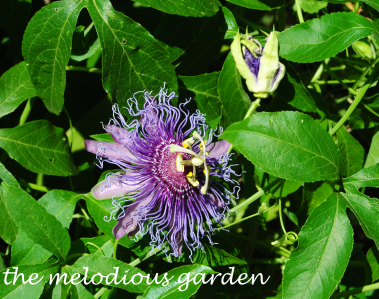
Passion fruit vine is showing off its exotic blossoms. It scrambles here and there throughout my garden, not being the best behaved of plants. Passion fruit vine is often grown in butterfly gardens, as the gulf fritillary butterfly uses this as a host plant.

passion vine

I love to grow fennel both for its ferny foliage and for the black swallowtail butterflies. This caterpillar has been munching and growing for the past week or so.

caterpiller june 1

“I wonder what it would be like to live in a world where it was always June.” ~ L.M. Montgomery (Montgomery is the author of The Anne of Green Gables series, a great book to read-aloud! Boys and girls alike can identify with the lovable Anne.)

Though I don’t have much shade, I love to tuck in hosta plants wherever I can. While grown for their foliage, hosta have beautiful and delicate blooms in early summer.

hosta in container

Hosta leaves and blooms are both edible. I have not yet tried them myself, but these blossoms would be a colorful addition to any salad. (As would daylily blooms, which are also edible.)

hosta june 1

I love how dainty hosta blooms are! This one is no larger than a nickle.

hosta june 1 2

Hellebores, which began blooming in mid-winter, are still going strong.

hellebore june 1

I love using metal tubs and buckets and such as planters. This old tub is planted with coleus, rue, silver thyme and begonia. Rue is a host plant to both the black swallowtail and the giant swallowtail butterflies.

metal bucket

An orange scented geranium and an old ceiling tile add a mix of texture to my potted garden by the front door.

scented geranium

Ah… The fig tree. Beautiful leaves. Wondrous shade. Edible figs! Though they are little now, they hold the promise of an abundant harvest.

fig tree

Once upon a time, when I grew antique roses by the dozens, I planted garlic around the garden, as it is reported to ward off insects. While it didn’t save my garden from being ravished by rose rosette, I still have garlic blooming here and there. I love their large flower heads.

garlic scape

I will leave you with one more bloom – a mutant coneflower. And one last poetic look at June.

coneflower june 1 4

“With flower petals soft unfurled
And vines around the trellis curled.
The grass is sweet and richly green
With shining luminescent sheen –
Your face, my June, a beauteous scene.”
~ My Lovely June, by Valerie Dohren

gardening, herbal fare

Of rhubarb and nutmeg

I have no clue who first tasted rhubarb and thought, “Why, if one only added enough sugar, this might be edible!” I do know that rhubarb didn’t become widely consumed until sugar became affordable.

When I was growing up, the children in my neighborhood would sit and swing and dare each other to eat a bit of raw rhubarb. “Found a peanut, found a peanut, found a peanut yesterday” we would sing as we swung. “Cracked it open, cracked it open, cracked it open yesterday,” and we would snap a piece off and eat it. If we were brave enough. My mouth still remembers that sharp tartness all these years later!

Much like lemon and gooseberry, rhubarb is in a league of its own. Perfectly inedible alone. Wonderfully edible with enough sugar.

As a new Texas homeowner 22 years ago, I thought rhubarb grew like a weed everywhere. Not so. The foliage came up beautifully that first spring. It grew and grew and looked wonderful. Then summer hit. And the rhubarb melted back into the earth from which it had emerged, never to be seen again. I have since thought rhubarb impossible to grow this far south.

Alas, Texas A&M says it is possible! As an annual, not a perennial like northern gardeners grow it. Oh. And through the winter, not the summer. Basically, if you are familiar with growing rhubarb up north, turn everything on its head and you, too, can grow it Texas. Maybe some day I will try again to grow rhubarb. Until then, I will just buy it at the grocery store.

(Texas A&M also says that rhubarb is never eaten raw, which may explain why I still shiver when I think about eating it raw as a child.)

rhubarb

Rhubarb upside down cake

Ingredients:

3 cups sliced fresh or frozen rhubarb
1 cup sugar
2 tablespoons all-purpose flour
1/4 teaspoon ground nutmeg
1/2 cup butter, melted

Batter:

1/4 cup butter, melted
3/4 cup sugar
1 large egg
1 1/2 cups all-purpose flour
2 teaspoons baking powder
1/2 teaspoon ground nutmeg
1/4 teaspoon salt
2/3 cup whole milk

Place rhubarb in a greased 10-ince cast iron skillet. Combine sugar, flour and nutmeg. Sprinkle over rhubarb. Drizzle with butter and set aside. For the batter, in a large bowl, beat the butter and sugar until blended. Beat in the egg. Combine flour, baking powder, nutmeg and salt. Gradually add to the egg mixture alternately with milk, beating well after each addition.

Spread over rhubarb mixture. Bake at 350 degrees for 35 minutes or until a toothpick inserted in the center comes out clean. Loosen edges immediately and invert onto a serving dish. Serve warm.

Serve with whipped, cream, if desired.

(Rhubarb is technically a vegetable so eating the leftovers for breakfast starts your day off right. Just sayin’.)

nutmeg

If you have never tried fresh ground nutmeg, you must… It is so much fresher than the ground spice bought at the grocery store.